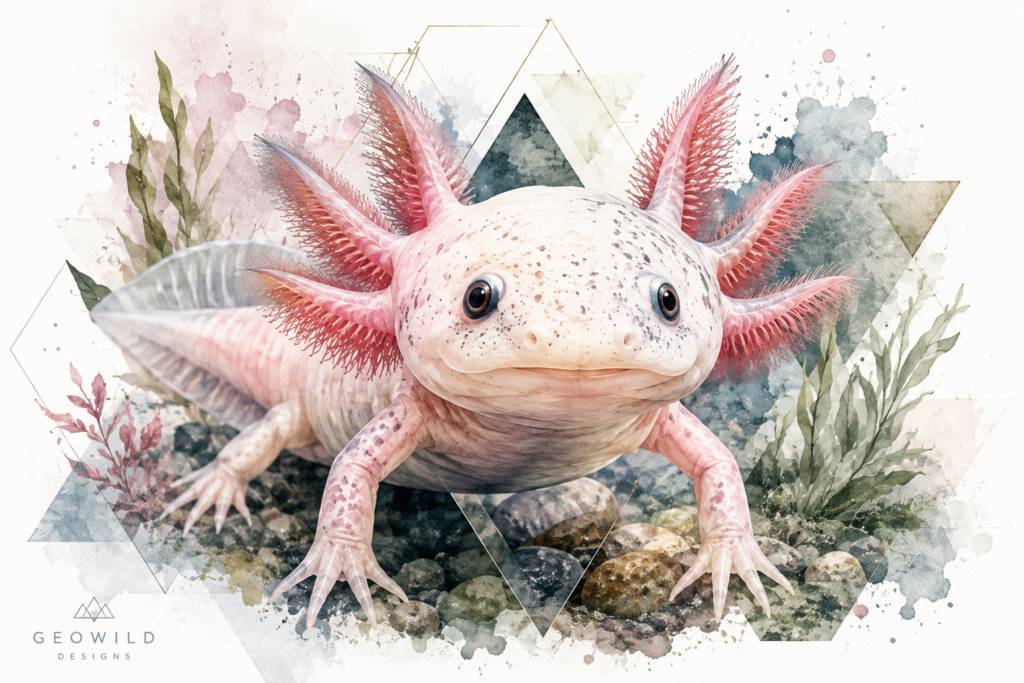
Why Can Axolotls Regrow Their Limbs? The Amazing Science of Regeneration
Imagine losing an arm or a leg and simply growing another one.
For humans, that sounds like something from science fiction. For the axolotl, however, replacing a lost limb is an extraordinary part of its biology.
These unusual aquatic salamanders are famous for their feathery external gills and almost permanently smiling faces, but beneath their cute appearance lies one of the most remarkable regenerative abilities in the animal kingdom.
An axolotl can replace an entire lost limb, rebuilding structures such as bone, muscle, nerves, blood vessels and skin. Even more remarkably, limbs are only part of the story. Scientists study axolotls because they can regenerate a range of other damaged tissues and body structures too.
So how can an axolotl accomplish something that humans cannot?
The answer takes us into the fascinating science of regeneration.
What Is an Axolotl?
The axolotl (Ambystoma mexicanum) is a salamander native to Mexico.
Unlike most salamanders, axolotls normally remain aquatic throughout their lives rather than undergoing the complete transformation into a land-dwelling adult form.
Their distinctive appearance includes a broad head and three feathery external gill branches on either side. Those gills give axolotls their instantly recognisable appearance.
But their ability to regenerate damaged or missing body parts is what has made them particularly important to scientists.
Researchers have been investigating salamander regeneration for generations, hoping that understanding how it works could eventually reveal new ways of improving human healing and regenerative medicine.
Can Axolotls Really Regrow Their Legs?
Yes.
If an axolotl loses a limb, it has the remarkable ability to construct a replacement.
This isn’t simply a case of closing the wound and producing a rough substitute. The regenerating limb can recreate the complicated collection of tissues needed for a functional limb.
That includes structures such as:
- skin
- bone and cartilage
- muscle
- nerves
- blood vessels
- connective tissues
Scientists describe axolotls as one of the relatively few four-limbed vertebrates capable of regenerating complete, complicated limbs throughout adulthood.
And they can perform this extraordinary feat more than once.
How Does an Axolotl Regrow a Limb?
The process begins soon after the injury.
When humans suffer a serious wound, our bodies concentrate heavily on closing and protecting it. Scar tissue frequently forms as part of that process.
Axolotls respond differently.
Cells and tissues around the injury begin a highly organised sequence of events that ultimately allows the missing structure to be rebuilt.
Step 1: The Wound Closes
The exposed surface of the injury is rapidly covered by specialised wound epidermis.
But instead of the process ending with ordinary wound healing and extensive scarring, signals around the injury help initiate regeneration.
Nerves and interactions between different tissues are particularly important during the early stages.
Step 2: A Blastema Forms
One of the most important parts of axolotl regeneration is the formation of something called a blastema.
A blastema is a collection of regeneration-capable cells that develops at the site of the missing limb.
You can think of it rather loosely as a temporary biological rebuilding zone.
Cells within and around the damaged tissues contribute to this growing structure. These cells divide and eventually help recreate the different tissues needed for the missing part of the limb.
Step 3: The New Limb Begins to Take Shape
The blastema continues to grow.
But growing cells isn’t enough.
Somehow, those cells have to know what they are supposed to become and where they belong.
If an axolotl loses part of its lower limb, for example, it shouldn’t grow an entirely new limb starting from the shoulder.
The regenerating tissues need positional information.
This is one of the most fascinating areas of axolotl research.
Step 4: Bone, Muscle, Nerves and Other Tissues Re-form
As regeneration progresses, cells differentiate into the specialised tissues required to construct the missing structure.
The new limb develops its skeletal elements and other tissues, eventually restoring a functional replacement rather than simply covering the injury.
In some respects, researchers have found similarities between limb regeneration and processes used when limbs first develop.
How Does an Axolotl Know What to Grow Back?
This question has puzzled scientists for an extraordinarily long time.
If an axolotl loses only a hand, how does its body know to replace a hand rather than starting again with an entire arm?
Recent research has provided an intriguing piece of the puzzle.
Scientists studying axolotl positional memory have investigated the role of retinoic acid signalling. Retinoic acid appears to provide information that helps regenerative cells understand where they are located along the limb and therefore what needs replacing.
Research reported in 2025 found differences in retinoic-acid signalling along an axolotl limb. Cells called fibroblasts can respond to this positional information during regeneration.
That means regeneration isn’t simply:
“Something is missing — grow.”
The cells also need instructions effectively telling them:
“This is where you are, and this is what needs to be rebuilt.”
That ability to reconstruct a correctly organised body part is one reason axolotl regeneration is so scientifically remarkable.
Do Axolotls Have Special Stem Cells?
Stem and progenitor cells are important in regeneration, but the story is more complicated than an axolotl possessing one magical type of cell capable of building absolutely everything.
Different mature tissues and specialised progenitor populations can contribute to the regenerating structure.
During limb regeneration, a blastema forms containing cells capable of proliferating and contributing to the missing tissues. Multiple types of cells participate, while signalling between cells helps organise the process.
So the axolotl’s ability isn’t based on one miraculous ingredient.
It’s a carefully coordinated biological response involving cells, genes, nerves and chemical signals.
Can Axolotls Regrow More Than Their Legs?
This is where axolotls become even more extraordinary.
Their regenerative abilities aren’t restricted to limbs.
Research has shown regenerative capacity involving structures including the:
tail, spinal cord, skin, jaw and parts of internal organs and nervous-system tissues.
Research has also demonstrated their remarkable ability to repair cardiac tissue, and axolotls are widely used as a model for studying heart regeneration.
Can Axolotls Regrow Their Spinal Cord?
Axolotls have an impressive capacity for spinal-cord regeneration.
This is particularly interesting because serious spinal-cord injuries in mammals can result in permanent damage.
Axolotl neural progenitor cells participate in rebuilding the spinal cord during regeneration, and researchers have been studying where these cells originate and how they behave.
More recent research continues to investigate how the axolotl nervous system responds to injury. A 2025 study identified activity in particular neurons in the brain that was important for successful tail regeneration, showing just how interconnected the regenerative response can be.
Can Axolotls Regrow Parts of Their Brain?
Remarkably, axolotls also possess regenerative abilities within their central nervous system, including parts of the brain.
Scientists are particularly interested in this because mammalian brains generally have much more limited regenerative capacity after significant injury.
That doesn’t mean an axolotl could lose its entire brain and simply grow another one. Claims about regeneration can easily become exaggerated online.
What the research shows is that axolotls possess an extraordinary capacity to regenerate damaged regions and nervous-system tissues that most vertebrates cannot replace so effectively.
Why Don’t Axolotls Scar Like Humans?
Scarring is one of the fundamental differences scientists investigate when comparing regeneration with ordinary mammalian wound healing.
Scar formation can be useful.
If you’re badly injured, rapidly sealing and stabilising the damaged area can help protect your body.
But scar tissue can also prevent the original structure from being recreated perfectly.
Axolotl wound healing follows a different path that allows regenerative processes to proceed.
This doesn’t mean axolotls are simply humans with better healing. Their immune responses, cellular behaviour, gene activity and tissue signalling work together differently.
Understanding those differences could be extremely important.
Does the Immune System Help Axolotls Regenerate?
Surprisingly, regeneration isn’t just about cells growing.
The immune system also plays an important role.
Research into salamander regeneration has shown that immune cells including macrophages participate in creating the environment required for successful regeneration.
This demonstrates something important about regeneration: the axolotl isn’t simply growing a leg again.
Its body coordinates wound healing, inflammation, nerves, cellular behaviour, tissue identity and growth.
Regeneration is a whole biological programme.
Can Axolotls Regrow a Limb More Than Once?
Axolotls retain their regenerative ability throughout life and can regenerate complex structures following repeated injuries.
However, that doesn’t mean regeneration is literally unlimited or that every regenerated limb will always be absolutely perfect regardless of circumstances.
Repeated injury, the location and nature of the damage, age and other biological factors can influence regenerative outcomes.
Nevertheless, the ability of an adult vertebrate to repeatedly reconstruct such complex structures is exceptional.
Why Can Axolotls Regenerate but Humans Can’t?
This is perhaps the biggest question of all.
Humans aren’t completely incapable of regeneration.
Our bodies constantly replace cells. Skin renews itself, bones can repair fractures, blood cells are continually produced and the liver has a remarkable capacity to restore lost tissue.
But if we lose an arm or leg, we cannot recreate it.
Our response to major injury generally prioritises wound closure and scar formation rather than reconstructing the missing structure.
Axolotls activate a different regenerative programme.
Their cells can respond to positional signals, form a blastema and coordinate the reconstruction of complex tissues.
Interestingly, some of the biological ingredients involved aren’t completely alien to humans.
For example, humans also have fibroblasts and retinoic acid signalling. Recent axolotl research suggests an important difference may lie partly in how cells interpret and respond to regenerative signals.
That discovery raises a tantalising question.
Could scientists one day persuade human cells to behave differently after injury?
Could Axolotls Help Humans Regrow Limbs?
Possibly — but we’re nowhere near being able to regrow a complete human arm or leg.
Axolotl research isn’t about simply transferring a regeneration gene into a person.
Scientists first need to understand an enormously complicated network of cellular and molecular events.
Questions include:
How is regeneration started?
How do cells know what is missing?
How is growth stopped at exactly the right point?
How are nerves reconnected?
How are bones, muscles and blood vessels positioned correctly?
Why does one animal regenerate while another forms scar tissue?
Researchers hope that answering questions like these could eventually contribute to regenerative medicine, improved wound healing and treatments for damaged tissues.
A future in which people routinely regrow complete limbs remains speculative.
But understanding axolotls could reveal biological principles that help medicine achieve things that aren’t currently possible.
Are Axolotls the Best Regenerators in the Animal Kingdom?
Axolotls are spectacular regenerators, but they aren’t necessarily the ultimate champions.
Other animals possess abilities that are even stranger.
Planarian flatworms, for example, can regenerate enormous portions of their bodies, while hydras also possess extraordinary regenerative abilities.
What makes the axolotl particularly valuable is that it is a vertebrate.
Axolotls have complex organs, limbs, a spinal cord and many biological systems that have useful parallels with other vertebrates.
That makes them particularly interesting when scientists investigate regeneration with human medicine in mind.
The Axolotl’s Real Superpower
It’s easy to describe axolotl regeneration as a superpower.
But perhaps the most extraordinary part is that it isn’t magic at all.
Every new piece of tissue is produced through biology: cells responding to injury, communicating with one another, interpreting chemical signals, dividing, changing identity and rebuilding a structure in the correct place.
Somewhere inside that process may be information that helps scientists understand why regenerative abilities vary so dramatically across the animal kingdom.
Axolotls have already shown us that a vertebrate body can rebuild an entire limb.
The challenge now is understanding exactly how they do it — and whether some of those lessons can one day be used to help us.
For more interesting blogs read on GeoWild Designs