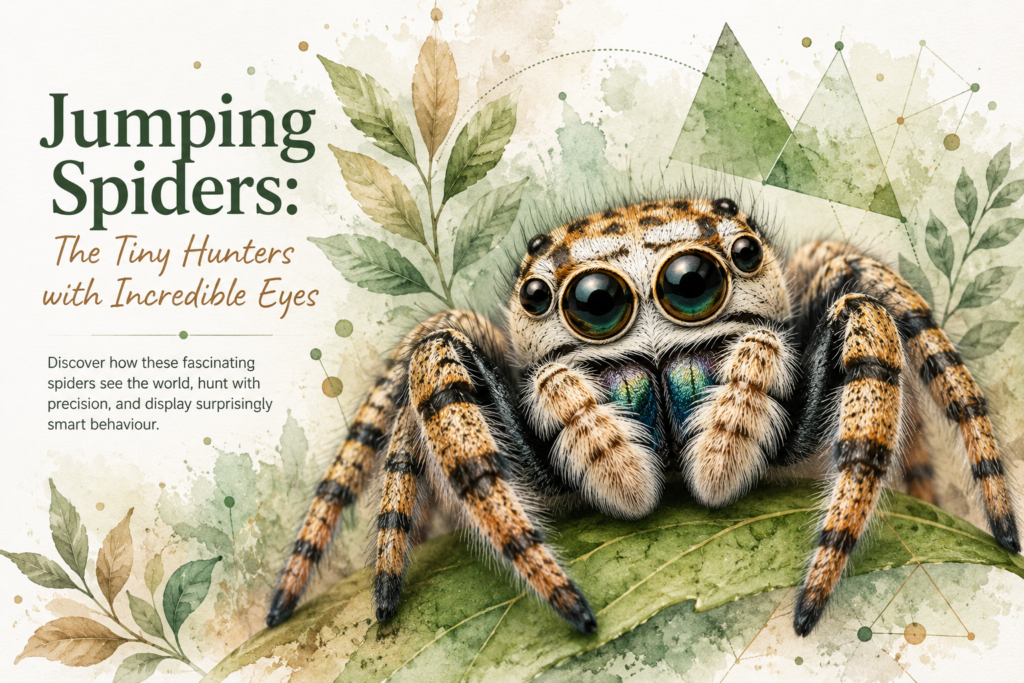
Jumping Spiders: Why These Tiny Spiders Are Far More Amazing Than They Look
If there is one spider capable of changing someone’s mind about spiders, the jumping spider might just be it.
With enormous forward-facing eyes, fluffy bodies and a habit of appearing to look directly at you, jumping spiders can seem surprisingly expressive. Watch one for a few minutes and it may turn towards you, follow movement and appear almost curious about what you are doing.
But behind that rather cute appearance is an extraordinary little predator.
Jumping spiders have exceptional eyesight, stalk their prey rather than waiting for it to become trapped in a web, can make remarkably precise leaps and display surprisingly sophisticated behaviour for an animal with such a tiny nervous system.
Some research has even found evidence of a sleep state resembling REM sleep — raising the fascinating, although still unanswered, question of whether jumping spiders might experience something comparable to dreaming.
So what exactly makes jumping spiders so unusual?
Let’s take a closer look.
What Is a Jumping Spider?
Jumping spiders belong to the spider family Salticidae.
Like other spiders, they are arachnids rather than insects. They have eight legs and a body divided into two main sections: the cephalothorax at the front and the abdomen behind it.
But jumping spiders are particularly well known for two things:
their incredible eyesight and their ability to jump.
Unlike many spiders that rely heavily on vibrations from a web, jumping spiders are active visual hunters.
They search for prey, watch it, approach it and then leap.
The Natural History Museum describes Britain’s zebra jumping spider (Salticus scenicus), for example, as an active daytime hunter that doesn’t use a web to capture prey. Instead, it uses its large eyes to locate small insects before pouncing on them.
And that brings us to perhaps their most noticeable feature.
Why Do Jumping Spiders Have Such Big Eyes?
Look closely at the face of a jumping spider and it is difficult to ignore those eyes.
A jumping spider actually has eight eyes, although you may not immediately see all eight.
The two enormous eyes facing forwards are called the principal eyes or anterior median eyes. Smaller eyes sit around them and towards the sides of the head.
This arrangement gives the spider different kinds of visual information.
The large principal eyes provide exceptionally detailed vision, while the secondary eyes help detect movement over a much wider area.
Jumping spiders are considered among the most visually capable arthropods. Research has even shown that some jumping-spider species can see ultraviolet wavelengths that humans cannot.
Can jumping spiders see you?
Yes.
If a jumping spider is facing you, it can certainly see something enormous in front of it.
What it understands that enormous object to be is another question.
Its visual world is very different from ours, but these spiders are exceptionally good at detecting objects and movement.
Their principal eyes are particularly remarkable. Research into jumping-spider vision has shown that layers within these eyes receive images with different amounts of blur. The spider can use that information to help determine how far away something is — extremely useful when you’re preparing to leap onto moving prey.
Why Do Jumping Spiders Stare at You?
This is probably one of the behaviours that makes people find jumping spiders so endearing.
Move your hand near one and the spider may turn around.
Move again and it may turn again.
It can genuinely seem as though the spider is thinking:
“What are you doing?”
It isn’t necessarily staring at you because it likes you, dislikes you or is preparing to attack.
The more likely explanation is that you are a large, moving object and the spider is gathering visual information about you.
Movement detected by the secondary eyes can prompt a jumping spider to turn its principal eyes towards whatever attracted its attention.
So when one turns and appears to look directly at you, it really is directing its sophisticated visual system towards you.
That doesn’t mean it understands you as another jumping spider would understand you. But the impression that it is actively looking at something isn’t entirely in our imagination.
Are Jumping Spiders Intelligent?
Calling an animal “intelligent” can be difficult because intelligence isn’t a single ability.
However, jumping spiders demonstrate some remarkably sophisticated behaviour for such tiny animals.
One particularly interesting experiment investigated whether jumping spiders could distinguish the movement of living things from other types of movement.
Researchers presented the spiders with moving points representing different patterns.
The spiders responded differently to biological and non-biological movement, demonstrating an ability to distinguish the visual characteristics associated with living organisms.
Researchers described it as the first demonstration of biological-motion recognition in an invertebrate.
That’s an impressive amount of visual processing happening inside an extremely small animal.
Can Jumping Spiders Recognise Humans?
This question needs a careful answer.
There is a big difference between:
“Can a jumping spider see and respond differently to things around it?”
and:
“Can my jumping spider recognise my individual face and know that I am me?”
We have good evidence that jumping spiders possess sophisticated vision and can distinguish different types of visual information.
However, that does not establish that jumping spiders recognise individual human faces in the way people recognise one another.
So if your jumping spider regularly turns towards you, follows your movements or behaves differently when you approach, it’s reasonable to say that the spider is detecting and responding to you.
It is much harder to claim that it actually recognises your face or knows you as an individual person.
For now, that’s a fascinating question rather than something we should treat as established fact.
Are Jumping Spiders Friendly?
Jumping spiders aren’t “friendly” in quite the same way that a dog or another social animal can be friendly.
Most spiders aren’t looking for a relationship with humans.
But jumping spiders are generally not interested in attacking people.
Their apparent curiosity and their tendency to watch movement can make interactions feel quite different from encounters with spiders that immediately run away.
If one is sitting on a wall watching you, it isn’t plotting an eight-legged assault.
It’s much more likely to be assessing what is going on around it.
Do Jumping Spiders Bite Humans?
They can, but spider bites in general are uncommon.
Spiders primarily use their fangs and venom to subdue prey, not to attack enormous animals such as humans.
The Natural History Museum notes that of around 650 spider species found in the UK, only about 12 have been recorded biting people, with only two or three producing a significant or unpleasant bite.
A spider should therefore be treated as a wild animal rather than deliberately provoked or squeezed.
If you ever experience a suspected bite followed by significant worsening symptoms or symptoms beyond the bite area, seek appropriate medical advice.
Are Jumping Spiders Venomous?
Jumping spiders use venom to immobilise their prey.
That can sound alarming until you remember what their prey actually is.
A jumping spider is equipped for hunting tiny invertebrates, not people.
Being venomous does not automatically mean an animal is dangerous to humans.
Venom is simply part of the spider’s hunting equipment.
What Do Jumping Spiders Eat?
Jumping spiders are predators.
Many hunt insects and other small arthropods.
And rather than sitting in the centre of a sticky web waiting for dinner to arrive, jumping spiders actively search for it.
Once prey has been spotted, the spider can stalk it before making its characteristic leap.
That makes a jumping spider more like a miniature eight-legged cat than a conventional web-building spider.
It sees.
It stalks.
It positions itself.
And then it pounces.
This predatory behaviour also makes spiders ecologically important because they help control populations of other small animals. The Smithsonian notes the importance of spiders as carnivorous predators of insects.
Do Jumping Spiders Make Webs?
Yes — but generally not to catch their dinner.
This is one of the most common misconceptions about spiders.
People often assume:
spider = web = trapped fly.
But many spiders don’t hunt that way.
Jumping spiders actively pursue their prey instead.
That doesn’t mean silk isn’t important to them.
Far from it.
What do jumping spiders use silk for?
Jumping spiders can use silk for shelters, resting places, egg protection and safety lines.
The Natural History Museum describes jumping spiders making small silken cells that act rather like sleeping bags. Spiders also use silk as a dragline, anchoring themselves so that a fall doesn’t necessarily mean falling all the way to the ground.
That safety line becomes particularly useful when you’re an animal whose hunting technique involves throwing yourself through the air.
How Do Jumping Spiders Jump?
They don’t have enormous muscular thighs hidden underneath all that fluff.
Spider movement works differently from ours.
A jumping spider can rapidly extend its legs to propel itself forwards, allowing it to launch towards prey or escape danger.
But perhaps even more impressive than the jump itself is the accuracy required.
Before launching at prey, the spider needs information about where its target is and how far away it is.
Its remarkable visual system helps provide that information.
That is why vision and jumping ability are so closely connected in these spiders.
They aren’t simply jumping randomly.
They’re calculating a tiny biological attack trajectory.
Can Jumping Spiders Jump on You?
They could.
But that doesn’t mean a jumping spider is deliberately attacking you.
To a tiny spider, your hand, arm or clothing can simply become another surface.
If a jumping spider jumps onto you, the best response is usually to remain calm and allow it to move away or gently encourage it onto another surface.
Why Are Jumping Spiders So Cute?
“Cute” isn’t exactly a scientific classification.
But jumping spiders possess several characteristics humans tend to respond to.
Their enormous forward-facing eyes are probably the biggest reason.
We are naturally drawn to faces and eyes, and the arrangement of a jumping spider’s largest eyes gives its face an unusually expressive appearance.
Many species are also:
- small
- furry
- colourful
- visually attentive
- active during daylight
- prone to turning towards movement
Put all those things together and you get a spider that can appear surprisingly characterful.
Even people who dislike spiders sometimes make an exception for jumping spiders.
Do Jumping Spiders Dance?
Some certainly do.
Courtship in jumping spiders can involve elaborate visual displays.
Males of some species wave legs, move their bodies and display colours to females.
Perhaps the most famous examples are the peacock spiders, whose males use spectacular colours and movements during courtship. Smithsonian material describes male peacock spiders dancing and showing off brightly coloured abdomens to attract mates.
These performances make sense for an animal group that relies so heavily on vision.
When your potential partner has extraordinary eyesight, appearance matters.
Do Jumping Spiders Sleep?
This is where things become particularly interesting.
Researchers studying jumping spiders observed them suspending themselves from silk during the night.
While examining sleeping spiders, researchers recorded periodic movements including twitching limbs and movements associated with their retinas.
The patterns had similarities to REM sleep.
In humans, REM sleep is strongly associated with dreaming.
Do jumping spiders dream?
We don’t know.
And that’s important.
Finding a REM-like sleep state does not prove that jumping spiders dream.
Researchers themselves have been cautious about making that leap.
But it does raise an extraordinary question: if these highly visual animals experience REM-like sleep, what exactly is happening inside their tiny nervous systems while they sleep?
Perhaps one day we’ll know more.
For now, the idea of a sleeping jumping spider processing its day’s visual experiences is fascinating enough.
Where Do Jumping Spiders Live?
Jumping spiders occur in an enormous variety of habitats around the world.
Depending on the species, they may be found among vegetation, on tree trunks, rocks, walls, buildings and other surfaces where they can hunt.
And yes — there are jumping spiders in Britain.
One particularly recognisable British example is the zebra jumping spider (Salticus scenicus).
It has distinctive black-and-white markings and can be seen from spring through autumn. The Natural History Museum says it is commonly found hunting on external walls and other surfaces and sometimes wanders indoors through open windows and doors.
So you don’t necessarily need to travel somewhere exotic to find a jumping spider.
You might have one hunting outside your house.
Are Jumping Spiders Good to Have Around?
Generally, yes.
Jumping spiders are predators of other small invertebrates and form part of the natural ecosystem around us.
If you find one outdoors, there is usually no reason to interfere with it.
And if a harmless spider has wandered indoors, it can often simply be allowed to leave or carefully relocated somewhere more suitable.
The Natural History Museum describes spiders as useful, environmentally friendly pest controllers in urban environments.
How Many Eyes Does a Jumping Spider Have?
Eight.
This deserves repeating because photographs can be confusing.
The huge pair at the front aren’t its only eyes.
A typical jumping spider has:
two enormous principal eyes at the front, smaller forward/side-facing eyes and additional eyes positioned farther around the head.
Together, these create a visual system very different from our own.
And those enormous central eyes aren’t just there to make jumping spiders photogenic.
They are precision instruments.
Why Jumping Spiders Are So Remarkable
A jumping spider is easy to overlook.
It can be only a few millimetres long, quietly hunting across a wall or leaf.
Yet inside that tiny animal is a visual system sophisticated enough to detect prey, estimate distance, recognise patterns of biological movement and guide precision jumps.
It can produce silk without relying on a capture web.
Some species perform elaborate courtship displays.
And research suggests jumping spiders experience a REM-like sleep state that has scientists asking questions once reserved largely for much bigger-brained animals.
Perhaps that’s what makes jumping spiders particularly fascinating.
The more closely you look at them, the less “simple” they seem.
So the next time a tiny jumping spider turns around and appears to stare straight back at you, take a second look.
There is a remarkable little predator staring back.
Inspired by the jumping spider?
Their huge eyes, intricate markings and surprisingly curious appearance inspired our GeoWild Designs jumping spider artwork. [Explore the Jumping Spider design here.]