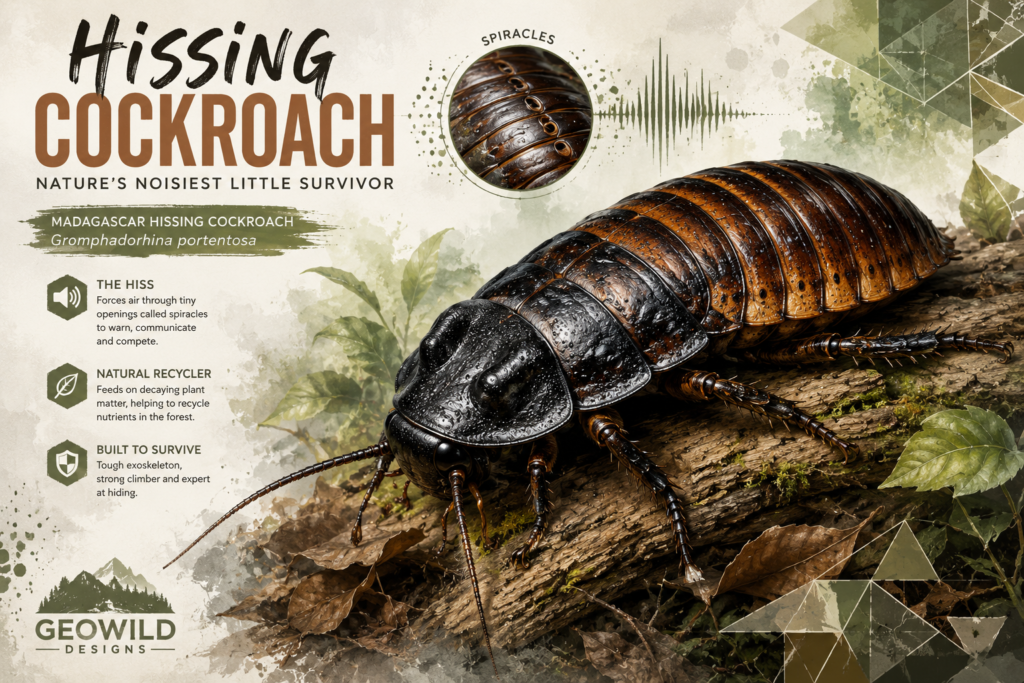
Hissing Cockroaches: Why Do They Hiss and Are They Really as Scary as They Look?
Few creatures have a name quite as dramatic as the hissing cockroach. Large, armoured-looking and capable of producing an unexpectedly loud hiss, these unusual insects can seem intimidating at first glance.
But behind their formidable appearance is a fascinating animal with some remarkable adaptations.
The Madagascar hissing cockroach is very different from the pest cockroaches people commonly associate with kitchens and drains. It is a forest-dwelling species with an important role in its natural ecosystem — and its famous hiss is only one of the things that makes it extraordinary.
So, why do hissing cockroaches hiss? Can they bite? What do they eat? And just how big can they become?
Let’s meet one of the insect world’s most misunderstood characters.
What Is a Hissing Cockroach?
When people talk about a hissing cockroach, they usually mean the Madagascar hissing cockroach, Gromphadorhina portentosa.
As its name suggests, it originates from the island of Madagascar, off the eastern coast of Africa.
Rather than living in people’s homes, these cockroaches naturally inhabit forest environments. They spend much of their time amongst leaf litter, fallen wood and other decaying plant material on the forest floor.
They are wingless, relatively slow-moving and considerably larger than many of the cockroaches people encounter as household pests.
Adults can grow to around 5–7.5 cm (2–3 inches) long, making them one of the world’s larger cockroaches.
Their sturdy body, dark colouring and thick exoskeleton give them an almost prehistoric appearance.
But their most famous characteristic isn’t something you can see.
It’s something you can hear.
Why Do Hissing Cockroaches Hiss?
The hiss of a Madagascar hissing cockroach is produced by forcing air through specialised openings called spiracles on its abdomen.
Spiracles are small openings insects use as part of their respiratory system.
This is unusual because many insects that make sounds do so by rubbing parts of their bodies together. Hissing cockroaches instead use expelled air to create their distinctive noise.
And they don’t hiss for just one reason.
A warning hiss
If a hissing cockroach is disturbed, handled or frightened, it may hiss as a defensive response.
For a predator expecting a silent insect, suddenly hearing a loud hiss could be enough to cause hesitation.
That moment might give the cockroach an opportunity to escape.
Male competition
Adult males also hiss when interacting with rival males.
Males can compete over territory and access to females, using displays, pushing and hissing during confrontations.
Courtship
Hissing can also form part of communication between males and females during courtship.
So although the sound may appear simple to us, hissing is actually an important part of the cockroach’s communication system.
How Loud Is a Hissing Cockroach?
If you’ve never heard one before, the sound can be surprisingly noticeable.
It is often described as something between a forceful exhalation and the hiss of a small snake.
For an insect, it is remarkably effective.
The sound also seems particularly dramatic because we don’t normally expect cockroaches to make an obvious noise at all.
Do Hissing Cockroaches Bite?
This is one of the most common questions people have about these insects.
Madagascar hissing cockroaches are not considered dangerous to humans and are not known for biting people.
They do have mouthparts capable of breaking down their food, but biting isn’t their normal defence against humans.
When threatened, their first responses are much more likely to involve hiding, gripping onto a surface or — unsurprisingly — hissing.
Their size can make them appear much more dangerous than they really are.
Can Hissing Cockroaches Fly?
No.
Madagascar hissing cockroaches are wingless.
Unlike some cockroach species, neither the adult males nor females develop functional wings.
That means the impressive-looking insect can’t suddenly launch itself into the air — something that may come as a relief to anyone who isn’t particularly fond of cockroaches!
They are, however, capable climbers.
Special structures on their feet allow them to grip surprisingly smooth surfaces, which helps them move around their forest habitat.
What Do Hissing Cockroaches Eat?
Hissing cockroaches are detritivores.
That means they feed largely on decaying organic material.
In the wild, their diet can include fallen fruit and decomposing plant matter.
It may not sound glamorous, but this feeding behaviour performs an extremely useful ecological function.
By consuming dead and decaying material, animals such as cockroaches help break it down. Nutrients contained within that material can eventually be returned to the ecosystem.
In other words, hissing cockroaches are part of nature’s recycling system.
This is one reason it’s worth looking beyond our instinctive reaction to animals such as cockroaches.
A creature doesn’t have to be beautiful, furry or colourful to have an important ecological role.
Where Do Madagascar Hissing Cockroaches Live?
These cockroaches are native to Madagascar.
Madagascar is particularly famous among biologists because of its extraordinary biodiversity and high number of endemic species — animals and plants found naturally nowhere else.
Hissing cockroaches live amongst the organic material of the forest floor, where fallen leaves and rotting wood provide shelter as well as food.
Their flattened body also helps them squeeze into narrow spaces.
This can be extremely useful when something larger decides a cockroach might make a good meal.
What Eats Hissing Cockroaches?
Despite their intimidating appearance, hissing cockroaches can become food for other animals.
Potential predators include birds, reptiles, amphibians and small mammals.
Their tough exoskeleton provides some protection, while hiding amongst forest debris makes them harder to find.
Then, of course, there’s that hiss.
Imagine being a predator investigating what appears to be an ordinary insect — only for your potential dinner to suddenly make a loud warning noise.
Sometimes looking and sounding formidable can be a very useful survival strategy.
How Big Do Hissing Cockroaches Get?
Madagascar hissing cockroaches are giants compared with many familiar cockroach species.
Adults can reach approximately 5–7.5 cm in length, although individual size varies.
They also have broad, heavily armoured-looking bodies, which can make them appear even larger.
Males and females can be distinguished from one another.
Adult males have prominent bumps or horn-like structures on the pronotum, the shield-like section behind the head. These are particularly useful during confrontations with other males.
Females generally lack such pronounced structures.
Do Hissing Cockroaches Have Wings?
No — and this is one of their particularly distinctive characteristics.
Adult Madagascar hissing cockroaches remain wingless.
Their lack of wings hasn’t prevented them from becoming highly successful in their particular ecological niche.
Instead of escaping danger by flying, they rely upon hiding, climbing, their protective exoskeleton and defensive behaviour.
How Long Do Hissing Cockroaches Live?
For an insect, Madagascar hissing cockroaches can live for a surprisingly long time.
Their lifespan is commonly around two to five years, particularly under favourable captive conditions.
Temperature, food, environmental conditions and general health can all influence lifespan.
That relatively long life is one reason they’ve become popular animals for educational displays and, for some people, unusual pets.
How Do Hissing Cockroaches Have Babies?
Here’s another surprising part of their biology.
Hissing cockroaches don’t simply lay an obvious cluster of eggs somewhere and leave them behind.
The female produces an ootheca, an egg case containing numerous developing young. She retains the egg case internally while the embryos develop.
Eventually she gives birth to live-looking young called nymphs.
The tiny pale nymphs look very different from the dark adults at first.
As they grow, they repeatedly shed their exoskeleton in a process called moulting.
After a moult, a cockroach can temporarily appear very pale or almost white because its new exoskeleton hasn’t yet hardened and darkened.
Are White Hissing Cockroaches Albino?
Usually, no.
Seeing a ghostly white cockroach can look extraordinary, but it often simply means that the animal has recently moulted.
An insect’s rigid exoskeleton cannot expand indefinitely as its body grows.
So the cockroach periodically sheds the old exoskeleton and replaces it.
Immediately afterwards, the new outer covering is soft and pale. Over time it hardens and develops its normal darker colour.
It’s a wonderful example of something that looks mysterious having a perfectly natural biological explanation.
Are Hissing Cockroaches Pests?
Madagascar hissing cockroaches should not be confused with common household pest species.
They are tropical forest insects and are not typical household-infesting cockroaches.
Their association with the word “cockroach” sometimes gives them an undeserved reputation.
In their natural habitat, they are simply another part of the forest ecosystem.
Why Do People Keep Hissing Cockroaches as Pets?
Perhaps surprisingly, Madagascar hissing cockroaches have become popular amongst people interested in unusual invertebrates.
They are also frequently used in educational settings because their large size makes it relatively easy to observe insect anatomy and behaviour.
Their lack of wings is another advantage in captivity.
And, of course, there’s the novelty of owning an animal that actually hisses at you.
They can provide an opportunity for children and adults to see an animal they may initially dislike from a completely different perspective.
Can Hissing Cockroaches Climb Glass?
Remarkably, yes.
Their feet are adapted to grip surfaces extremely effectively, including smooth ones.
This is important for anyone keeping the species in captivity, because an enclosure that looks impossible to climb may not appear particularly challenging to a determined hissing cockroach.
Their climbing ability is another reminder that cockroaches are far more sophisticated animals than their reputation suggests.
Are Hissing Cockroaches Dangerous?
For most people, a Madagascar hissing cockroach is far more startling than dangerous.
They are not venomous, they don’t have a sting and they aren’t aggressive predators.
Their dramatic appearance and hiss are defensive adaptations rather than signs that the animal is looking for a fight.
As with any animal, sensible hygiene should be used after handling them, and people with allergies or respiratory sensitivities should take appropriate care around cockroaches and their enclosures.
Why Are Cockroaches Important?
This may be the most important question of all.
Cockroaches aren’t usually the animals featured on conservation posters.
They don’t receive the affection given to elephants, tigers, wolves or pandas.
But ecosystems don’t work because of a handful of charismatic species.
They work because thousands of different organisms perform different jobs.
Animals that consume decaying organic matter contribute to decomposition and nutrient cycling. They are also part of food webs, becoming prey for other species.
Remove enough of those apparently insignificant organisms and the effects can travel throughout an ecosystem.
The Madagascar hissing cockroach is therefore a perfect example of something we strongly believe at GeoWild Designs:
Every species has a story — and every species matters.
Hissing Cockroach FAQs
Why does a hissing cockroach make a noise?
It forces air through specialised respiratory openings called spiracles. Hissing can be associated with defence, courtship and interactions between males.
Can a Madagascar hissing cockroach hurt you?
They are not considered dangerous to humans. They don’t sting or possess venom and aren’t generally known for biting people.
Do hissing cockroaches fly?
No. Madagascar hissing cockroaches are wingless.
Where are hissing cockroaches from?
They are native to the island of Madagascar.
What do hissing cockroaches eat?
They feed largely on decaying plant material and fallen fruit, helping break down organic matter.
How big is a Madagascar hissing cockroach?
Adults can reach roughly 5–7.5 cm (2–3 inches) in length.
How long does a hissing cockroach live?
They can live for several years, with around two to five years often reported under captive conditions.
Why is my hissing cockroach white?
A pale or white individual has probably recently moulted. Its new exoskeleton will gradually harden and darken.
Can hissing cockroaches climb?
Yes. They’re excellent climbers and can even grip very smooth surfaces.
Not Just a Creepy-Crawly
The Madagascar hissing cockroach probably won’t win everyone over.
For some people, one look at those spiny legs and that enormous armoured body will still be enough!
But that’s part of what makes the species so interesting.
It communicates using air, climbs surfaces that appear almost impossible to grip, gives birth to live-looking young and helps recycle organic material on the forest floor.
Sometimes the animals we dismiss as creepy, ugly or frightening turn out to have some of the most fascinating stories in nature.
And perhaps the next time you hear the word cockroach, you’ll think of something other than a household pest.
You might just think of a remarkable little recycler hissing away on a forest floor in Madagascar.
Inspired by the Hissing Cockroach?
If this remarkable little survivor has changed the way you look at cockroaches, you can take that fascination a little further with our Hissing Cockroach collection at GeoWild Designs. Inspired by the unusual wildlife we share our planet with, our designs celebrate the creatures that are often overlooked — from the beautiful and familiar to the wonderfully weird. Explore our Hissing Cockroach designs, available across a selection of clothing, wall art and other products, and celebrate one of nature’s most extraordinary insects.