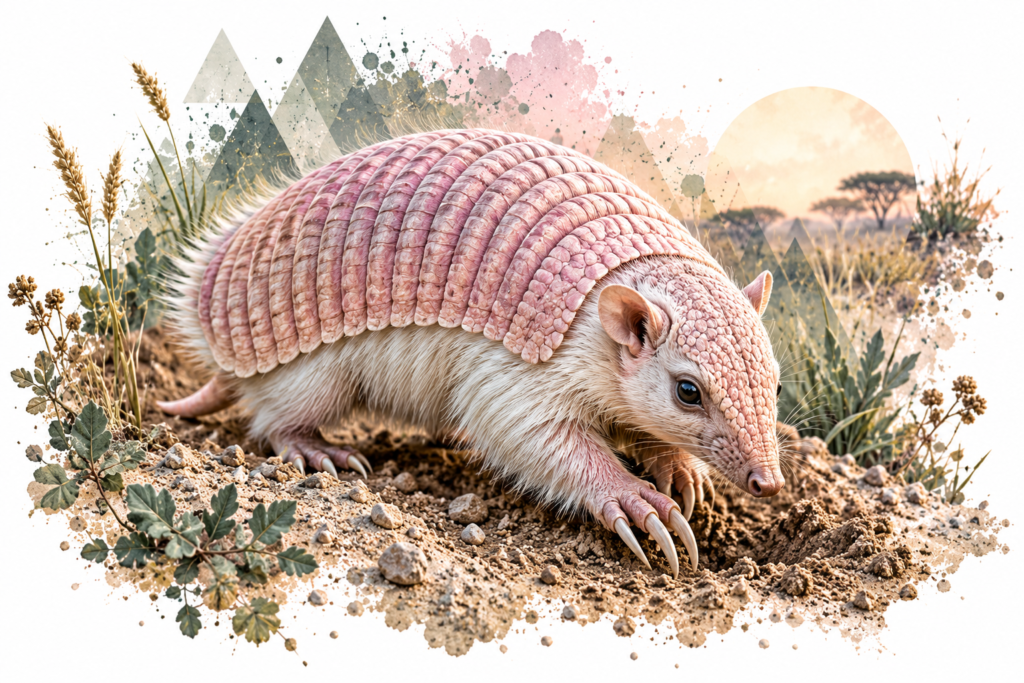
The Pink Fairy Armadillo: Meet the Tiny Underground Animal That Hardly Anyone Sees
There are unusual animals, and then there is the pink fairy armadillo.
Small enough to fit comfortably in your hands, covered in silky white fur and carrying a delicate pink shell across its back, this remarkable animal looks almost as though it belongs in a fantasy story.
But the pink fairy armadillo is very real.
Known scientifically as Chlamyphorus truncatus, it lives in Argentina and spends much of its life underground. Its secretive lifestyle means that even scientists have relatively few opportunities to observe it in the wild.
Why is the pink fairy armadillo pink? How small is it? What does it eat? Can it really bury itself within seconds? And can you keep one as a pet?
Let’s explore one of the strangest little mammals on Earth.
What Is a Pink Fairy Armadillo?
The pink fairy armadillo is a tiny burrowing mammal native to central Argentina.
It belongs to the armadillo family, but it looks quite different from the larger armadillos that many people are familiar with.
Its body is covered with fine pale fur, while a flexible pinkish shell protects the upper surface of its body.
Perhaps most remarkable of all is its size.
The pink fairy armadillo is generally considered the smallest living armadillo species in the world.
Its unusual appearance has earned it several names, including the pichiciego and lesser fairy armadillo.
How Big Is a Pink Fairy Armadillo?
Pink fairy armadillos are tiny.
An adult’s body is generally only around 9–15 cm (3.5–6 inches) long, excluding the tail.
That makes one considerably smaller than many people’s idea of an armadillo.
Its compact body is perfectly suited to life beneath the ground, where being small allows it to move through loose soil and narrow tunnels.
Why Is the Pink Fairy Armadillo Pink?
The animal’s colour is one of its most distinctive features.
Its shell can range from a very pale pink to a stronger rosy shade.
Unlike the thick, rigid armour you might imagine on a larger armadillo, the pink fairy armadillo has a relatively flexible shell.
Blood vessels beneath and around the shell contribute to its characteristic pink appearance.
Researchers also believe the shell may play a role in thermoregulation, helping the animal control its body temperature.
The combination of pink armour and silky white fur gives the animal its almost unreal appearance.
Is the Pink Fairy Armadillo Really an Armadillo?
Yes.
Despite looking very different from many of its larger relatives, the pink fairy armadillo really is an armadillo.
Armadillos belong to an ancient group of mammals called Xenarthra, which also includes sloths and anteaters.
So a tiny pink fairy armadillo is more closely related to a giant anteater or sloth than it is to rodents such as mice or rats.
Where Do Pink Fairy Armadillos Live?
Pink fairy armadillos are found only in Argentina, making them an endemic species.
They are particularly associated with dry grasslands, scrublands and sandy environments in central parts of the country.
Loose, dry soil is extremely important.
This is an animal built for digging, and suitable ground allows it to disappear beneath the surface incredibly quickly.
Its underground lifestyle also makes determining exactly where pink fairy armadillos occur — and how many remain — surprisingly difficult.
Do Pink Fairy Armadillos Live Underground?
They certainly spend a great deal of their lives there.
Pink fairy armadillos are fossorial, meaning they are specially adapted for digging and living underground.
Look closely at one and you can see those adaptations immediately.
They have powerful front claws for excavating soil, a compact body and a shell shaped to help them move underground.
They have sometimes been described as “sand swimmers” because of the way they can move through loose soil.
How Fast Can a Pink Fairy Armadillo Dig?
Very quickly.
Its large front claws act almost like miniature digging tools, breaking apart the soil and moving it away.
When threatened, a pink fairy armadillo can rapidly disappear underground.
This is one of its most important defences.
Instead of confronting a predator, it can simply do what it does best:
dig.
What Does a Pink Fairy Armadillo Eat?
Pink fairy armadillos are omnivorous, although small invertebrates appear to form an important part of their diet.
They are believed to eat foods including:
- ants
- ant larvae
- termites
- worms
- other small invertebrates
- plant material.
Their strong claws therefore aren’t useful only for building tunnels. They can also help the animal uncover food beneath the ground.
Are Pink Fairy Armadillos Nocturnal?
They are generally thought to be primarily nocturnal.
Coming above ground at night may help them avoid both predators and the extreme daytime temperatures that can occur in their habitat.
However, studying their daily behaviour isn’t easy.
Because pink fairy armadillos spend so much time underground and are rarely encountered, there are still gaps in our knowledge about their natural behaviour.
That mystery is part of what makes them so fascinating.
Why Are Pink Fairy Armadillos So Rarely Seen?
Imagine trying to study an animal that is:
small, nocturnal, incredibly good at digging and spends much of its life underneath the ground.
That is the challenge researchers face.
A pink fairy armadillo can be living beneath an area without giving people many obvious clues that it is there.
Sightings are therefore uncommon, even within its native range.
Rarely seeing an animal, however, isn’t necessarily the same thing as the animal itself being exceptionally rare.
This distinction is important when discussing the pink fairy armadillo.
Are Pink Fairy Armadillos Blind?
No, pink fairy armadillos are not completely blind.
They do, however, have very small eyes.
Vision is unlikely to be as important to an animal spending much of its life underground as it is to an animal that depends heavily upon sight above ground.
Their compact head, tiny eyes and underground adaptations are another reason people sometimes assume they cannot see at all.
Can Pink Fairy Armadillos Swim?
This question probably arises partly because armadillos as a group have some surprisingly good swimming abilities.
The pink fairy armadillo, however, is far more famous for a different kind of “swimming”.
It has been described as moving through loose soil almost as if it were swimming through sand.
Its body is extraordinarily specialised for underground movement.
What Is the Pink Fairy Armadillo’s Shell Made Of?
Like other armadillos, its armour contains bony plates called osteoderms, associated with a covering of keratinised skin.
But the armour isn’t simply a miniature version of the heavy shell seen on some larger armadillos.
The pink fairy armadillo’s shell is relatively flexible and is attached differently to the body.
That flexibility helps make it suitable for an animal whose life revolves around moving through soil.
Why Does the Pink Fairy Armadillo Have So Much Fur?
The sight of an armadillo covered in silky fur can seem strange.
But underground environments can experience very different temperatures from the surface.
Its pale fur provides insulation and helps the animal retain body heat.
Combined with its unusual shell and compact body, the fur contributes to one of the most distinctive appearances of any mammal.
What Is the Strange Flat Part at the Back of Its Body?
One of the pink fairy armadillo’s most interesting features is easy to overlook.
Its rear end has a flattened plate.
When the animal is inside a tunnel, this can help compact soil behind it and may also help block the tunnel.
It’s almost as though the animal carries a tiny built-in shovel at both ends — powerful claws at the front and a compacting surface at the rear.
Does a Pink Fairy Armadillo Have a Tail?
Yes.
It has a relatively short, stiff tail.
Rather unusually, the tail isn’t used in quite the same way as the flexible tail of many mammals. Its shape and position are part of the pink fairy armadillo’s highly specialised body plan for underground life.
What Animals Eat Pink Fairy Armadillos?
Because the animal is small, it could potentially fall prey to a variety of predators when above ground.
These may include larger carnivorous mammals and birds of prey.
Domestic dogs and cats can also potentially pose a danger.
Its greatest protection is its ability to get underground quickly.
Once buried, its colouring becomes irrelevant. Instead, powerful digging abilities and a specialised body become its defence.
Can a Pink Fairy Armadillo Roll Into a Ball?
This is a particularly good question because people often assume that all armadillos can roll into a ball.
They can’t.
Only certain armadillo species are capable of curling themselves completely into a protective ball.
The pink fairy armadillo relies much more heavily on escaping underground.
When danger appears, digging is a far more useful defence for this highly specialised little animal.
Can You Keep a Pink Fairy Armadillo as a Pet?
No. A pink fairy armadillo is not a suitable pet.
Its cute appearance inevitably makes people wonder whether one could be kept at home, but this is a highly specialised wild animal.
Pink fairy armadillos have proved notoriously difficult to maintain in captivity.
Removing an animal adapted to a very specific underground environment and attempting to keep it as an exotic pet is completely different from caring for a domesticated species.
The best place for a pink fairy armadillo is in its natural habitat.
How Long Do Pink Fairy Armadillos Live?
Surprisingly, we don’t have a reliable answer.
Because the animals are so difficult to observe and have historically done poorly in captivity, their lifespan is not well established.
You’ll sometimes find very precise lifespan figures online, but these should be treated cautiously.
This is a good example of an important wildlife lesson:
Sometimes the scientifically accurate answer really is “we don’t know yet.”
How Many Pink Fairy Armadillos Are Left?
Again, there is no reliable global population figure.
Their secretive underground lifestyle makes conventional wildlife surveys extremely difficult.
Researchers cannot simply walk through their habitat and count them.
This means we should be cautious about websites giving very precise figures for the number of pink fairy armadillos remaining in the wild.
The true population size is uncertain.
Are Pink Fairy Armadillos Endangered?
This is another question where the answer requires a little explanation.
The species has historically been difficult to assess because scientists lack enough information about its population size and trends.
Rather than assuming that rarely seeing the animal automatically means it is on the verge of extinction, researchers need reliable evidence about population numbers and changes over time.
What we do know is that maintaining suitable habitat is extremely important.
What Threatens Pink Fairy Armadillos?
Potential threats include habitat alteration, agricultural activity, livestock, soil disturbance and predation by domestic animals.
Climate and environmental changes could also matter because this animal depends so heavily on particular soil conditions.
For a creature adapted to digging through relatively loose ground, changes to the structure of its habitat can have significant consequences.
Do Pink Fairy Armadillos Carry Leprosy?
This question appears because some other armadillos are associated with the bacterium that causes Hansen’s disease, commonly known as leprosy.
However, it is misleading to assume that every armadillo species routinely carries leprosy.
Most of the well-known research concerns particular armadillo populations and especially the nine-banded armadillo.
It shouldn’t simply be transferred to the pink fairy armadillo.
As with all wild animals, however, people should avoid unnecessary handling.
Are Pink Fairy Armadillos Related to Dinosaurs?
No.
Despite their armour-plated appearance, armadillos aren’t descendants of armoured dinosaurs.
They are mammals.
Their evolutionary history is fascinating in its own right, and their wider group, Xenarthra, has a very long history in the Americas.
Some extinct relatives of modern armadillos were enormous compared with today’s species.
Why Is the Pink Fairy Armadillo So Weird?
What looks “weird” to us actually makes perfect sense for the animal’s lifestyle.
Its strange body is essentially a collection of adaptations for underground survival:
Powerful claws help it excavate soil.
A streamlined body helps it travel through tunnels.
Silky fur provides insulation.
Its flexible armour offers protection without preventing underground movement.
Its flattened rear plate helps it work inside its burrow.
Rather than being bizarre for the sake of being bizarre, the pink fairy armadillo is beautifully adapted to a very specialised way of life.
Can You See a Pink Fairy Armadillo in the Wild?
Technically yes — but don’t count on it.
Even people living within their range may rarely encounter one.
Their underground lifestyle, nocturnal habits and extraordinary digging ability make them extremely difficult to find.
And deliberately digging animals out of burrows simply to see or photograph them would cause unnecessary disturbance.
For wildlife enthusiasts, sometimes knowing an extraordinary animal is quietly living beneath the landscape has to be enough.
10 Amazing Pink Fairy Armadillo Facts
- The pink fairy armadillo is generally considered the world’s smallest armadillo.
- Its scientific name is Chlamyphorus truncatus.
- It is native to Argentina.
- Adults can be only around 9–15 cm long, excluding the tail.
- Its shell really can have a distinctive pink colour.
- It has silky pale fur underneath its armour.
- Powerful claws allow it to disappear rapidly into loose soil.
- It is sometimes described as a “sand swimmer”.
- It cannot simply be assumed to roll into a ball like some armadillos.
- Scientists still know surprisingly little about its life underground.
A Tiny Animal With a Big Mystery
The pink fairy armadillo demonstrates just how strange and specialised evolution can become.
At first glance, its pink armour, silky fur, enormous claws and tiny eyes make it look almost imaginary.
But every unusual feature has a purpose.
This is an animal shaped by life beneath the ground — a miniature digging specialist capable of disappearing into its sandy habitat when danger approaches.
Perhaps what makes the pink fairy armadillo most fascinating is how much remains unknown.
In an age when it can feel as though we’ve discovered everything about the natural world, a tiny mammal beneath the soils of Argentina reminds us that there are still mysteries right beneath our feet.
Love the Pink Fairy Armadillo?
If this extraordinary little animal has captured your imagination, you can also discover my GeoWild Designs Pink Fairy Armadillo wildlife artwork, inspired by its unusual pink armour, delicate features and secretive underground life. Explore the Pink Fairy Armadillo design here and celebrate one of the world’s most unusual mammals.