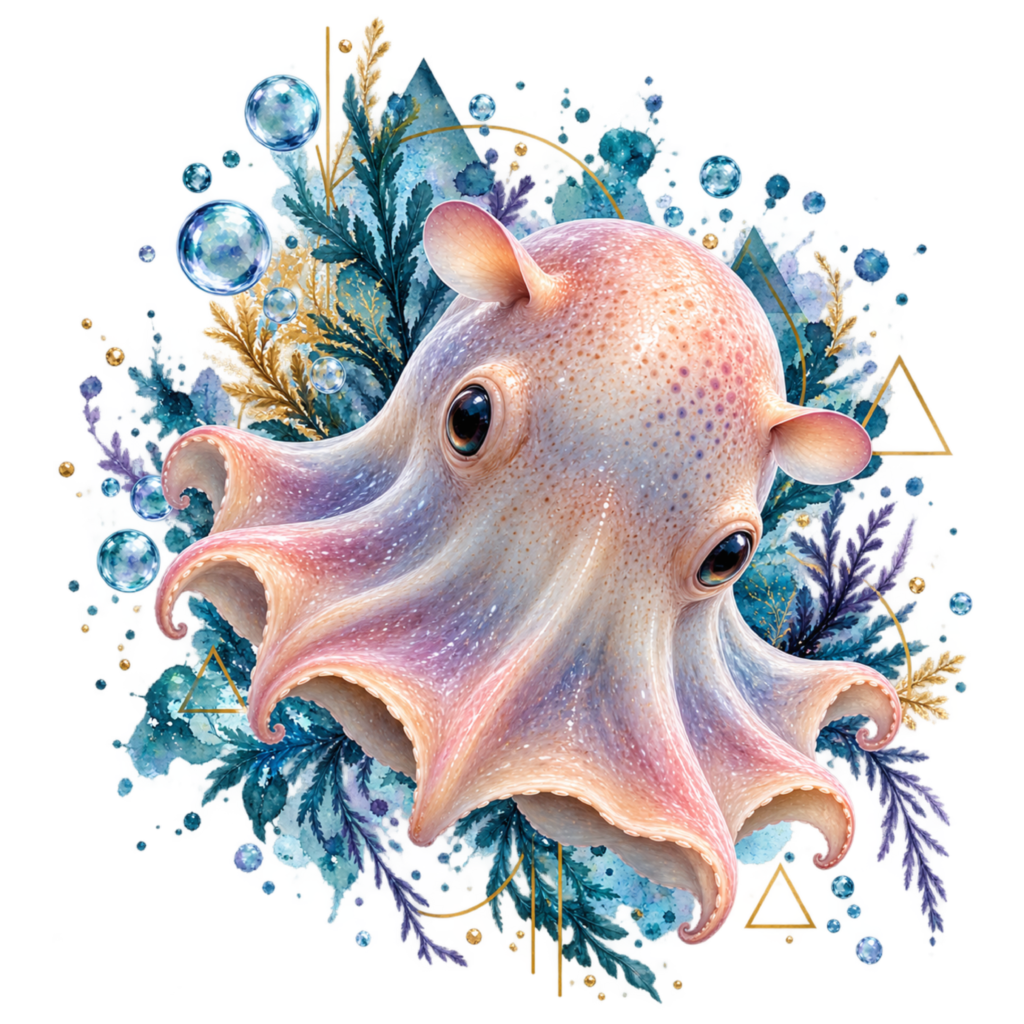
The Dumbo Octopus: Meet One of the Deep Sea’s Strangest and Cutest Creatures
Thousands of metres beneath the surface of the ocean, where sunlight has disappeared and the pressure is immense, lives an animal that looks almost too unusual to be real.
The dumbo octopus is famous for the pair of rounded fins projecting from its head, which resemble the oversized ears of Disney’s flying elephant, Dumbo.
But behind its cute appearance is an extraordinary deep-sea animal adapted to survive in one of the most extreme environments on Earth.
Dumbo octopuses can live thousands of metres below the ocean surface. They swim using their distinctive fins, have webbing between their arms and live in a world of almost complete darkness.
But what exactly is a dumbo octopus? How deep does it live? What does it eat? How big can it get? And does it really have ears?
Let’s descend into the deep ocean and discover the remarkable life of the dumbo octopus.
What Is a Dumbo Octopus?
The name dumbo octopus doesn’t refer to just one species.
It is the common name given to a group of deep-sea octopuses belonging to the genus Grimpoteuthis.
They are part of a wider group known as cirrate octopuses, which differ in several interesting ways from many of the octopuses we encounter in shallower water.
Their most famous feature is a pair of prominent fins on the mantle.
Combined with their rounded bodies and umbrella-like webbing, these fins give dumbo octopuses an appearance unlike almost any other animal in the ocean.
Why Is It Called a Dumbo Octopus?
The name comes from those unmistakable fins.
They project from either side of the animal’s mantle and look remarkably like a pair of large ears.
This reminded people of Dumbo, the animated elephant famous for flying with his enormous ears.
The resemblance gave the animal its popular name.
However, there’s an important difference.
Does a Dumbo Octopus Really Have Ears?
No.
Those adorable “ears” are actually fins.
A dumbo octopus moves them through the water to help propel and manoeuvre its body.
So while photographs can make it look like a tiny underwater elephant, it isn’t flapping ears through the ocean.
It is swimming with fins.
Where Do Dumbo Octopuses Live?
Dumbo octopuses live in the deep ocean and have been recorded in different oceans around the world.
Unlike tropical reef octopuses, you’re not going to encounter one while snorkelling on holiday.
They inhabit deep-water environments including the continental slope, abyssal plains and other areas far below the reach of sunlight.
Different species occur at different depths and in different geographical regions.
How Deep Do Dumbo Octopuses Live?
This is one of the most extraordinary things about them.
Dumbo octopuses are among the deepest-living octopuses known to science.
Members of their wider cirrate group have been observed at depths approaching 7,000 metres.
To put that into perspective, that’s several kilometres beneath the surface.
At those depths there is no sunlight, temperatures are extremely low and the water pressure is enormous.
Yet this is precisely the environment these animals have evolved to inhabit.
How Do Dumbo Octopuses Survive the Pressure?
Imagine the weight of kilometres of seawater pressing down from above.
For a human being without specialist equipment, such an environment would be deadly.
Deep-sea animals don’t experience pressure in quite the same way because their bodies have evolved under those conditions.
Dumbo octopuses have soft, gelatinous bodies without the large gas-filled spaces that would create serious problems under enormous pressure.
Their unusual appearance isn’t simply cute — it is part of a body designed for life in the deep ocean.
What Does a Dumbo Octopus Look Like?
Although appearances vary between species, dumbo octopuses typically have:
a soft body, two prominent fins, eight arms, webbing connecting the arms and rows of suckers.
Cirrate octopuses also possess small structures called cirri associated with their arms.
When the webbing between the arms is spread, the animal can take on an umbrella-like or bell-shaped appearance.
That is one reason an anatomically accurate dumbo octopus looks quite different from the familiar long-armed octopus shape.
How Many Arms Does a Dumbo Octopus Have?
Like other octopuses, dumbo octopuses have eight arms.
However, those arms are substantially connected by webbing.
This creates something resembling an umbrella or skirt beneath the body.
The webbing can help the octopus move and may also help it surround or capture small prey.
Does a Dumbo Octopus Have Tentacles?
This is a surprisingly useful distinction.
People commonly refer to an octopus’s limbs as tentacles, but scientifically an octopus has arms, not tentacles.
Tentacles generally have suckers concentrated towards their ends, while octopus arms have suckers running along them.
So a dumbo octopus has eight arms.
How Big Is a Dumbo Octopus?
There isn’t one simple size because “dumbo octopus” covers multiple species.
Many are relatively small animals, with some around 20–30 cm long, although size varies considerably.
Occasionally, much larger specimens have been reported.
This is another reason to be cautious with claims such as “a dumbo octopus grows to exactly X centimetres.”
Nature is rarely that tidy.
What Colour Is a Dumbo Octopus?
You may have seen photographs showing dumbo octopuses in pink, white, orange, reddish or purple shades.
Their appearance varies between species and individuals, and underwater lighting can also dramatically affect the colours we see in photographs and video.
Deep-sea animals aren’t living in the brightly illuminated blue environment we see in documentary footage.
At the depths where dumbo octopuses live, sunlight doesn’t reach them at all.
The beautiful colours we see are often revealed by the powerful lights carried by remotely operated vehicles and submersibles.
How Does a Dumbo Octopus Swim?
This is where those famous “ears” become important.
A dumbo octopus can propel itself by flapping its fins.
It can also use movements of its webbed arms and mantle to manoeuvre.
The result can look remarkably graceful.
Instead of constantly jetting around like some shallow-water octopuses, a dumbo octopus can appear to gently glide through the darkness.
In an environment where food may be scarce, efficient movement is extremely valuable.
Can a Dumbo Octopus Ink?
This is one of the most interesting differences between dumbo octopuses and many familiar octopuses.
Dumbo octopuses do not have the functional ink sac associated with many shallow-water octopuses.
Think about where they live and this starts to make sense.
Ink is particularly useful when a predator can see you.
But in the permanent darkness of the deep ocean, releasing a dark cloud of ink isn’t necessarily a particularly useful defence.
Evolution doesn’t keep expensive equipment simply because other relatives have it.
What Do Dumbo Octopuses Eat?
Dumbo octopuses are predators, but they aren’t hunting enormous deep-sea monsters.
Their diet consists mainly of relatively small animals found on or close to the seafloor.
Depending on species and habitat, prey can include:
- small crustaceans
- worms
- copepods
- amphipods
- isopods
- other small bottom-dwelling invertebrates.
Rather than tearing large prey apart, dumbo octopuses can swallow relatively small prey whole.
How Does a Dumbo Octopus Find Food in the Dark?
This is a major challenge of deep-sea life.
At the depths inhabited by dumbo octopuses, relying entirely on vision would be limiting.
Their suckers and specialised sensory structures associated with the arms can help them investigate their surroundings and locate prey.
They can move just above the seafloor, searching for small animals to eat.
It is a completely different hunting environment from a brightly lit coral reef.
What Eats a Dumbo Octopus?
Life in the deep sea doesn’t mean being free from predators.
Potential predators include large deep-sea fishes and marine mammals capable of diving to considerable depths.
Scientists still have much to learn about predator-prey relationships in the deep ocean because direct observations are so difficult.
Dumbo octopuses therefore inhabit a world in which many interactions may occur without humans ever witnessing them.
Are Dumbo Octopuses Dangerous?
No.
There is no reason to consider dumbo octopuses dangerous to people.
They live at depths humans cannot normally reach without sophisticated equipment and feed on small invertebrates.
They aren’t enormous aggressive predators waiting in the darkness.
If anything, we pose a far greater potential threat to their environment than they could ever pose to us.
Are Dumbo Octopuses Venomous?
Octopuses as a group have fascinating chemical and feeding adaptations, but dumbo octopuses are not regarded as a danger to humans in the way people sometimes imagine when they hear the word “octopus”.
You are also extraordinarily unlikely ever to physically encounter one.
Their deep-sea habitat keeps their world largely separate from ours.
Do Dumbo Octopuses Have Three Hearts?
Yes.
Like other octopuses, dumbo octopuses have three hearts.
Two branchial hearts help pump blood towards the gills, while a systemic heart circulates oxygenated blood around the rest of the body.
It’s one of those wonderful facts that sounds invented but isn’t.
An animal with eight arms, two ear-like fins and three hearts sounds like something from science fiction.
Yet it exists.
Is Dumbo Octopus Blood Blue?
Yes — octopuses have blue blood.
Instead of relying on iron-containing haemoglobin like humans do, their blood uses a copper-containing molecule called haemocyanin to transport oxygen.
Haemocyanin gives oxygenated blood a bluish colour.
This oxygen transport system is particularly useful in cold, low-oxygen marine environments.
For a deep-sea animal, that’s extremely important.
Do Dumbo Octopuses Have Bones?
No.
Dumbo octopuses are invertebrates.
They don’t have an internal skeleton like mammals, birds or fish.
Their soft bodies help them live successfully under enormous deep-sea pressures.
However, cirrate octopuses do possess internal supporting structures associated with their fins.
How Do Dumbo Octopuses Reproduce?
Dumbo octopus reproduction is particularly fascinating because deep-sea life doesn’t necessarily follow the familiar seasonal rhythms experienced by animals at the surface.
Females can carry eggs at different stages of development, suggesting that reproduction may occur throughout the year rather than during one tightly defined breeding season.
The eggs are relatively large and may be attached individually to hard surfaces on the seafloor, such as rocks or deep-sea corals.
Do Dumbo Octopuses Look After Their Babies?
Not in the way a bird feeds chicks in a nest.
Once a young dumbo octopus emerges from its egg, it is believed to be remarkably well developed.
It must be capable of surviving in the deep-sea environment without prolonged parental care.
For a newborn animal, that’s an extraordinary start to life.
How Long Does a Dumbo Octopus Live?
We don’t know precisely.
This is another case where you may encounter very specific numbers online even though the biology of these animals remains incompletely understood.
Studying the entire lifespan of an animal living thousands of metres beneath the ocean is enormously difficult.
So rather than pretending science has a precise answer, the more accurate answer is:
the lifespan of wild dumbo octopuses is not well established.
Can Dumbo Octopuses Change Colour?
Octopuses are famous for extraordinary colour-changing abilities, but dumbo octopuses don’t necessarily behave exactly like the shallow-water species most people have seen changing colour on television.
Deep-sea life creates different evolutionary pressures.
In an environment without sunlight, spectacular visual camouflage has far less value than it would on a colourful coral reef.
Some dumbo octopuses can nevertheless show variations in colour and appearance.
Do Dumbo Octopuses Glow in the Dark?
Dumbo octopuses are sometimes described online as though they are naturally glowing deep-sea animals.
That shouldn’t be assumed.
The deep sea contains many spectacular bioluminescent organisms, but dumbo octopuses aren’t generally known for producing the dramatic light displays associated with creatures such as some jellyfish and deep-sea fishes.
Their pale or translucent appearance under submersible lights can sometimes give them an almost luminous quality.
That’s different from producing their own light.
Why Are Dumbo Octopuses So Cute?
“Cute” obviously isn’t a scientific classification.
But dumbo octopuses happen to possess several features that humans tend to find appealing:
a rounded body, large-looking eyes, small size, gentle movements and, of course, those famous ear-like fins.
Together, they create an animal that can appear almost like a cartoon character.
The irony is that this cute-looking creature lives in one of the darkest and most extreme environments on the planet.
Are Dumbo Octopuses Rare?
This is difficult to answer.
Seeing one is certainly rare for humans.
But rarely observed doesn’t automatically mean biologically rare.
The deep ocean is enormous and extraordinarily difficult to survey.
An animal living several kilometres beneath the surface can potentially be widespread without humans encountering it very often.
Different dumbo octopus species may also have very different population sizes and distributions.
Are Dumbo Octopuses Endangered?
It isn’t accurate to treat every dumbo octopus as though it were one species with one conservation status.
Remember that “dumbo octopus” refers to multiple species within the genus Grimpoteuthis.
For many deep-sea animals, scientists simply don’t have the population data available for familiar conservation assessments.
However, that doesn’t mean their habitats are immune to human influence.
What Threatens Dumbo Octopuses?
The deep ocean once seemed almost completely beyond human influence.
We now know that isn’t true.
Potential pressures on deep-sea ecosystems include climate change, pollution, fishing activity and disturbance of the seafloor.
There is also considerable concern about how future industrial activities such as deep-sea mining could affect poorly understood ecosystems.
The difficulty is obvious:
How can we fully understand the impact on species that we’re still discovering and learning about?
Can You Keep a Dumbo Octopus as a Pet?
No.
A dumbo octopus is absolutely not a suitable aquarium pet.
These animals are adapted to deep water with extremely high pressure, cold temperatures and very specific environmental conditions.
Recreating their natural habitat in an ordinary aquarium would be impossible.
The fact that an animal looks adorable doesn’t mean it belongs in captivity.
For dumbo octopuses, their home is the deep ocean.
Can You See a Dumbo Octopus in an Aquarium?
You are extremely unlikely to see a living dumbo octopus in a conventional public aquarium.
Keeping deep-sea animals alive at the surface presents enormous technical challenges, particularly for animals adapted to tremendous pressure.
Most of what we know from observing living dumbo octopuses therefore comes from deep-sea research expeditions, submersibles and remotely operated vehicles (ROVs).
These technologies allow us to visit their world without bringing the animal into ours.
How Do Scientists Find Dumbo Octopuses?
Modern deep-sea exploration has transformed what we know about these animals.
Research vessels can deploy ROVs equipped with powerful lights and high-definition cameras thousands of metres beneath the surface.
Scientists sitting aboard a ship can then watch a dumbo octopus swimming across the seafloor in real time.
Occasionally specimens are collected for scientific research, allowing researchers to study anatomy and identify species.
Every expedition has the potential to reveal something new.
Why Do We Know So Little About Dumbo Octopuses?
Imagine trying to study an animal when its habitat is several kilometres beneath your feet, completely dark and under crushing pressure.
That’s the fundamental problem.
The deep ocean covers an enormous part of our planet, yet physically exploring it is difficult and expensive.
A research vessel may spend days reaching a suitable location. An ROV then has to descend for hours before scientists can even begin observing the seafloor.
That means every sighting is valuable.
And it explains why even basic questions about some deep-sea species remain unanswered.
12 Amazing Dumbo Octopus Facts
- Dumbo octopus isn’t a single species — the name covers species within the genus Grimpoteuthis.
- Their famous “ears” are actually fins.
- They live in the deep ocean.
- Dumbo octopuses have eight arms.
- Their arms are connected by substantial webbing.
- They belong to a group called cirrate octopuses.
- They don’t rely on the typical ink defence associated with many shallow-water octopuses.
- Dumbo octopuses eat small animals such as crustaceans and worms.
- Like other octopuses, they have three hearts.
- Their blood is blue because it contains haemocyanin.
- Some members of their wider group live at extraordinary depths of several kilometres.
- Scientists still have a great deal to learn about their lives.
A Remarkable Animal From a Hidden World
The dumbo octopus is a perfect example of why the deep ocean is one of the most fascinating habitats on Earth.
Its ear-like fins may have given it a cute nickname, but underneath that appealing appearance is a highly specialised animal.
Its soft body withstands enormous pressure. Its fins allow it to glide through the water. Its webbed arms help it navigate and hunt, while its entire biology has evolved for a world without sunlight.
And perhaps the most exciting thing about the dumbo octopus is how much we don’t know.
Every new deep-sea expedition gives scientists another brief window into a world that humans have barely explored.
There could be behaviours we’ve never witnessed, ecological relationships we don’t understand and perhaps even dumbo octopus species that science hasn’t yet described.
The next time you look out across the ocean, remember that kilometres beneath its surface, strange little octopuses may be quietly flapping their “ears” through the darkness.
And that is a wonderful reminder that some of Earth’s greatest mysteries are still very much alive.
Love the Dumbo Octopus?
If this extraordinary deep-sea animal has captured your imagination, you can also discover my GeoWild Designs Dumbo Octopus wildlife artwork, inspired by its distinctive fins, graceful movement and mysterious deep-ocean home. Explore the Dumbo Octopus design here and celebrate one of the most unusual creatures living beneath the waves.