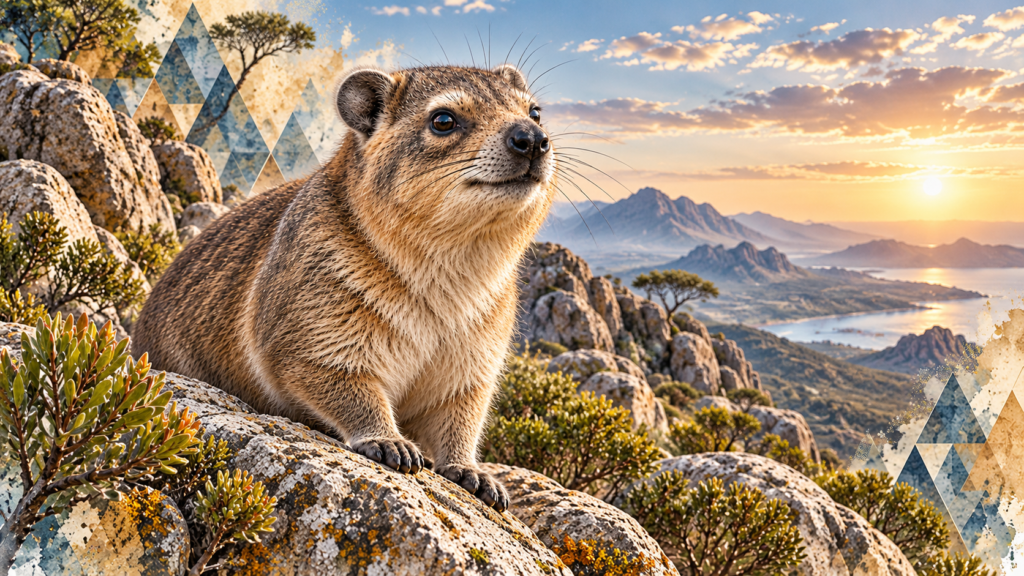
The Rock Hyrax: The Small Mammal With a Surprisingly Huge Family Secret
At first glance, a rock hyrax looks a little like an oversized guinea pig, a chunky rabbit without long ears, or perhaps a particularly sturdy type of rodent.
But appearances can be very misleading.
The rock hyrax is not a rodent at all. In fact, one of its closest living relatives is an animal so different in size and appearance that it sounds almost unbelievable: the elephant.
These remarkable little mammals live among rocky landscapes across parts of Africa and the Middle East, where they spend their days sunbathing, scrambling over cliffs, calling to one another and keeping a careful watch for predators.
So what exactly is a hyrax? Why are hyraxes related to elephants? What do they eat? And how do such seemingly vulnerable animals survive in some very challenging environments?
Let’s meet one of nature’s strangest little mammals.
What Is a Hyrax?
Hyraxes are small, thickset mammals belonging to the order Hyracoidea.
There are several living species of hyrax, generally divided between rock hyraxes and tree hyraxes.
The rock hyrax (Procavia capensis) is probably the best-known.
An adult rock hyrax usually has a compact body, short legs, rounded ears and dense brownish or greyish fur. Depending on the individual and population, its coat can vary considerably in colour.
Although their appearance frequently causes people to mistake them for rodents, hyraxes belong to an entirely different branch of the mammalian family tree.
And that is where their story becomes particularly interesting.
Are Hyraxes Really Related to Elephants?
Yes. Hyraxes and elephants really are related.
They certainly aren’t as closely related as two species belonging to the same family, but both belong to a much larger evolutionary group known as Afrotheria.
Hyraxes belong to the group Paenungulata alongside elephants and sirenians — the group containing manatees and dugongs.
This means the little rock-dwelling hyrax shares ancient evolutionary ancestry with some enormous mammals.
Scientists have found a number of anatomical features that reflect this relationship.
For example, hyraxes have unusual continuously growing upper incisors which can resemble tiny tusks. Their feet and skeletal anatomy also contain characteristics that help reveal their evolutionary history.
So although a hyrax might look much more like a guinea pig than an elephant, appearances don’t tell the whole evolutionary story.
It’s a wonderful example of how dramatically related animals can change over millions of years.
Is a Hyrax a Rodent?
No.
This is probably one of the most common misconceptions about hyraxes.
Their small size, rounded bodies and prominent front teeth make them look rodent-like, but hyraxes are not rats, guinea pigs, marmots or rodents of any kind.
Rodents belong to the order Rodentia.
Hyraxes belong to Hyracoidea.
Their resemblance is an example of how unrelated animals can develop superficially similar body shapes.
Where Do Rock Hyraxes Live?
Rock hyraxes are found across large areas of sub-Saharan Africa, with populations also occurring farther north and into parts of the Middle East.
As their name suggests, they are strongly associated with rocky environments.
Typical hyrax habitat includes:
- rocky hillsides and outcrops
- cliffs
- mountains
- boulder fields
- rocky savannah
- areas containing cracks and crevices suitable for shelter
Those rocks aren’t simply somewhere convenient to sit.
They are fundamental to the hyrax’s survival.
When danger appears, a hyrax can quickly disappear into narrow crevices that many larger predators cannot enter.
Rocky areas also provide elevated lookout points from which members of the colony can watch their surroundings.
Why Do Hyraxes Spend So Much Time Sunbathing?
A group of hyraxes sitting together on warm rocks can look as though they’re simply enjoying the sunshine.
There is actually an important biological reason for it.
Hyraxes aren’t as efficient at regulating their body temperature as many other mammals.
Their body temperature can fluctuate more substantially throughout the day, so basking helps them warm themselves after cooler periods.
You may therefore see hyraxes emerging from their shelters and gathering in sunny areas.
At other times they may huddle together, helping conserve body heat.
For a small mammal living in environments where temperatures can change dramatically between day and night, behavioural temperature regulation is extremely useful.
Do Hyraxes Live in Groups?
Rock hyraxes are highly social animals and commonly live in colonies.
Groups may contain numerous individuals, including females, youngsters and a territorial adult male.
Living together provides an important advantage: more eyes watching for danger.
While some members of the colony feed or rest, others may remain alert.
If a potential predator is detected, alarm calls can warn the group.
The hyraxes can then race for the safety of nearby rocks and crevices.
What Sound Does a Hyrax Make?
For such an unassuming-looking animal, hyraxes have a surprisingly impressive vocal repertoire.
They can produce whistles, squeals, barks, grunts and other calls.
Male rock hyraxes are particularly famous for producing elaborate vocal sequences sometimes described as songs.
Researchers studying these calls have discovered that hyrax vocalisations can contain complex patterns.
Calls may communicate information about the animal producing them and play a role in social interactions.
It’s another example of an animal being far more complicated than its appearance might suggest.
What Do Hyraxes Eat?
Rock hyraxes are predominantly herbivorous.
Their diet can include:
- grasses
- leaves
- shoots
- buds
- fruit
- bark and other plant material
What they eat depends partly upon the habitat and what vegetation is available.
Feeding outside the protection of the rocks exposes hyraxes to predators, so they often remain relatively close to places where they can quickly escape.
Their ability to exploit a variety of vegetation helps them survive in landscapes where food availability can change seasonally.
What Animals Eat Hyraxes?
Being relatively small and living in exposed rocky landscapes means hyraxes have plenty of predators.
Potential predators include large birds of prey, leopards, caracals, jackals and snakes, depending upon the region.
One particularly important hyrax predator is the Verreaux’s eagle.
In areas where the two occur together, rock hyraxes can form a significant part of this eagle’s diet.
This relationship illustrates why the hyrax’s vigilance and rocky habitat are so important.
An open patch of ground might be perfectly safe one moment and dangerous the next.
How Do Hyraxes Protect Themselves?
A hyrax doesn’t have the speed of an antelope or the physical defences of many larger mammals.
Instead, its survival strategy relies heavily on vigilance and shelter.
Their rocky homes contain cracks and holes into which they can retreat remarkably quickly.
Members of a colony also watch for danger and give alarm calls.
This means the group itself effectively becomes part of the animal’s defence system.
Rather than every hyrax having to constantly watch every direction, individuals benefit from the vigilance of their neighbours.
Can Hyraxes Climb Rocks?
Absolutely.
Rock hyraxes are superbly adapted for moving over steep and uneven surfaces.
The soles of their feet contain specialised pads which remain moist and provide excellent grip.
Muscular structures in their feet help create additional traction against rocky surfaces.
The result is an animal that can scramble confidently across terrain that would be extremely awkward for many similarly sized mammals.
Their feet are one of the hyrax’s most important adaptations.
Do Hyraxes Have Hooves?
Not in the way we normally imagine hooves.
Their toes have flattened, nail-like structures rather than typical claws, while one toe on the hind foot carries a specialised claw used for grooming.
Their unusual feet are another clue to the fact that hyraxes are very different from the rodents they superficially resemble.
How Big Is a Rock Hyrax?
A rock hyrax is much smaller than its elephant relatives!
Adults are generally around 30–60 cm long, although size varies between individuals and populations.
Their stocky build can make them appear heavier and more substantial than their length suggests.
They also have such a tiny external tail that it can be difficult to notice at all.
How Long Do Hyraxes Live?
Wild lifespan varies considerably because hyraxes face predation, disease, competition and environmental pressures.
Individuals that survive the hazards of their early years can live for roughly a decade or more, although lifespan varies.
Young hyraxes enter a world where staying close to the colony and learning when to hide can quite literally be a matter of life and death.
Do Baby Hyraxes Look Like Adults?
Baby hyraxes are remarkably well developed when they are born.
Unlike helpless newborn mice or rabbits, young hyraxes arrive with their eyes open and fur already covering their bodies.
They can begin moving around very quickly.
This is an important advantage for an animal living around predators and rocky terrain.
The young remain associated with their mothers and other members of the colony as they develop.
Why Is Hyrax Pregnancy So Long?
One of the most surprising facts about hyraxes is their unusually long pregnancy for such a small mammal.
Rock hyrax gestation lasts roughly seven to eight months.
That seems extraordinary when you compare them with many other mammals of a similar size.
The relatively advanced state of newborn hyraxes partly explains where all that developmental time goes.
By the time the youngsters arrive, they are already remarkably capable.
Do Hyraxes Have Tusks?
Not true elephant tusks, but there is another fascinating similarity between these distant relatives.
A hyrax’s upper incisors grow continuously and can form small tusk-like teeth.
This differs from rodents, whose famous gnawing teeth are structured differently.
It is one of those subtle anatomical details that reveals there’s much more to the hyrax than its guinea-pig-like appearance suggests.
Why Do Hyraxes Have a Gland on Their Back?
Hyraxes have a specialised dorsal gland on their back.
The area is surrounded by distinctive hairs and produces secretions involved in communication and scent marking.
Smell is an important part of communication for many mammals, allowing individuals to leave information behind even after they have moved away.
The gland is another characteristic that makes hyrax biology particularly unusual.
Are Hyraxes Dangerous to Humans?
Generally, wild hyraxes aren’t looking for confrontations with people.
Their usual response to perceived danger is to retreat.
However, they are still wild animals with strong teeth, and any animal may bite when frightened, cornered or handled.
They should therefore be watched from a respectful distance rather than approached or fed.
Can You Keep a Hyrax as a Pet?
A cute face doesn’t necessarily make a suitable pet.
Hyraxes are wild, social animals with specialised behavioural, dietary and environmental needs.
Their natural lives involve colonies, rocky refuges, climbing, basking, communication and complex interactions with other hyraxes.
Keeping an exotic animal in a domestic environment also raises welfare and legal considerations that vary between countries.
They are far better appreciated behaving naturally in the wild.
Are Hyraxes Endangered?
The conservation picture depends on the particular hyrax species.
The rock hyrax is not currently regarded as one of the world’s most threatened mammals, but that doesn’t make hyrax conservation irrelevant.
Healthy hyrax populations form part of functioning ecosystems.
They consume vegetation, influence plant communities and provide food for predators including large raptors and carnivorous mammals.
Removing a seemingly ordinary small mammal from an ecosystem can therefore have consequences for animals much higher up the food chain.
10 Amazing Rock Hyrax Facts
Here are ten facts worth remembering about this extraordinary little animal:
- Hyraxes are not rodents.
- They share ancient evolutionary ancestry with elephants and manatees.
- Their specialised feet help them grip rocky surfaces.
- They often bask in sunshine to help regulate body temperature.
- Rock hyraxes are highly social and commonly live in colonies.
- They use alarm calls to warn one another about predators.
- Males can produce surprisingly complicated vocal “songs”.
- Their pregnancy lasts around seven to eight months.
- Babies are born well developed, furry and with their eyes open.
- Their small size hides one of the most fascinating evolutionary stories in the mammal world.
A Small Animal With a Big Story
The rock hyrax is easy to overlook.
It isn’t enormous, brightly coloured or armed with spectacular horns. It doesn’t have the immediate fame of an elephant, lion or giraffe.
But that’s exactly what makes discovering it so rewarding.
Behind that round, rather endearing face is an animal beautifully adapted to life among the rocks — with gripping feet, complex social behaviour, an impressive vocabulary and an evolutionary family tree connecting it to some of the largest mammals on Earth.
The next time you see a photograph of a hyrax sitting quietly on a sun-warmed rock, remember what you’re actually looking at.
Not a strange guinea pig.
Not an oversized rodent.
But the surviving member of an ancient and remarkable branch of the mammalian family tree.
Bring the Rock Hyrax Into Your Home
If the rock hyrax has captured your imagination, you can discover our GeoWild Designs Rock Hyrax collection, inspired by this remarkable little mammal and its rugged natural habitat. Combining realistic wildlife detail with our signature geometric style, the design celebrates one of nature’s most overlooked and fascinating animals. Explore the Rock Hyrax collection here and take a little piece of the wild home with you.