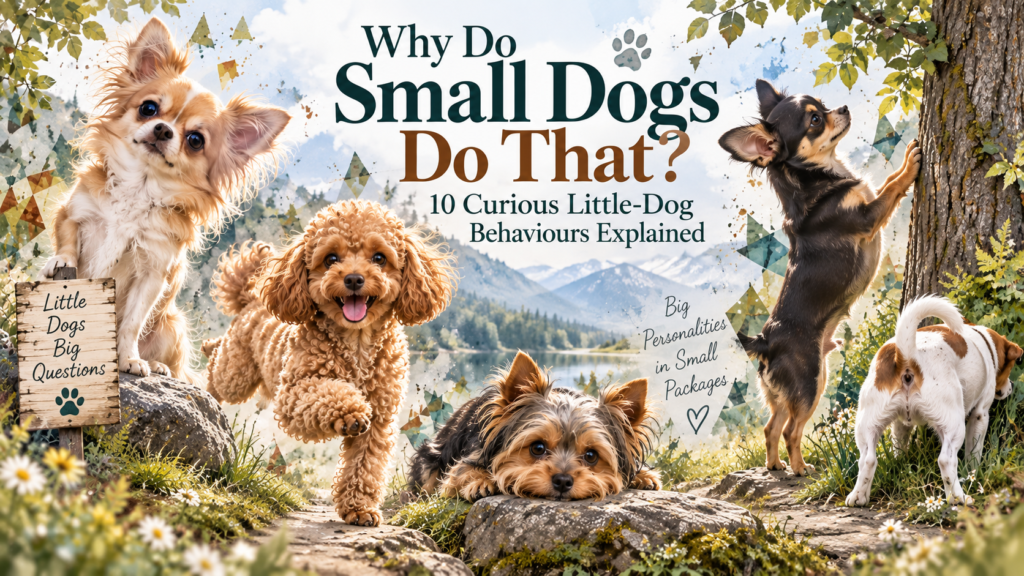
Small dogs may take up less room on the sofa, but they certainly don’t seem to have fewer quirks.
If you’ve ever lived with a Chihuahua, Yorkshire Terrier, Pomeranian, Maltese, Toy Poodle or another little dog, you may have witnessed some rather peculiar sights. One moment they’re walking normally, the next they’re skipping along on three legs. Some little dogs even perform what looks like a handstand when they go for a wee.
So why do small dogs do these things?
Some behaviours have surprisingly interesting explanations, while others that look like funny little habits can actually be associated with physical characteristics or health conditions that are more common in smaller breeds.
Here are ten fascinating things you may notice in little dogs.
1. Why Do Small Dogs Sometimes Skip on Three Legs?
You’ve probably seen this one.
A little dog trots along perfectly normally, suddenly holds up one of its back legs and skips for several steps before putting the leg down and carrying on as though nothing happened.
One possible explanation is a luxating patella, where the kneecap temporarily moves out of its normal position.
This is particularly associated with small and toy breeds. When the kneecap moves, the dog may lift the affected leg until it returns to its normal position, creating that characteristic skipping movement.
An occasional skip doesn’t tell you by itself what is causing it, however. Paw injuries, muscle problems and other orthopaedic conditions can also make a dog lift a leg.
If a dog regularly skips, appears uncomfortable, becomes lame or the problem is getting worse, it is worth asking a vet to examine it.
2. Why Do Some Little Dogs Do a Handstand When They Wee?
This has to be one of the strangest sights in the dog world.
Some dogs raise their hindquarters so high when urinating that both back feet leave the ground. For a moment, the dog is effectively balancing on its front legs.
It isn’t simply a canine party trick.
Dogs use urine for communication as well as emptying their bladder, and research has found that smaller dogs scent-mark more frequently than larger dogs.
Researchers have suggested that scent marking could be particularly useful to smaller dogs because it allows them to communicate without needing a potentially risky face-to-face encounter with a larger dog.
The height of a urine mark may also convey information about the dog that left it.
That gives an intriguing possible explanation for those extraordinary raised-leg positions: getting the urine higher may make the scent mark more noticeable.
So that tiny dog apparently attempting gymnastics against a lamppost may actually be leaving a message for the neighbourhood.
3. Why Do Small Dogs Scent-Mark So Much?
Ever walked a little dog who seems determined to stop at every tree, post and clump of grass?
There is evidence that size really does make a difference.
In one study of shelter dogs, small dogs urinated more frequently during walks than medium and large dogs. They also directed a greater proportion of their urinations towards objects than large dogs did.
Researchers suggested that scent communication could be especially valuable for a small animal because it provides information without requiring direct confrontation.
In other words, what seems like an incredibly long toilet break may actually be a little dog’s social media feed.
They’re reading messages — and leaving a few of their own.
4. Why Do Little Dogs Shake So Much?
Chihuahuas in particular have become famous for trembling, but shaking is seen in a number of small breeds.
There isn’t one single explanation.
Small dogs have a larger surface-area-to-volume ratio than big dogs, meaning they can lose body heat relatively quickly. A tiny short-coated dog can therefore become chilly much more easily than a large, heavily coated breed.
But temperature isn’t always responsible.
Dogs can also tremble through excitement, anxiety, anticipation, fear or discomfort.
That means a shaking little dog isn’t necessarily cold — and persistent or unexplained trembling shouldn’t automatically be dismissed as something small dogs simply do.
5. Why Do Small Dogs Love Burrowing Under Blankets?
You climb into bed and discover a mysterious dog-shaped lump underneath the duvet.
For owners of some little breeds, this is perfectly normal.
Small dogs can benefit considerably from conserving warmth, which makes a cosy blanket very appealing. Breed history can play a part too.
Dachshunds, for example, were developed to pursue animals underground, while several small terriers also have a history of entering confined spaces in pursuit of prey.
Add warmth, darkness, softness and proximity to their favourite human and the attraction of disappearing underneath a blanket isn’t difficult to understand.
Just make sure your dog can easily get in and out and isn’t becoming too hot.
6. Why Do Small Dogs Reverse Sneeze?
The first time you witness a reverse sneeze can be frightening.
Instead of sneezing air outwards, a dog suddenly makes a series of rapid inward breaths, often accompanied by loud snorting sounds.
Although any dog can reverse sneeze, it is reported more frequently in smaller dogs and is also common in flat-faced breeds.
An episode can be triggered by irritation around the back of the nose and throat. Excitement, eating or drinking quickly, allergens and pulling against a lead are among the possible triggers.
Most occasional episodes resolve quickly.
However, frequent, severe or changing episodes deserve veterinary attention because similar symptoms can sometimes have other causes.
7. Why Do Some Small Dogs Make a ‘Goose-Honk’ Cough?
This is another sound that owners of little dogs may encounter.
A harsh, dry cough that sounds rather like a goose honking can be associated with tracheal collapse.
The trachea is supported by rings of cartilage that help keep the airway open. In affected dogs these structures weaken, allowing the windpipe to flatten or narrow.
Although it can occur in other dogs, tracheal collapse is particularly associated with toy and small breeds including Yorkshire Terriers, Pomeranians, Chihuahuas and Toy Poodles.
Excitement, exercise, heat and pressure around the neck can make coughing worse in affected dogs.
Unlike some of the amusing behaviours in this article, repeated honking isn’t something to laugh off as a little-dog quirk. A dog with a persistent cough or breathing difficulty should be assessed by a vet.
8. Why Do Tiny Dogs Seem So Determined to Get Up High?
Back of the sofa. Your lap. A cushion. The highest part of the bed.
Many little companion dogs appear to enjoy elevated positions.
Part of the explanation can be very practical: the world looks rather different when you’re only a few inches off the floor.
Being higher can give a small dog a better view of what’s happening around it, while sitting on a person also provides warmth and security.
And once a dog discovers that climbing onto somebody’s lap results in attention, cuddles and a comfortable seat, there’s plenty of incentive to do it again.
9. Why Can Little Dogs Seem So Fearless Around Huge Dogs?
It’s one of the great contradictions of dog ownership.
A tiny dog weighing a few kilograms spots a dog several times its size and apparently decides, “Yes. That’s the one I’m going to challenge.”
But describing this simply as a small dog believing it is bigger than it really is is probably too simplistic.
Barking or lunging can result from excitement, fear, frustration, previous experiences, genetics and inadequate socialisation.
Human behaviour can matter too.
Owners naturally want to protect tiny dogs and may pick them up or remove them from situations that feel threatening. At other times, behaviours that would be considered unacceptable in a very large dog may be tolerated because a tiny dog seems less physically threatening.
Over time, dogs learn from what happens after they behave in particular ways.
So-called “small dog syndrome” isn’t a personality trait that every little dog possesses. A well-socialised small dog can be every bit as calm and confident as a larger one.
10. Why Are Small Dogs Often So Attached to Their Humans?
Some little dogs don’t merely follow their owners.
They supervise them.
Kitchen? Dog follows.
Bathroom? Dog follows.
Sofa? Dog is already there.
Many of today’s toy and companion breeds have histories closely connected with human companionship. Unlike breeds developed primarily for independent guarding, hunting or livestock work, companionship itself has been an important part of the role of many little dogs.
Their size also makes physical closeness exceptionally easy. A Chihuahua can spend hours on somebody’s lap in a way that would be considerably less practical with a Great Dane.
Of course, individual personalities vary enormously. Not every small dog wants constant attention, and plenty of enormous dogs would happily spend their lives sitting on their owners if given the opportunity.
Small Body, Fascinating Behaviour
Small dogs aren’t simply miniature versions of large dogs.
Their size affects how they experience temperature, interact with their environment and communicate with other dogs. Selective breeding has also produced little dogs with remarkably different histories — from dedicated human companions to determined hunters capable of pursuing animals underground.
And occasionally their anatomy makes certain conditions more likely, which means something that looks like an amusing habit can be worth investigating.
So the next time you see a little dog skipping down the pavement on three legs or balancing on its front paws to leave a strategically positioned scent mark, remember that there may be much more happening than meets the eye.
Small dog. Big personality. And sometimes some very strange behaviour indeed.