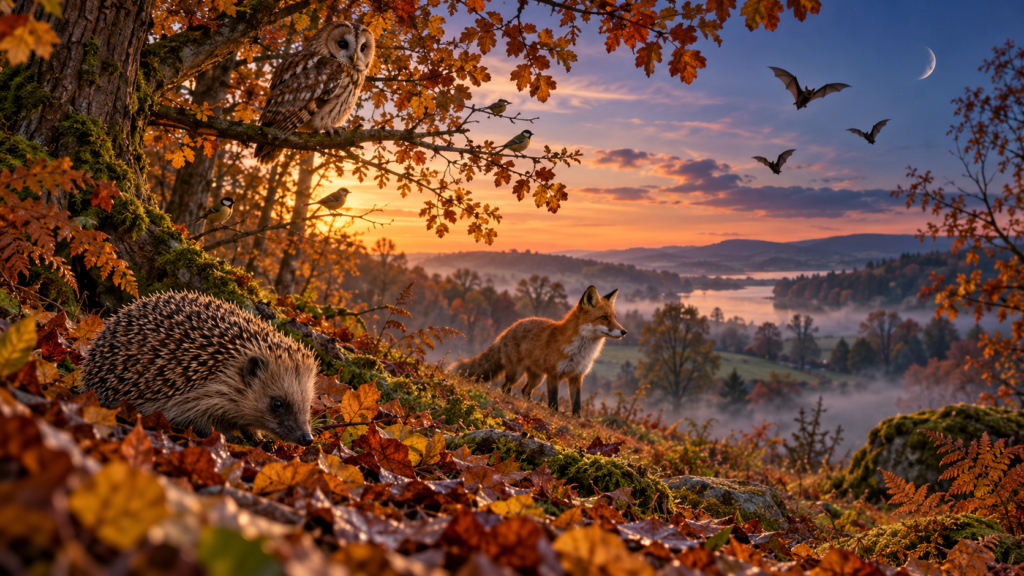
What happens to wildlife when the nights get longer? As autumn settles in and daylight begins to fade earlier each evening, the natural world starts to change in ways we do not always notice.
For wildlife, shorter days are more than just a sign that winter is coming. Changes in daylight can affect feeding, movement, migration, breeding, sleep and even body chemistry.
Animals do not need a calendar to know the seasons are changing. For many species, the length of the day is one of the most important signals they receive from the environment.
Why does daylight matter to animals?
The amount of daylight an animal experiences is known as the photoperiod.
As autumn progresses, the shortening days help trigger seasonal changes in many species. These changes can influence hormones, appetite, coat growth, migration and reproductive behaviour.
Temperature matters too, but daylight is often more reliable because it changes in a predictable pattern every year.
A warm spell in October might confuse us into thinking winter is still a long way off, but the steadily shortening days continue to signal to wildlife that the season is moving on.
Hedgehogs start preparing for hibernation
Hedgehogs are one of the clearest examples of autumn behaviour.
As nights become longer and colder, hedgehogs spend more time feeding and building up fat reserves. They need enough stored energy to survive hibernation, which may last for several months.
During autumn they may travel surprisingly long distances looking for beetles, caterpillars, worms and other food.
Eventually, as temperatures fall and food becomes harder to find, many hedgehogs retreat into nests made from leaves, grass and other vegetation.
During hibernation, their heart rate and body temperature fall dramatically to conserve energy.
This is one reason autumn gardens can be so important for hedgehogs. Leaf piles, log piles and undisturbed corners can provide valuable shelter.
Bats begin to slow down
Bats are also strongly affected by changing seasons.
During warm summer evenings, insects are plentiful and bats may spend hours feeding. As autumn arrives, insect numbers begin to fall and colder nights make feeding less productive.
Many British bats gradually become less active before entering periods of torpor or hibernation.
Torpor is a temporary state in which an animal lowers its body temperature and metabolism to conserve energy.
Some bats may wake occasionally during winter, particularly during mild weather, but they generally spend much less time flying and feeding.
Before winter arrives, bats also need to build up enough fat to survive long periods with little or no food.
Birds change their behaviour
For birds, shorter days can trigger some of the most dramatic seasonal changes in nature.
Many species migrate thousands of miles as autumn approaches.
Some birds leave Britain for warmer countries, while others arrive here from colder regions further north.
Swallows, house martins and many warblers head south, while winter visitors such as redwings, fieldfares and some geese arrive in the UK.
Bird migration is influenced by several factors, including daylight, weather, food availability and instinct.
Even birds that stay in the same area throughout winter change their routines.
Shorter daylight hours mean there is less time to find enough food. Small birds in particular may need to feed intensively during daylight to build enough energy to survive cold nights.
Foxes may become more noticeable
Foxes do not hibernate, so they remain active throughout autumn and winter.
However, as the nights become longer, people may notice them more often.
Foxes are naturally most active around dusk, during the night and around dawn. When darkness arrives earlier, their active period overlaps more with the time people are still awake.
Autumn also brings changes in food availability.
Foxes are highly adaptable and may eat rodents, insects, fruit, carrion and discarded human food.
As the season progresses, young foxes born earlier in the year may also begin ranging more independently.
This can lead to increased movement through gardens, fields and urban areas.
Deer enter an important breeding season
Autumn is an important time for several deer species.
For red deer, autumn is associated with the rut, when males compete for access to females.
Their behaviour can become much more energetic and dramatic, with males roaring, displaying and occasionally fighting.
Other deer species have different breeding cycles, but seasonal changes in daylight still play an important role in regulating hormones and behaviour.
For people walking in areas with deer during autumn, it is sensible to give them plenty of space.
Dormice prepare for a long sleep
Dormice spend much of autumn eating as much high-energy food as they can find.
Hazelnuts, berries and other autumn foods help them build fat reserves.
As temperatures fall, dormice eventually move into nests close to the ground and enter hibernation.
Their body temperature drops and their metabolism slows dramatically.
Dormice can spend a large proportion of the year either asleep or in torpor, which is one of the reasons they are so rarely seen.
Insects start disappearing from view
One of the most noticeable signs of autumn is the gradual disappearance of insects.
But they have not all simply died.
Different insects survive winter in different ways.
Some overwinter as eggs, others as larvae or pupae, while some adults hide in sheltered locations.
Butterflies such as peacocks and small tortoiseshells may overwinter as adults in sheds, garages, tree hollows or other protected places.
Ladybirds often gather together in sheltered areas.
Spiders may also become more noticeable indoors during autumn, although this is often connected to their breeding season rather than simply escaping the cold.
Nocturnal animals gain more darkness
For animals that are most active at night, longer nights can mean more time to feed and move around.
Owls, foxes, badgers and many small mammals can benefit from the extended darkness.
However, winter is not necessarily easier for nocturnal wildlife.
Food may be much harder to find, and colder temperatures mean animals must use more energy simply to stay warm.
For some species, survival becomes a careful balance between finding enough food and conserving enough energy.
Why artificial light can make a difference
Wildlife has evolved around natural cycles of daylight and darkness.
Artificial lighting can interfere with those patterns.
Streetlights, garden lights and brightly illuminated buildings may affect insects, bats, birds and other animals.
Some insects are drawn repeatedly towards artificial lights, which can waste energy and make them more vulnerable to predators.
Certain bat species avoid brightly lit areas altogether.
Birds can also become confused by artificial light, particularly during migration.
Reducing unnecessary outdoor lighting at night can therefore make gardens and neighbourhoods more wildlife-friendly.
How can we help wildlife during autumn?
Small changes can make a big difference.
Leaving some fallen leaves under shrubs gives insects and small animals somewhere to shelter.
Allowing seed heads to remain on plants can provide food for birds.
A small pile of logs or branches can create useful hiding places.
Fresh water is also valuable throughout autumn and winter.
Bird feeders can help too, particularly as natural food becomes less abundant.
Most importantly, leaving a few areas of the garden slightly untidy can create exactly the kind of habitat wildlife needs.
Autumn is a season of preparation
When the evenings begin drawing in, wildlife is already responding.
Some animals migrate.
Some hibernate.
Some grow thicker coats.
Others simply change the times they feed, travel or rest.
Longer nights signal that winter is approaching, and animals across the natural world begin adjusting long before the coldest weather arrives.
So the next time darkness falls unusually early, it is worth remembering that for wildlife, that fading daylight is not just the end of another day.
It is an important seasonal message.
Frequently Asked Questions
Do all animals sleep more when winter approaches?
No. Some species enter hibernation or torpor, while others remain fully active throughout winter.
Why do animals know when winter is coming?
Many species respond to changes in daylight, temperature and food availability.
Do foxes hibernate?
No. Foxes remain active throughout autumn and winter.
Do bats hibernate in the UK?
Many UK bat species enter long periods of torpor or hibernation during colder months.
Should I remove fallen leaves from my garden?
You can remove them from paths and lawns if needed, but leaving some leaf piles in quiet areas can provide valuable shelter for wildlife.
Want to learn more about the animals featured in this article? Explore more GeoWild wildlife stories, including our guides to bats, dormice, foxes, owls and hedgehogs, or browse our wildlife-inspired designs in the GeoWild shop. For further information about British wildlife and conservation, you can also visit trusted organisations such as the Bat Conservation Trust, RSPB, British Hedgehog Preservation Society and People’s Trust for Endangered Species.