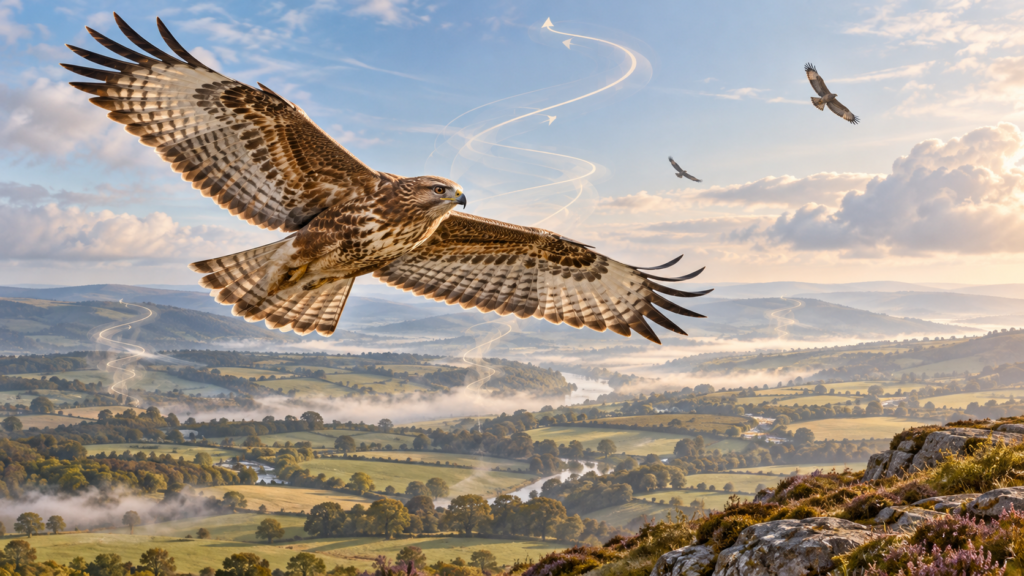
Have you ever looked up on a warm, sunny day and spotted a buzzard circling high above the countryside, seemingly without moving its wings? It might glide effortlessly for several minutes, climbing higher and higher before drifting away across the landscape.
It almost looks as though the bird is floating.
But there’s something remarkable happening in the air around it. The buzzard is taking advantage of an invisible natural phenomenon known as a thermal — a rising column of warm air that allows birds to gain height without using much energy.
From buzzards circling over British fields to enormous vultures soaring above mountain ranges, many birds have mastered the art of using the atmosphere to their advantage.
This article explains how birds use thermals to gain height, save energy and soar across the landscape with very little flapping.
What Exactly Is a Thermal?
Thermals form when the sun heats the Earth’s surface unevenly.
Fields, roads, bare soil, woodland and other surfaces absorb and release heat at different rates. As the ground warms, it heats the air immediately above it.
Because warmer air is generally less dense than the surrounding cooler air, it begins to rise.
This creates an upward-moving current of air called a thermal.
Thermals are not necessarily neat, invisible tubes. They can be irregular, turbulent and constantly changing as the wind moves them across the landscape.
For a soaring bird, however, they can act like a natural lift.
By spreading its wings and positioning itself within this rising air, a bird can climb without having to flap continuously.
Why Do Buzzards Fly in Circles?
One of the most recognisable sights in the British countryside is a common buzzard slowly circling overhead.
These broad-winged birds of prey are particularly skilled at using thermals.
When a buzzard encounters rising warm air, it begins to turn in circles, attempting to remain within the area providing the strongest lift.
As the air rises, the bird rises with it.
The circling isn’t simply a way of looking for prey, although buzzards may also scan the landscape while soaring. It is an efficient way of staying within the rising current.
Once the buzzard has gained sufficient height, it can glide towards another area without flapping much at all.
If it encounters another thermal, the process begins again.
In suitable weather, buzzards can travel considerable distances while conserving energy.
How Can a Bird Stay in the Air Without Flapping?
A bird doesn’t need to flap constantly to remain airborne.
Its wings generate lift as air flows over and around them, while gravity continuously pulls it downwards.
During ordinary gliding, a bird gradually loses altitude.
But when it enters a thermal, the surrounding air may rise faster than the bird would otherwise descend.
The result?
The bird gains height, even though its wings remain almost motionless.
This is known as thermal soaring.
Broad wings help birds such as buzzards fly efficiently at relatively low speeds. Their feathers can also adjust to changing airflow, helping them remain stable while circling and gliding.
Rather than spending valuable energy beating their wings, they make use of energy already present in the atmosphere.
How Do Birds Find Invisible Thermals?
This is perhaps the most fascinating part.
Thermals are invisible to us, yet experienced soaring birds can locate and exploit them with remarkable precision.
They may use several clues.
Changes in the air: Birds can detect subtle changes in lift and adjust their flight paths to remain in rising air.
Landscape features: Sun-warmed slopes, open ground and other surfaces can create favourable conditions for thermal development.
Other soaring birds: A bird may notice another bird circling and gaining height, indicating that useful rising air could be present.
Experience: Over time, birds can learn how different landscapes and weather conditions influence air movement.
A buzzard doesn’t need to understand the science behind thermals. Its natural abilities and experience allow it to respond to the changing conditions.
Do Buzzards Use Thermals to Hunt?
Buzzards often soar while searching for food, but thermal soaring serves several purposes.
Gaining altitude gives a buzzard an elevated view of the surrounding countryside, allowing it to survey fields, hedgerows and open spaces.
Common buzzards feed on a variety of animals, including small mammals, birds and reptiles. They also eat earthworms and carrion.
However, not every circling buzzard is actively hunting.
Sometimes it is simply gaining height, travelling between locations or conserving energy.
Buzzards also frequently hunt from perches, watching the ground from trees, posts or other suitable vantage points.
Which Other Birds Use Thermals?
Buzzards are far from the only birds to exploit rising warm air.
Red Kites
With their distinctive forked tails and long wings, red kites are wonderfully graceful in flight.
They use rising air to gain height and can glide effortlessly over large areas while searching for food.
Their constantly adjusting tails help them manoeuvre through changing air currents.
Vultures
Some of the world’s most impressive thermal-soaring birds are vultures.
Their large wings allow them to cover enormous distances efficiently, an important advantage when searching for widely scattered food sources.
In favourable conditions, vultures can soar for hours while using relatively little energy compared with continuous flapping flight.
Storks
Many storks rely heavily on thermals during migration.
Rather than continuously flapping over huge distances, they gain height in rising air before gliding onwards.
They often follow migration routes where land-based thermals are available, avoiding long sea crossings when possible.
Eagles
Many eagles also use thermals to climb above their surroundings.
Their impressive wingspans and ability to respond to rising air allow them to conserve energy while travelling or surveying large territories.
Gulls
Although gulls are commonly associated with flapping and gliding along coastlines, some species can also use thermals, particularly over land.
They may also exploit rising air created by wind blowing against cliffs and other obstacles.
Why Are Thermals Stronger on Some Days?
You are more likely to see birds thermal-soaring when sunshine has had time to warm the ground.
Thermals often become more useful from late morning into the afternoon, depending on the season and weather.
On a cool, overcast day, thermal activity may be weak because the ground receives less direct solar heating.
Strong winds can also disrupt or displace thermals, although some rising air can still form in windy conditions.
This helps explain why buzzards are sometimes seen perched quietly in trees during less favourable flying weather.
They may simply be waiting for better conditions.
Can Birds Soar Above the Clouds?
Under suitable conditions, thermals can rise thousands of feet into the atmosphere.
Their development is influenced by temperature, humidity, wind and the stability of the surrounding air.
Some thermals are associated with the formation of fluffy cumulus clouds, which develop when rising moist air cools sufficiently for water vapour to condense.
Soaring birds can climb to impressive heights beneath cloud bases, although they do not normally need to reach the clouds to benefit from thermal lift.
The next time you see a buzzard becoming smaller and smaller as it circles into the sky, it may be riding a thermal that extends far above the fields below.
Do Birds Ever Use Other Types of Rising Air?
Yes. Thermals are only one of the ways birds take advantage of moving air.
Ridge lift occurs when wind is forced upwards by hills, cliffs or slopes. Birds can glide along these areas while benefiting from the rising air.
Dynamic soaring is another technique, particularly associated with seabirds such as albatrosses. These birds exploit differences in wind speed at different heights to gain energy during flight.
While the techniques differ, they demonstrate just how effectively birds have adapted to the atmosphere.
Why Is Soaring So Important?
Flight can be extremely energy-intensive, especially for large birds.
By using thermals and other forms of rising air, birds reduce the amount of muscular effort needed to stay airborne and travel.
This can help them:
- Search larger areas for food.
- Travel long distances more efficiently.
- Gain altitude without continuous wingbeats.
- Conserve energy during migration.
- Remain airborne while surveying their surroundings.
For some large soaring birds, these natural air currents are a vital part of their everyday lives.
A Hidden World Above Our Heads
We often think of the sky as empty space, but for birds, it is a constantly changing environment filled with invisible opportunities.
A patch of sun-warmed ground, a gentle hillside or a change in the wind can create the perfect conditions for effortless flight.
What looks like a buzzard lazily circling over a field is actually an extraordinary example of an animal using the physics of its environment.
So next time you spot a buzzard overhead, watch carefully.
Notice how it circles, gradually gains height, then straightens its wings and glides away.
You may be watching it travel on an invisible elevator made entirely of warm air.
And perhaps the most remarkable thing is that it has been doing this naturally, without instruments or engines, long before humans ever learned to fly.