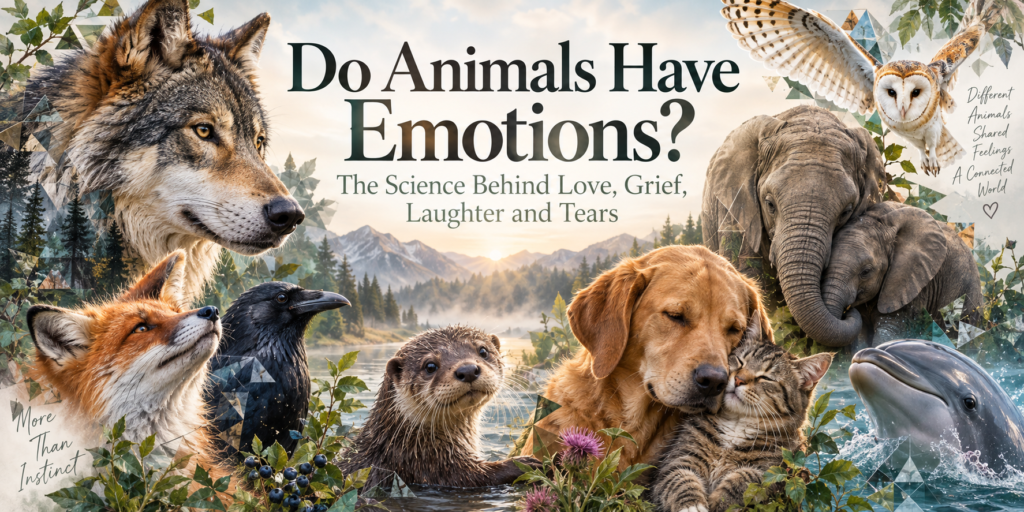
For centuries, people have wondered whether animals experience emotions in anything like the way humans do. A dog races to greet its owner after an absence. Elephants linger around the remains of another elephant. Rats make unusual high-pitched vocalisations during play. Crows form complex social relationships, while many animals appear distressed when separated from companions.
But are we simply interpreting animal behaviour through human eyes, or is there genuine scientific evidence that animals experience emotions?
Research into animal behaviour, neuroscience and cognition has transformed our understanding of this question. Scientists still have to be careful about claiming that another species experiences an emotion exactly as we do, but there is compelling evidence that humans are far from being the only animals capable of complex emotional states.
So, can animals love? Do they grieve? Can they really laugh or cry? And just how similar are animal emotions to our own?
Do Animals Have Emotions?
The short answer is yes — there is strong scientific evidence that many animals experience emotional states.
Scientists can study emotions indirectly through behaviour, changes in hormones, brain activity, heart rate, vocalisations and responses to positive or negative experiences.
Some basic emotional systems also have very ancient evolutionary origins. Fear, for example, is enormously useful for survival. An animal that recognises danger and responds quickly has a better chance of surviving.
Pleasure and reward can encourage behaviours such as eating, playing, bonding and caring for offspring.
However, there is an important distinction between saying an animal experiences an emotional state and claiming that it experiences that emotion in precisely the same way a human does.
We cannot simply ask an elephant, wolf or crow what it is feeling.
Scientists therefore build evidence from what animals do and what is happening inside their bodies and brains.
Do Animals Have Emotions Like Humans?
Some appear surprisingly similar, while others may be very different.
Humans and many other mammals share brain structures and chemical systems involved in fear, pleasure, attachment and stress. This makes it unsurprising that there are similarities in the way we respond emotionally.
But every species experiences the world differently.
A dog’s extraordinary sense of smell, a bat’s echolocation and an elephant’s ability to detect very low-frequency sounds mean their perception of the world is unlike ours.
Their emotional lives are therefore unlikely to be simply human emotions inside a different body.
It is better to ask what an emotion means for that particular animal.
Can Animals Feel Love?
“Love” is a difficult word scientifically because it encompasses many different human experiences.
But strong social attachment is certainly not unique to humans.
Animals can form long-lasting bonds with mates, offspring, family members and social companions.
Dogs are perhaps the most familiar example. Their relationship with humans developed over thousands of years, and research has found physiological changes associated with bonding during positive interactions between dogs and their owners.
Other animals form powerful social relationships within their own species.
Wolves live in highly social family groups. Elephants maintain relationships over many years. Primates form alliances and friendships, while some birds maintain long-term pair bonds.
Whether we should call all of these relationships “love” is partly a question of language.
But the underlying ability to become deeply attached to another individual is clearly present in many species.
Do Animals Miss Each Other?
Anyone who has lived with bonded pets may have seen behaviour change when one animal disappears.
Similar responses occur in wild animals.
Social animals recognise particular individuals and can form relationships that persist for years. Separation can therefore affect their behaviour.
Some animals search for an absent companion, call repeatedly, become less active or change their eating and sleeping patterns.
This doesn’t prove that every case represents the same feeling humans call “missing someone”, but it does demonstrate that the disappearance of a social companion can matter enormously to another animal.
Do Animals Grieve?
This is one of the most fascinating and difficult areas of animal emotion research.
Behaviours that resemble grief have been documented in several species.
Elephants have attracted particular attention because of their reactions to dead elephants. Individuals may investigate bones and bodies using their trunks and sometimes remain near a deceased individual.
Primates have also displayed striking responses to death. Mothers of some species have been observed continuing to carry dead infants for extended periods.
Cetaceans, including dolphins and whales, have sometimes been observed supporting or remaining with dead or dying companions.
Even some birds display unusual behaviour around dead members of their species.
Scientists are understandably cautious about automatically describing every such behaviour as grief. But it is increasingly difficult to dismiss the possibility that some highly social animals experience profound responses to loss.
Do Animals Understand Death?
This question is harder.
Reacting emotionally to the death of another animal doesn’t necessarily mean an animal understands the concept of death in the same abstract way humans do.
There may also be differences between species.
An animal could recognise that another individual is no longer responding without understanding that death is permanent.
Researchers study how animals behave around dead companions to try to understand what they know. Do they attempt to wake them? Do they remain nearby? Do they return later? Does their behaviour change after repeated exposure to death?
There is still much we don’t know.
And that uncertainty is one of the things that makes animal cognition so fascinating.
Can Animals Laugh?
This was one of the interesting questions we discovered while researching this subject — and the answer is more complicated than simply yes or no.
Some animals produce vocalisations during play that researchers have compared with laughter.
Great apes, for example, make distinctive sounds during play and tickling.
Rats have also become famous in studies of animal play. They produce ultrasonic vocalisations — sounds above the range of human hearing — during positive social interactions and when being playfully tickled by researchers.
These aren’t necessarily identical to human laughter.
But laughter itself may have evolutionary roots in much older forms of play communication.
Think about what laughter often communicates between humans: I’m playing. This isn’t threatening. We’re enjoying this.
Play signals can perform remarkably similar functions in other social animals.
Which Animals Laugh?
Laughter-like or play-related vocalisations have been studied in a variety of animals, particularly mammals.
Great apes provide some of the clearest comparisons with humans because we are closely related.
Chimpanzees, bonobos, gorillas and orangutans produce characteristic vocalisations during play.
Rats produce their ultrasonic calls.
Dogs also use distinctive play behaviours and vocal signals to communicate friendly intentions, although describing these simply as laughter can be misleading.
Scientists have also investigated play vocalisations across many other species.
Rather than asking whether animals laugh exactly as humans do, the more interesting question may be:
Why did playful vocal communication evolve in the first place?
Can Animals Cry?
Animals certainly produce tears.
But tears don’t automatically mean sadness.
Tears have important biological functions. They lubricate and protect the eyes, remove debris and help maintain a healthy surface.
Humans, however, do something unusual: we produce obvious emotional tears in response to feelings such as sadness, joy, pain and overwhelming emotion.
Whether other animals routinely cry emotional tears in the same way remains much less certain.
An animal with watery eyes shouldn’t automatically be described as crying with sadness.
That doesn’t mean animals cannot feel distress. They can express it in many other ways — through posture, facial expressions, vocalisations, withdrawal, changes in appetite or altered social behaviour.
Can Animals Feel Sadness?
There is substantial evidence that animals can experience negative emotional states.
Stress, fear, anxiety-like behaviour and responses to social separation have been extensively studied.
Depression-like states can also be investigated experimentally, although scientists must be cautious when applying human psychiatric terminology directly to animals.
What we can say with much greater confidence is that many animals are capable of experiencing prolonged negative states rather than simply reacting reflexively to something unpleasant.
This has important consequences for animal welfare.
If animals can experience fear, distress, loneliness and frustration, then providing food and shelter alone isn’t necessarily enough to ensure good welfare.
Their emotional needs matter too.
Do Animals Feel Happiness?
If animals can experience negative states, what about positive ones?
This is an increasingly important area of animal-welfare research.
Play is one obvious example.
Young mammals often devote considerable time and energy to playing even though it doesn’t provide an immediate meal or directly protect them from predators.
Animals may also actively seek social contact, grooming, exploration and other rewarding experiences.
Researchers increasingly look not only at whether an animal is free from suffering but whether it has opportunities for positive experiences.
A good life isn’t simply the absence of something bad.
Can Animals Feel Fear?
Absolutely.
Fear is one of the most evolutionarily important emotional systems.
It helps animals recognise and respond to danger.
Different species have evolved different responses. One animal may run, another freeze, another hide and another defend itself.
Fear can also be learned.
An animal that survives a dangerous encounter may remember the situation, location or even the individual involved.
This ability can be extremely valuable in the wild.
Can Animals Remember People Who Hurt Them?
Some certainly can.
Recognition abilities vary enormously between species, but several animals can distinguish individual humans.
Crows are a particularly fascinating example. Research has shown that they can learn to recognise threatening human faces and retain that information for long periods.
This makes evolutionary sense.
If a particular individual represents danger, remembering them could increase an animal’s chances of survival.
The opposite may also be true: animals can learn that particular people are associated with food, safety or positive experiences.
Do Animals Have Empathy?
Empathy is another word that needs careful definition.
At its simplest, it can involve responding to another individual’s emotional state.
Scientists have observed behaviours in several social species that suggest animals can be affected by the distress of others.
Some animals console distressed companions. Others alter their behaviour when another individual is frightened or in pain.
Helping behaviour has also been documented in several species.
The most complex human forms of empathy may involve abilities that are difficult to demonstrate in other animals, but the evolutionary building blocks of empathy appear unlikely to belong exclusively to us.
Do Animals Have Friends?
Yes — and this is one of the loveliest areas of animal behaviour research.
Friendship doesn’t have to mean exactly what it means to humans.
Scientists can identify stable social preferences: two individuals consistently choosing to spend time together, grooming one another, cooperating or supporting one another during conflict.
Primates provide many examples, but friendships and preferred social partners have also been documented in animals including horses, dolphins and other highly social species.
Some of these relationships can last for years.
Can Different Species Become Friends?
They can certainly form relationships.
Domesticated animals provide obvious examples. Dogs and cats that grow up together can become strongly bonded despite having very different natural communication systems.
Unusual relationships between different species also occur in captivity and occasionally in the wild.
However, we need to be careful when interpreting viral videos showing supposedly unlikely animal friendships. A short clip doesn’t necessarily tell us the history or nature of a relationship.
Genuine interspecies social bonds do occur, but each case needs to be considered on its own evidence.
Why Do Animals Play?
Play is particularly interesting because it appears unnecessary at first glance.
Wild animals need food, safety and opportunities to reproduce. Why waste valuable energy chasing, wrestling, jumping and playing?
One explanation is that play helps young animals develop physical and social skills.
A young predator can practise movements that will later help with hunting. Social animals can learn boundaries, communication and how strongly they can bite or push without ending a game.
But play may also simply be rewarding.
Animals appear motivated to seek it out.
That possibility tells us something important about their inner lives.
Do Animals Have Emotional Intelligence?
“Emotional intelligence” is primarily a human psychological concept, so applying it directly to animals can be problematic.
But many animals unquestionably possess sophisticated social abilities.
They may recognise social relationships, respond differently depending on another individual’s behaviour, reconcile after conflicts, cooperate, form alliances and adjust their behaviour according to social circumstances.
For an animal living in a complex group, understanding other individuals can be just as important for survival as finding food.
Which Animals Are the Most Emotional?
There probably isn’t a meaningful league table.
Different animals evolved different social systems and survival strategies.
Elephants may display extraordinarily complex social relationships. Primates possess sophisticated social cognition. Wolves depend heavily upon cooperation. Dolphins live within intricate social networks. Crows and other corvids display remarkable cognitive abilities.
Even animals that humans traditionally considered simple are continually surprising researchers.
The absence of an obvious human-like facial expression doesn’t mean an animal lacks an emotional life.
We are naturally better at recognising emotions in animals that look and behave like us.
That can create a bias.
What About Fish, Reptiles and Insects?
This is where things become particularly interesting.
Public perceptions of animal emotion have traditionally focused on mammals and birds.
But research into fish cognition and welfare has challenged the idea that fish are merely creatures of instinct.
Reptile cognition is also receiving increasing attention.
Insects are even more controversial, yet studies of learning, motivation and behaviour in species such as bees have raised fascinating questions about just how far back the evolutionary roots of basic emotion-like states might extend.
Science doesn’t yet have all the answers.
Our understanding is still developing.
Are We Guilty of Humanising Animals?
Sometimes.
The scientific term often used is anthropomorphism — attributing human characteristics or motivations to non-human animals.
It can lead us astray.
A dog showing its teeth isn’t necessarily smiling. An animal sitting quietly isn’t necessarily sad. A behaviour that looks romantic to us may have a completely different biological purpose.
But scientists also warn against going too far in the opposite direction.
Automatically assuming that animals cannot experience something simply because humans experience it can be equally misleading.
The best approach is evidence.
Observe the behaviour, understand the biology and remain open to what research reveals.
Why Animal Emotions Matter
Understanding animal emotions isn’t simply an interesting scientific puzzle.
It changes how we think about our responsibilities towards other species.
If an animal can experience fear, frustration, pleasure, attachment or social loss, then the way we treat that animal matters in ways that extend beyond physical health.
This applies to pets, farm animals, animals in captivity and wildlife affected by human activity.
It also gives us a different perspective on the animals living around us.
A crow isn’t simply a black bird passing overhead. A wolf isn’t simply a predator. An elephant isn’t simply an enormous mammal.
Each is an individual animal processing information, remembering experiences and responding to its social and physical world.
So, Do Animals Really Love, Grieve, Laugh and Cry?
The answer isn’t a simple yes to every word.
There is compelling evidence that many animals experience emotional states and form powerful social bonds. Some display behaviours consistent with grief. Some produce laughter-like vocalisations during play. Animals experience fear and distress, and many actively seek rewarding experiences and companionship.
Emotional tears like those of humans are much less clearly established.
And we should be cautious about assuming that an animal experiences “love”, “grief” or “happiness” in precisely the same way we do.
But perhaps animals don’t need to experience emotions exactly like humans for those emotions to matter.
The more scientists discover about animal minds, the harder it becomes to view other species as creatures simply reacting automatically to the world around them.
Their emotional lives may be different from ours.
But different doesn’t mean insignificant.
Discover More About the Animals Behind the Science
If this article has made you curious about the animals behind these remarkable behaviours, there is plenty more to discover across the GeoWild Designs wildlife blog. Explore our articles about wolves, dogs, crows, foxes and other fascinating species to learn more about how animals communicate, form relationships, survive and experience the world around them.
And if one particular animal has captured your imagination, you can also explore our GeoWild wildlife-inspired artwork, where the character and beauty of the natural world inspires designs for wall art, clothing and more.