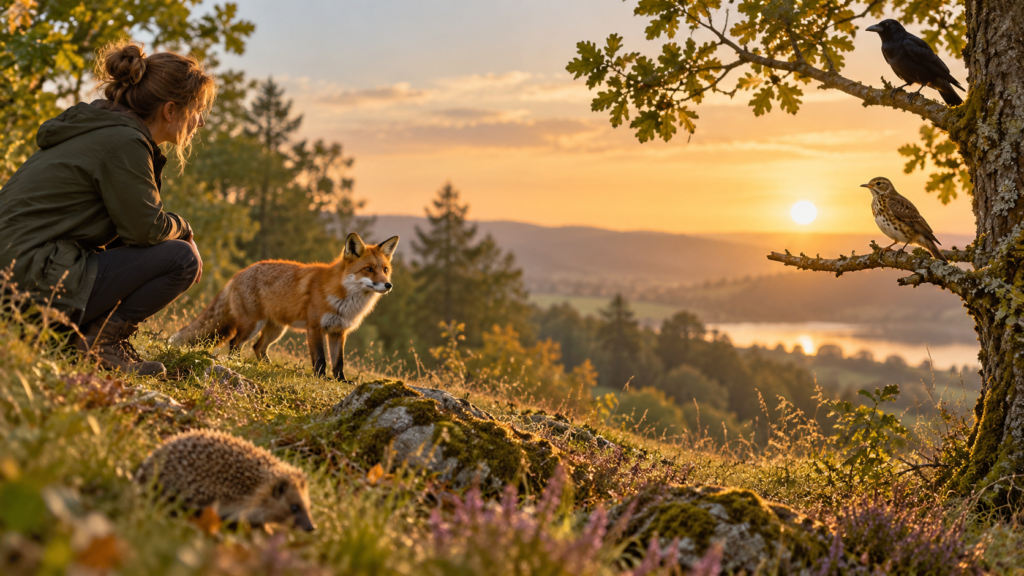
Do wild animals remember humans who have helped them? It’s a fascinating question that scientists are beginning to answer through research into animal intelligence, memory and recognition. From crows that recognise human faces to elephants with remarkable memories, the evidence suggests that some wildlife can remember individual people and their past experiences.
Could it possibly remember you?
It’s a question that has fascinated animal lovers for generations. Stories of rescued wildlife recognising their rescuers are heartwarming, but is there any science behind them?
The answer is more interesting than you might think.
Research suggests that some wild animals can recognise individual humans, remember previous encounters and change their behaviour depending on how those people treated them.
But does that mean they actually remember kindness?
Can Wild Animals Recognise Individual Humans?
For many wild animals, recognising a particular person could be a valuable survival skill.
After all, not every human represents the same level of danger.
One person might regularly disturb an animal’s habitat, while another might quietly pass by without causing any trouble.
Being able to distinguish between these individuals could help an animal decide whether to flee, remain hidden or continue its normal activities.
Scientists have discovered that several species can distinguish between humans using visual appearance, voices and other clues.
Some animals can even retain these memories for surprisingly long periods.
Crows: The Birds That Remember Human Faces
Crows are among the most impressive examples of animal memory.
Researchers at the University of Washington conducted experiments involving wild American crows and people wearing distinctive masks.
During the experiments, certain masks became associated with the unpleasant experience of being captured and handled.
Even years later, crows continued to react defensively when they encountered those particular faces.
The birds had apparently learned which human appearances represented danger.
But here is where the research becomes particularly interesting.
Further studies examining crow brain activity found that the birds responded differently to faces associated with threatening experiences and those associated with caretaking.
This suggests that crows can associate particular people with previous experiences and use those memories to guide their behaviour.
Could a crow remember someone who rescued it?
It’s certainly possible that a crow could remember a person associated with a positive experience. However, scientists cannot yet establish whether the bird would understand the event as an act of kindness in the human sense.
What we do know is that crows are far more observant than many people realise.
Ravens: Do They Remember Who Treated Them Fairly?
Ravens, close relatives of crows, are another group of birds with remarkable memories.
In one fascinating experiment, researchers investigated whether ravens could remember people who had treated them fairly during food exchanges.
Some experimenters reliably exchanged a less desirable food item for a preferred reward, while others did not.
When the ravens were later given a choice, they tended to favour the people who had previously behaved fairly.
Even more remarkably, the birds remembered these interactions after approximately a month.
Although this experiment involved ravens in a controlled research setting rather than wild rescue situations, it demonstrates an important ability.
Ravens can remember past interactions with individual people and use that information when deciding whom to approach.
That is a surprisingly sophisticated social skill.
Elephants: Extraordinary Memories and Human Recognition
Elephants have long been associated with remarkable memories, and scientific research suggests there is good reason for that reputation.
Their survival depends partly on remembering important places, social relationships and potential threats.
But can elephants distinguish between different humans?
Researchers working with African elephants in Kenya discovered that the animals responded differently to recordings of human voices.
The elephants could distinguish between vocal characteristics associated with groups of people who historically presented different levels of danger.
They also responded to differences associated with the speakers’ age and sex.
This ability may help elephants make better decisions about potential threats.
There are many moving accounts of elephants behaving gently towards familiar caretakers or returning to places where they previously received assistance.
However, such stories should be treated carefully.
Scientific evidence supports sophisticated recognition and memory in elephants, but proving that a wild elephant remembers a particular rescue and feels gratitude towards its rescuer is much more difficult.
Nevertheless, their ability to learn from experience is extraordinary.
Dolphins: Can They Recognise Familiar People?
Dolphins are well known for their intelligence, curiosity and complex social relationships.
Research has demonstrated that bottlenose dolphins can recognise one another through distinctive signature whistles.
These whistles play an important role in identifying individuals within their social groups.
But what about recognising humans?
Studies involving dolphins in human care have found that they can distinguish between familiar trainers and other people.
In one experiment, dolphins were able to identify their regular trainers using visual information, although clothing and body appearance appeared to be important clues.
Other research has shown that dolphins behave differently towards familiar humans depending on their previous experiences.
Stories sometimes describe wild dolphins approaching swimmers or helping people in distress.
While these accounts are intriguing, they do not automatically demonstrate that dolphins understand human emergencies or intentionally act out of compassion.
What science does show is that dolphins possess sophisticated abilities for learning, social recognition and remembering important relationships.
What About Foxes, Hedgehogs and Garden Birds?
You don’t need to travel to Africa or visit the ocean to observe the relationship between wild animals and humans.
Some of the most interesting examples could be happening in British gardens.
Foxes
Foxes are intelligent, adaptable animals that can learn which places and situations are relatively safe.
A fox that regularly encounters a person who behaves calmly may gradually become less nervous around them.
This could reflect habituation, where an animal learns that a repeated experience is not threatening.
It doesn’t necessarily mean that the fox feels affection towards the person.
Hedgehogs
Hedgehogs may become accustomed to familiar garden environments, including places where food, water and shelter are available.
However, a hedgehog returning to the same garden is not proof that it remembers the homeowner personally.
It may simply remember a reliable source of resources.
Garden Birds
Many garden birds learn where food is regularly available and can adjust their behaviour around people.
Some species are particularly observant, especially members of the crow family.
A bird that appears relaxed when a particular person enters the garden may have learned that their presence is not dangerous.
But recognising a familiar situation and recognising a specific individual are not necessarily the same thing.
Do Wild Animals Actually Feel Gratitude?
This is perhaps the most fascinating question of all.
Imagine an animal trapped in fencing, exhausted and frightened.
A person carefully frees it, and the animal escapes.
If that animal encounters the same person again, will it remember being rescued?
And if it does, will it feel grateful?
There are three important possibilities.
Recognition: The animal remembers the person or some distinguishing features.
Association: The animal connects that person with a particular experience, such as safety, food or reduced danger.
Gratitude: The animal understands that someone deliberately helped it and experiences an emotion comparable to human thankfulness.
Scientific research provides evidence for the first two abilities in several species.
The third is much harder to demonstrate.
Animals may experience positive emotions and form lasting associations without interpreting events in exactly the way humans do.
That doesn’t make their experiences any less fascinating.
It simply reminds us that animal intelligence may work differently from our own.
Can Animals Remember Someone After Several Years?
Some certainly can.
Research involving crows has demonstrated that they can remember human faces associated with threatening experiences for years.
Other animals, including elephants and dolphins, possess sophisticated long-term social memories.
However, memory abilities vary enormously between species.
How long an animal remembers something may depend on the importance of the experience, how frequently it occurs and whether remembering it provides a survival advantage.
A single dramatic encounter could potentially leave a stronger impression than an ordinary event.
But we should avoid assuming that every rescued animal will recognise its rescuer years later.
Should You Try to Make Friends With Wild Animals?
Although the idea of gaining a wild animal’s trust is appealing, the kindest thing we can usually do is allow wildlife to remain wild.
Animals that become overly comfortable around people can face additional dangers, including traffic, unsuitable food and encounters with humans who may not treat them kindly.
If you encounter an injured or distressed wild animal, the safest approach is to contact an appropriate wildlife rescue organisation for advice.
You can also help wildlife by providing suitable habitats, keeping gardens wildlife-friendly and reducing unnecessary disturbance.
Remember, an animal doesn’t need to approach you or show affection for your kindness to matter.
Sometimes the greatest gift we can give wildlife is the freedom to live naturally.
Frequently Asked Questions
Can a wild animal remember the person who rescued it?
Possibly. Some wild animals can recognise individual humans and remember previous interactions. However, recognising a rescuer is not necessarily the same as understanding that they were deliberately saved.
Do crows remember people who are kind to them?
Crows can recognise human faces and associate particular individuals with previous experiences. Research supports their ability to distinguish threatening from non-threatening people, although the meaning of kindness to a crow remains difficult to measure.
Do elephants remember people who helped them?
Elephants have sophisticated memories and can distinguish between human voices and other characteristics. However, individual rescue stories do not always provide scientific proof of long-term personal recognition or gratitude.
Can foxes recognise individual humans?
Foxes can learn from repeated encounters with people and may become more comfortable around familiar, non-threatening situations. Whether a particular fox recognises an individual person would require closer observation.
Do animals understand when humans are helping them?
Animals may learn that certain people or actions produce positive outcomes. Whether they understand the human intention behind those actions is much less certain.
Final Thoughts: Perhaps Kindness Is Remembered After All
The natural world is filled with animals whose memories are more sophisticated than we once imagined.
Crows can remember human faces. Ravens can recall fair treatment. Elephants can distinguish between different human voices, and dolphins can recognise familiar individuals.
These discoveries don’t prove that every rescued animal feels gratitude towards the person who helped it.
But they do reveal something wonderful.
Wild animals are not simply reacting to the world around them without thought or memory. Many are constantly learning, recognising patterns and drawing on past experiences.
Perhaps the fox that pauses when you walk into the garden isn’t showing affection.
Perhaps the bird that calmly watches you from a nearby branch isn’t thanking you.
But it is possible that, in its own way, an animal remembers that you were never a threat.
And sometimes, that is a beautiful thought in itself.
At GeoWild Designs, we believe that understanding wildlife is one of the best ways to appreciate and protect it. Explore more of our animal behaviour articles and discover the remarkable creatures that share our planet.