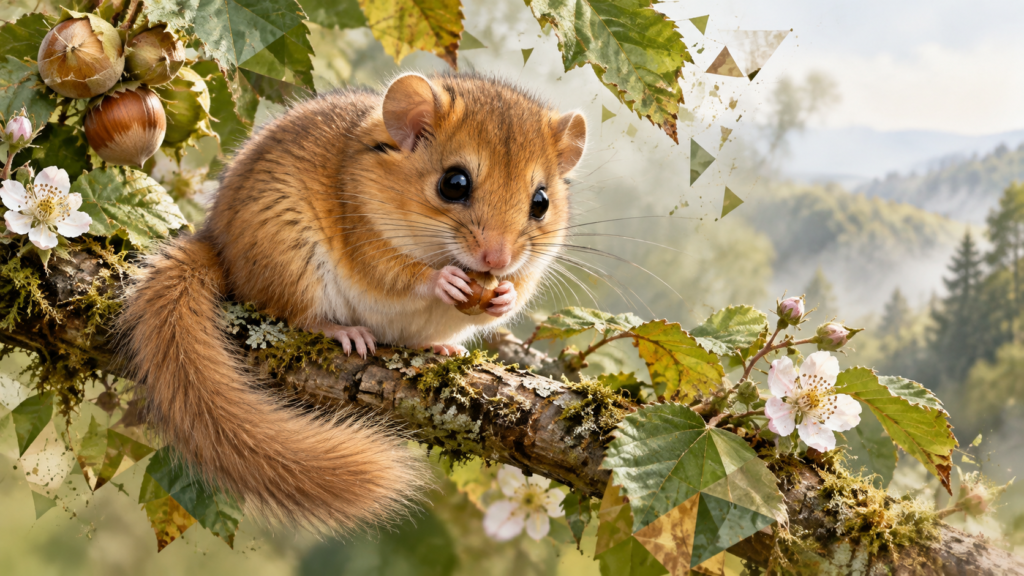
The Secret Life of Dormice: Tiny Sleepy Acrobats of the Woodland
With enormous dark eyes, golden-brown fur and a fluffy tail, the hazel dormouse looks almost like a storybook animal. Yet these tiny mammals are very real, and they lead surprisingly secretive lives in Britain’s woodlands and hedgerows.
Dormice spend much of their time above the ground, moving through tangled branches in search of flowers, insects, berries and nuts. They are also famous for sleeping — and not just during winter.
So where do dormice live? What do they eat? Why do they hibernate for so long? And just how rare are they in Britain?
What Is a Dormouse?
The hazel dormouse (Muscardinus avellanarius) is a small rodent native to Britain and parts of Europe.
Despite the name, dormice aren’t simply a type of ordinary mouse. They belong to a different family of rodents called Gliridae, which contains the dormice.
A hazel dormouse is easy to recognise if you’re fortunate enough to see one. It has warm golden or orange-brown fur, a pale underside, large black eyes, rounded ears and a furry tail.
That furry tail is one of the easiest ways to distinguish a dormouse from many of Britain’s other small rodents.
How Big Is a Dormouse?
Hazel dormice really are tiny.
An adult’s head and body are usually only around 6–9 centimetres long, with the tail adding roughly another 5–7 centimetres.
They generally weigh somewhere around 15–30 grams, although their weight changes throughout the year.
Before hibernation, dormice deliberately put on weight so they have enough stored energy to survive the winter months.
For an animal this small, getting through a long winter without eating is an impressive achievement.
Where Do Dormice Live?
Hazel dormice are strongly associated with woodland, particularly places containing a rich mixture of shrubs, trees and climbing vegetation.
They can also live in well-connected hedgerows and scrub.
The important thing isn’t simply the presence of hazel trees. Dormice need a varied habitat that provides different foods throughout the year.
They are remarkably agile climbers and often travel through branches and vegetation rather than crossing open ground.
This makes connected habitats particularly important. A continuous hedgerow, for example, can provide both food and a safe route between areas of suitable habitat.
Are Dormice Rare in the UK?
Unfortunately, hazel dormice have experienced a substantial decline in Britain and have disappeared from many areas where they once lived.
Habitat loss, deterioration and fragmentation are among the problems facing them.
When woodland or hedgerows become isolated, dormice can find it difficult to move safely between suitable habitats.
This is one reason traditional hedgerows and well-managed woodland are so valuable. To us, a hedge may simply mark the edge of a field. To a dormouse, it can be a feeding ground, shelter and a wildlife corridor all at once.
What Do Dormice Eat?
Dormice have a wonderfully varied seasonal diet.
Rather than relying on one food throughout the year, they take advantage of whatever nature is providing at the time.
During spring and summer they may eat flowers, pollen, nectar and insects. Later in the year, berries, fruits and nutsbecome increasingly important.
Hazelnuts are particularly famous as dormouse food.
In fact, experts can sometimes examine the way a hazelnut shell has been opened for clues that a dormouse has been feeding nearby.
By autumn, energy-rich foods are especially important because dormice need to build up fat reserves before hibernation.
Do Dormice Really Sleep a Lot?
Yes — their sleepy reputation is well deserved.
The word “dormouse” is associated with the idea of sleeping, and these little mammals certainly spend an extraordinary amount of their lives doing it.
They are predominantly nocturnal, so much of their activity takes place at night.
But dormice can also enter a state called torpor.
During torpor, an animal reduces its metabolic rate and body temperature to conserve energy. This can be useful during periods of cold weather or when food is difficult to find.
So a dormouse doesn’t reserve its energy-saving behaviour exclusively for winter.
When Do Dormice Hibernate?
In Britain, dormice generally hibernate through the colder part of the year, although the exact timing depends upon conditions.
Their hibernation can last for many months.
Interestingly, despite being excellent climbers during their active months, dormice usually hibernate at or close to ground level.
They create tightly constructed nests amongst vegetation, leaf litter or other sheltered places.
During hibernation their metabolism slows dramatically, allowing their stored body fat to sustain them until conditions improve.
This long hibernation is one of the most extraordinary aspects of dormouse life.
Where Do Dormice Sleep During Summer?
During their active season, dormice construct nests above ground amongst shrubs and trees.
These nests are often beautifully woven structures made from materials such as grasses, leaves, honeysuckle bark and other vegetation.
They may build different nests for different purposes, including breeding nests used by females raising young.
Because dormice are nocturnal, a secure daytime nest gives them somewhere sheltered to rest while the woodland around them is busy.
Do Dormice Live in Trees?
Dormice aren’t strictly tree-dwelling animals, but they are exceptionally well adapted to climbing.
Their feet allow them to grip branches, while their long furry tails help with balance.
They can move through surprisingly thin twigs and tangled vegetation.
Instead of thinking of a woodland only in terms of its trees, imagine the whole network of branches, brambles, honeysuckle and shrubs as a three-dimensional pathway.
For a dormouse, that network can function almost like a system of roads.
Can Dormice Jump?
Yes. Dormice can jump between branches and are extremely agile for such small animals.
However, climbing and carefully moving through connected vegetation are enormously important parts of their behaviour.
Their ability to negotiate fine branches helps them reach food while avoiding spending unnecessary time on exposed ground.
What Animals Eat Dormice?
Being small inevitably means having predators.
Dormice may fall prey to animals including owls and other birds of prey, as well as mammalian predators.
Their nocturnal lifestyle, climbing ability, camouflage and tendency to remain within dense vegetation all provide some protection.
However, hibernation presents another vulnerable period because the dormouse is inactive for such a long time.
How Long Do Dormice Live?
For such tiny rodents, dormice can live surprisingly long lives.
Some individuals can survive for several years, although many will not reach the maximum possible lifespan in the wild.
One reason they may live longer than we might expect from such a small mammal is the considerable amount of time they spend in torpor and hibernation, when their metabolism is greatly reduced.
Do Dormice Have Babies Every Year?
Dormice normally breed during their active season.
A female constructs a breeding nest where she gives birth to a small litter of young. The babies are born tiny and dependent on their mother before gradually developing the fur, strength and climbing skills needed for an independent life.
Timing matters enormously.
Young born later in the season have less time to grow and accumulate the fat reserves they need before their first winter hibernation.
Are Dormice Dangerous?
No. Hazel dormice pose no meaningful danger to people.
They’re shy wild animals and generally try to avoid us.
They also shouldn’t be confused with household mice. Finding evidence of dormice in woodland or a hedgerow doesn’t mean they’re going to move into your kitchen.
In Britain, hazel dormice are also legally protected, so they shouldn’t be caught, handled or disturbed without appropriate authority.
Can You Keep a Dormouse as a Pet?
A wild hazel dormouse is not a pet.
Because of its protected status in Britain, deliberately capturing or disturbing one can be an offence except under appropriate licensing or circumstances permitted by law.
And that’s really how these animals should be appreciated — as part of Britain’s native wildlife rather than something to take home.
What’s the Difference Between a Dormouse and a Mouse?
At first glance, the two can look similar because both are tiny rodents.
Look more closely and there are some noticeable differences.
A hazel dormouse has a thick furry tail, whereas the tail of a typical mouse is much less furry. Dormice also have particularly large dark eyes, rounded ears and golden-brown fur.
Their lifestyles differ too. Hazel dormice are highly accomplished climbers and undergo prolonged winter hibernation.
Why Are Hazel Dormice Important?
Dormice are much more than exceptionally cute woodland residents.
Their presence can tell us something about the quality and connectivity of a habitat. A landscape capable of supporting dormice often contains the diverse woodland structure, shrubs, flowers and interconnected vegetation that benefit many other species too.
Protecting dormice therefore isn’t only about protecting one tiny mammal.
It means protecting the living network of woodland and hedgerows around them.
How Can We Help Dormice?
One of the most valuable things we can do is protect and reconnect suitable habitat.
Maintaining native hedgerows, allowing a variety of plants to grow, managing woodland sensitively and avoiding unnecessary fragmentation can all contribute to healthier landscapes.
Even apparently untidy areas can have tremendous wildlife value.
A tangle of bramble and honeysuckle may not look particularly special to us, but to a dormouse it could provide food, shelter and a safe route through its territory.
A Tiny Animal With an Extraordinary Life
It’s easy to understand why the dormouse has captured people’s imaginations.
It weighs little more than a handful of coins, spends its nights performing acrobatics amongst woodland branches and can disappear into hibernation for a remarkable portion of the year.
Yet behind those huge black eyes and storybook appearance is an animal exquisitely adapted to the changing seasons.
The hazel dormouse is also a reminder that wildlife doesn’t necessarily need vast wildernesses to survive. Sometimes the connections between habitats — an old hedge, a strip of scrub or an unbroken line of woodland — can be just as important.
And somewhere amongst those branches, while the rest of us are asleep, one of Britain’s smallest woodland mammals may be waking up to begin its night.
Discover the Dormouse at GeoWild Designs
If the hazel dormouse has won you over, you can also discover my GeoWild dormouse design, inspired by the beauty and character of this tiny woodland acrobat. The design combines realistic wildlife detail with GeoWild’s subtle geometric style and is available across selected wall art and clothing in the GeoWild Designs collection.
Bring a Little Woodland Wildlife into Your Home
If the hazel dormouse has captured your heart, why not explore our GeoWild dormouse designs? Inspired by the beauty and character of this tiny British woodland animal, our dormouse artwork is available across a selection of wall art and clothing. Explore the dormouse collection here and discover a little piece of woodland wildlife for your home or wardrobe.