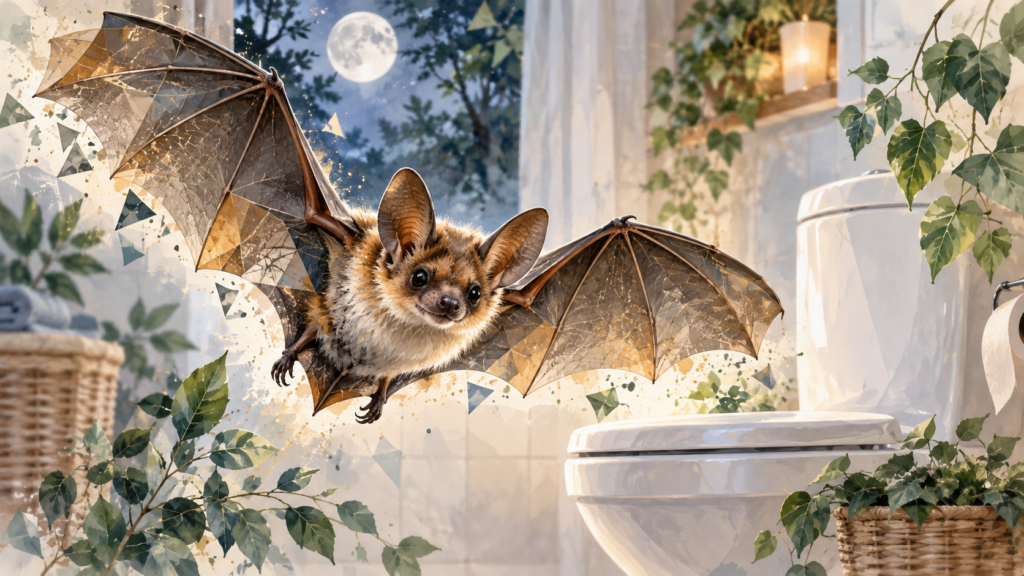
Imagine walking into your bathroom late at night and discovering a bat somewhere you would never expect to find one — perhaps clinging to a curtain, sitting in the bath or, even more surprisingly, inside the toilet.
It sounds like the beginning of a horror film, but strange encounters like these really do happen. They inevitably leave people wondering the same thing: how on earth did the bat get there?
Did it fly down the chimney? Crawl through a tiny crack? Could it actually have travelled through the plumbing and emerged from the toilet?
Bats are remarkably good at finding their way into spaces we would never imagine they could enter. But when one suddenly appears inside a house, the explanation is usually much less alarming than it first seems.
How Do Bats Get Into Houses?
The most important thing to understand is that bats don’t usually enter houses because they are interested in people.
A house simply contains many of the things a bat might look for in a natural roost: shelter, darkness, warmth and protection from predators and bad weather.
In the wild, bats may roost in caves, hollow trees, cracks in rocks and beneath loose bark. Buildings can provide surprisingly similar spaces.
Depending on the species, bats can exploit very small openings around:
- roof tiles
- eaves and soffits
- gaps around windows
- chimneys
- vents
- flashing
- gaps where pipes or cables enter a building
- damaged roofing
- cracks in walls
Once inside the structure, a bat may find its way into a loft, wall cavity or roof space without ever entering the rooms where people live.
Occasionally, however, one takes a wrong turn.
How Can a Bat Suddenly Appear Inside a Room?
If you’ve never seen a bat inside your house before, its sudden appearance can seem impossible.
But it may have entered through an open door or window while hunting insects outside. A bat flying after a moth, for example, could accidentally cross through an open window.
Another possibility is that the bat was already somewhere within the building.
A bat roosting in a roof space or wall cavity may accidentally find an opening leading into the living area rather than outside.
Young bats can be particularly prone to mistakes as they begin flying and exploring their surroundings.
This can result in the rather surreal experience of a bat suddenly flying around a bedroom, kitchen or bathroom.
Why Do Bats Sometimes Turn Up in Bathrooms?
Bathrooms seem like particularly strange places to encounter bats, but there are several possible explanations.
A bathroom window may have been left open during the evening. There may also be small gaps around pipes, roof spaces or ventilation systems that connect with areas bats can access.
Bathrooms can also contain smooth surfaces that make an accidental visitor very noticeable. A bat that would disappear into the clutter of another room may end up clearly visible in a bath, basin or toilet.
And this brings us to the question that causes the most alarm.
Can Bats Really Come Up Through a Toilet?
The idea of a bat swimming through the sewer system, navigating the plumbing and suddenly emerging from the toilet is certainly memorable.
Fortunately, that is not the most likely explanation when a bat is discovered in a toilet.
Modern toilets contain a water-filled trap that acts as a barrier between the toilet bowl and the sewer system. Travelling through that system would be an extremely difficult and unnatural route for a bat.
Bats are capable of swimming if necessary, but they aren’t aquatic animals and they don’t normally travel around through water-filled pipes.
So if you find a bat in a toilet, it is far more likely that the bat entered the room another way and subsequently ended up in the toilet bowl.
It may have fallen in, attempted to drink, become exhausted or simply landed somewhere from which it couldn’t easily escape.
In other words, finding a bat in a toilet doesn’t necessarily mean it arrived through the toilet.
Can Bats Get Through Drains or Pipes?
This is slightly different from asking whether they can swim through a toilet’s plumbing.
Some buildings contain larger pipes, vents, ducts and openings that aren’t permanently filled with water. If these connect with the outside or with a roof space, they could potentially provide a route through a building.
That doesn’t mean bats routinely travel through household plumbing.
If a bat repeatedly appears in a bathroom, it would be more sensible to investigate gaps around the building, roof spaces, vents and other possible entry points rather than immediately assuming it is travelling through the drains.
How Small a Gap Can a Bat Get Through?
This is where bats become particularly impressive.
Some species can squeeze through surprisingly narrow gaps because their bodies are small and flexible.
A gap that looks insignificant to us may therefore be perfectly usable by a bat.
This is one reason a homeowner may insist that there is “absolutely no way” a bat could have entered the building — only for a tiny opening to eventually be discovered beneath a roof tile or around the eaves.
Bats don’t need an entrance that looks like a doorway. Sometimes a narrow crack is enough.
Does Finding One Bat Mean You Have a Colony in Your House?
Not necessarily.
A single bat inside a room may simply be a lost visitor that entered through an open window.
However, repeated sightings deserve more attention.
Other possible signs of bats using a building can include bats regularly emerging from the same area around dusk, sounds coming from a roof or wall space, or droppings appearing beneath a particular roosting point.
It’s important not to immediately seal an opening if you suspect bats are using it.
You could accidentally trap animals inside.
There is another particularly important reason for being cautious in the UK.
Bats Are Protected in the UK
All bat species in the UK and their roosts receive legal protection.
That means you shouldn’t simply block entrances, destroy a roost or attempt to remove a colony yourself.
Interestingly, the protection of a bat roost doesn’t simply disappear when the bats temporarily leave it. Because many bats return to particular roosting sites, places used as bat roosts can remain legally protected even when bats aren’t visibly present at that moment.
If you believe bats are living within your property, specialist advice should therefore be sought before carrying out work that could disturb them or block their access.
Are Bats Dangerous If They Get Into Your House?
For most people, the biggest problem caused by a bat flying around indoors is panic — for both the person and the bat.
The bat isn’t flying around the room trying to attack you.
It is usually attempting to work out where it is and how to escape.
Bats have sophisticated echolocation abilities, but an unfamiliar indoor environment filled with furniture, curtains, walls and frightened humans is very different from flying through open countryside.
That said, bats are wild animals and shouldn’t be handled casually.
Like any frightened wild animal, a bat may bite if it feels threatened or is picked up. In the UK, a very small number of bats can carry rabies-related viruses, which is another reason to avoid direct handling and seek appropriate advice following a bite or scratch.
Will a Bat Get Tangled in Your Hair?
This is one of the most persistent bat myths.
Bats aren’t interested in flying into people’s hair.
Their echolocation allows them to detect and avoid objects with extraordinary precision.
If a bat flies close to you, it may simply be navigating the room or possibly following insects. From our perspective, a fast-moving bat passing nearby can feel alarmingly close, but that doesn’t mean it is aiming for your head.
Your hair is not an attractive bat destination.
What Should You Do If You Find a Bat Inside?
The first priority is to remain calm and keep pets and other people away from the bat.
If the bat is flying around, avoid chasing it or trying to knock it down. Where appropriate, giving it a clear route outside may allow it to leave by itself.
If the bat is grounded, injured, trapped or unable to fly, specialist wildlife advice should be sought rather than simply picking it up with bare hands.
In the UK, organisations such as the Bat Conservation Trust can provide guidance about what to do when a bat is found indoors.
If there has been a bite, scratch or possible direct exposure, medical advice should also be sought promptly.
Why Would a Bat Want to Live in a House?
From a bat’s perspective, parts of our houses can be excellent real estate.
Roof spaces and wall cavities can provide warmth and shelter while keeping bats hidden from many predators.
Different species also have different roosting requirements. Some may prefer tiny crevices, while others use larger roof spaces.
And because bats can return to established roosting areas year after year, a building may quietly accommodate bats for a very long time without the people living there ever knowing.
In fact, many householders only discover their unexpected neighbours when building work begins or an individual bat accidentally enters a room.
Why Don’t We Notice Bats More Often?
Bats are masters of living alongside us without attracting much attention.
Most British bats are small, they are active primarily when we’re less likely to be outside watching them, and many spend daylight hours tucked into hidden crevices.
A house could therefore provide a roosting site while its human occupants remain completely unaware.
At dusk, the bats emerge, feed on insects and later return to their hidden roost.
From their perspective, they’re simply using another feature of the landscape.
What If a Bat Keeps Appearing in the House?
One unexpected bat may be an accident.
Repeated appearances are different.
If bats regularly enter the living areas of a house, there may be a route connecting their roosting area with the rooms below. Alternatively, there could be an external opening that repeatedly allows bats inside.
Because of their protected status, this isn’t something that should be solved by simply filling every visible hole.
Specialist advice can help determine whether bats are actually roosting in the building and how the problem can be addressed legally and safely.
Bats Aren’t Trying to Invade Our Homes
Finding a bat in your bedroom is surprising.
Finding one in your bathroom is stranger still.
And finding one sitting in your toilet is probably an experience you’ll be telling people about for years.
But these encounters reveal something fascinating about bats.
They have adapted extraordinarily well to a world increasingly dominated by human buildings. Roofs can imitate caves and tree cavities. Tiny gaps can provide entrances to warm, protected spaces. Gardens and streetlights can provide abundant insects nearby.
Occasionally, the boundaries between our homes and theirs become blurred.
So if someone discovers a bat in their toilet, the most likely explanation isn’t a daring underwater journey through miles of sewer pipes.
It’s probably something much simpler.
The bat got into the house — and then, just like its extremely surprised human host, ended up somewhere it never intended to be.
Need Help With a Bat?
If you’ve found a bat in your home, discovered what you think may be a bat roost, or simply want to learn more about these fascinating animals, the Bat Conservation Trust provides expert information and advice. Their website includes guidance on what to do if you find a bat, how to get help with an injured or grounded bat, and information about bats and their protected roosts in the UK. You can visit the Bat Conservation Trust website for further advice and support.