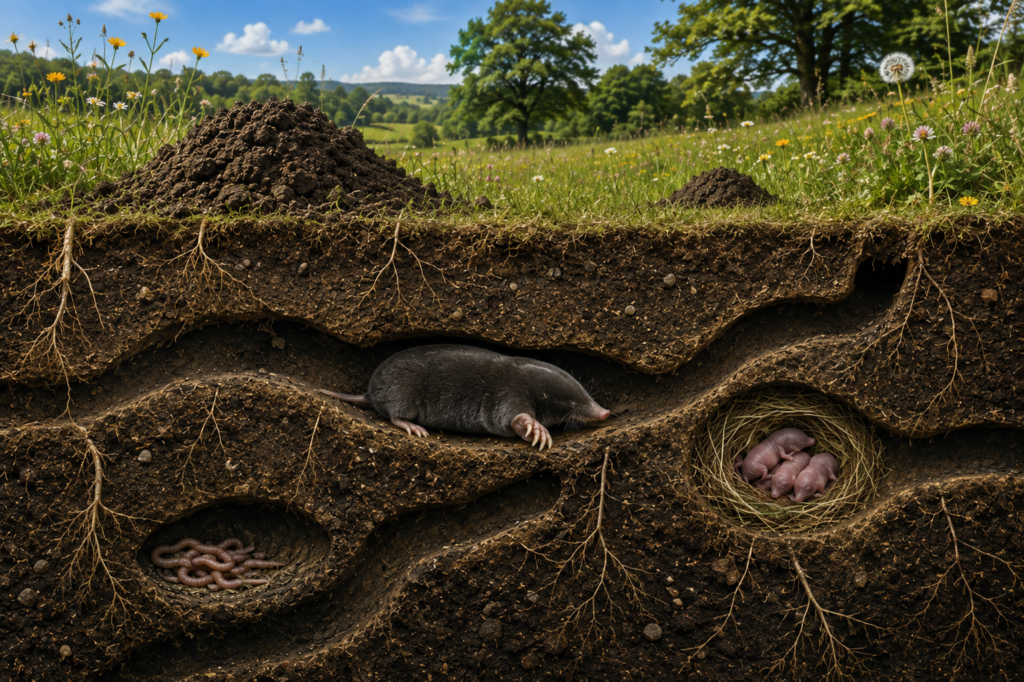
The secret life of moles is something most of us never get to see, but there is a good chance you have seen the evidence they leave behind.
A neat lawn can seemingly change overnight, with fresh mounds of dark soil appearing across the grass. In fields and meadows, lines of molehills can stretch surprisingly long distances. Yet the animal responsible is almost never anywhere to be seen.
That’s because the European mole (Talpa europaea) spends almost its entire life beneath our feet.
Hidden below gardens, fields and woodland is a surprisingly complicated world of tunnels, feeding routes and nesting chambers. Moles are specially adapted for life underground, where they hunt, sleep and even raise their young largely out of sight.
So what is actually happening down there?
Let’s enter the secret underground world of one of Britain’s most familiar — yet rarely seen — mammals.
What Does a Mole Look Like?
A mole looks rather unusual because almost every part of its body has evolved to make life underground easier.
European moles have cylindrical bodies covered in short, velvety, usually dark fur. Their most striking feature is their enormous front feet. These broad, spade-like paws have powerful claws and are perfectly suited to pushing through soil.
Their ears aren’t externally visible and their eyes are tiny. An adult’s body is generally around 11–16 cm long, excluding its short tail, and males tend to be larger than females.
Those oversized paws might look cumbersome above ground, but underground they turn a mole into an extremely capable excavator.
Are Moles Really Blind?
This is probably one of the biggest myths about moles.
No, moles aren’t blind.
They do have extremely small eyes, which makes sense for an animal that spends most of its life in darkness. Their eyesight isn’t their most important sense, but their eyes are functional.
Instead, moles rely heavily on other senses to understand their surroundings.
Their sensitive snout is particularly important when investigating the dark tunnels around them. Their bodies are essentially designed for a world where being able to see long distances simply isn’t very useful.
What Is Underneath a Molehill?
A molehill isn’t actually a mole’s house.
It’s largely waste soil from excavation.
As a mole digs and expands its underground tunnel system, the loose earth has to go somewhere. The mole pushes that soil along its tunnels and upwards through shafts until it reaches the surface.
The resulting pile is the familiar molehill.
This means that the tunnels themselves can be some distance below the molehills you see on the surface.
And what lies beneath can be far more extensive than you might imagine.
What Do Mole Tunnels Look Like?
Think less of a single burrow and more of an underground road network.
Moles create permanent and temporary tunnels at different depths.
Some shallow tunnels are associated with feeding near the surface, while more established tunnels can form extensive networks. The Mammal Society reports that permanent systems can extend for hundreds of metres. Deeper tunnels become particularly important during cold or dry conditions.
A mole therefore doesn’t necessarily spend every day endlessly digging completely new tunnels.
Established passages can be revisited repeatedly as the mole searches for food.
Some may even continue to be used by successive generations.
So beneath an ordinary-looking patch of grass could be a tunnel network that has existed far longer than the newest molehill suggests.
Why Do Moles Build So Many Tunnels?
The tunnels aren’t simply somewhere for the mole to live.
They’re also part of its hunting strategy.
Earthworms and other small invertebrates move through the surrounding soil and enter the tunnels. The mole patrols its underground network looking for them.
In effect, parts of the tunnel system act rather like a huge underground feeding ground.
And moles need plenty of food.
According to the Mammal Society, an 80g mole may need around 50g of earthworms in a day.
That helps explain why such a small animal invests so much energy in maintaining an extensive network of tunnels.
What Do Moles Eat?
Earthworms are the star of the menu.
Moles also eat insect larvae and other underground invertebrates, with the balance changing through the year.
This also clears up another common misconception.
Moles aren’t digging through your garden because they want to eat your plants.
They are primarily hunting animals.
In fact, some of the insect larvae they consume are species gardeners and farmers might otherwise consider pests. The Wildlife Trusts notes that moles can help control underground grubs that feed on crops.
Do Moles Really Store Earthworms?
Here’s where mole behaviour becomes particularly fascinating.
A mole doesn’t necessarily eat every worm as soon as it catches it.
Moles have been recorded creating underground stores of live earthworms.
The mole bites the worm near its head, immobilising it without immediately killing it, and stores it for later.
And we’re not talking about two or three spare worms.
The Mammal Society reports that as many as 470 earthworms have been found in a single storage chamber.
It’s essentially a mole’s underground larder.
Where Do Moles Sleep?
Somewhere within that complicated tunnel network is another important feature: a nest.
Moles construct roughly spherical nesting chambers and line them with dry plant material.
These provide somewhere to sleep and, for females, somewhere to raise their young.
So the underground world of a mole isn’t just a collection of random passages.
It contains areas serving different purposes — routes for travelling and feeding, deeper tunnels, nesting chambers and sometimes food stores.
Do Moles Live Together?
For most of the year, moles are solitary animals.
Males and females generally occupy their own territories rather than living together as families or colonies.
That changes during the breeding season.
Males expand their ranges and travel in search of females. Once mating is over, however, mole life returns to being largely solitary.
This means that a garden covered with molehills doesn’t necessarily contain dozens of moles.
A surprisingly large amount of digging can be associated with a relatively small number of animals.
When Do Moles Have Babies?
Moles usually produce a litter in spring.
A typical litter contains around three or four young, which are born naked. Their fur begins developing at around two weeks, their eyes open at roughly three weeks, and they are weaned at about four to five weeks old.
For their first weeks, the young remain safely inside the underground nest.
Eventually, though, they have to leave.
And that’s when life becomes considerably more dangerous.
Do Moles Ever Come Above Ground?
They do — although seeing one is unusual.
Young moles eventually leave their mother’s territory and have to establish territories of their own. Some of this dispersal can take place above ground.
Adult moles may also venture onto the surface occasionally. People’s Trust for Endangered Species notes that they may come above ground looking for food, particularly during hot, dry spells.
Above ground, however, a mole loses many of the advantages that make it so successful underground.
Potential predators include tawny owls, buzzards and stoats, while domestic cats and dogs can also kill moles.
So disappearing back beneath the soil is usually the safer option.
Are Moles Active at Night?
Moles don’t live by quite the same day-and-night routine that we do.
After all, it’s dark in a mole tunnel whether it’s midday or midnight.
They can be active during both the day and night and throughout the year.
Their activity is influenced more by feeding and environmental conditions than by whether the sun is shining above them.
So while you’re walking across a quiet lawn in the middle of the afternoon, a mole could be busily hunting just beneath your feet.
How Do Moles Dig So Well?
Take another look at a mole’s front feet and the answer becomes obvious.
They are extraordinarily well adapted for digging.
The front limbs are broad and powerful, with large claws. Instead of digging in the way a dog might scrape at the ground, a mole can force soil aside as it drives itself forward.
Its body shape also helps it move through confined spaces, while its short velvety fur is suited to travelling through tunnels.
To us, the underground environment would be dark, cramped and almost impossible to navigate.
To a mole, it’s home.
Are Moles Good for Your Garden?
This is where opinions about moles tend to differ.
If you’ve spent years creating a perfectly smooth lawn, waking up to a line of fresh molehills may not make you particularly enthusiastic about your new resident.
Moles can disturb roots while tunnelling, and molehills can create problems in agricultural land.
But they aren’t simply destructive pests.
Their tunnelling can aerate and help drain soil, while their diet includes insect larvae that can damage plants.
Moles are part of the underground ecosystem, and their digging physically changes the soil around them.
The molehill we notice is therefore only the visible evidence of a much larger process happening below ground.
Where Do Moles Live in Britain?
European moles are widespread across mainland Britain and can occur in gardens, farmland, grassland, woodland and other places where suitable soil allows them to dig and there is enough prey.
Interestingly, though, moles are absent from Ireland.
They can be difficult to survey precisely because the animals themselves are so rarely seen. Fortunately, they leave one rather obvious calling card.
Those unmistakable piles of freshly excavated earth make molehills one of Britain’s easiest mammal field signs to recognise.
How Long Does a Mole Live?
Life underground doesn’t guarantee a long life.
Most moles don’t survive beyond about three years, although individuals can potentially live for as long as six.
During that relatively short lifetime, however, a mole can construct and maintain an extraordinary subterranean world that most of us will never see.
A Hidden World Beneath Our Feet
Perhaps the most remarkable thing about moles is how little of their lives we ever witness.
We see the molehills.
We sometimes complain about the lawn.
But the animal responsible may be somewhere beneath us, travelling along an established tunnel, searching for earthworms, sleeping in a plant-lined nest or adding another passage to a network stretching for hundreds of metres.
The mole isn’t simply an animal that digs holes.
It is a highly specialised underground hunter living in a hidden landscape that exists alongside our own.
And the next time a fresh molehill appears overnight, it might be worth looking at it slightly differently.
It’s not just a pile of soil.
It’s a tiny window into an entire world beneath your feet.
For Young Wildlife Explorers
Fascinated by what moles get up to underground?
Children can continue exploring the secret world beneath their feet with our Milo the Mole Activity Pack, a printable wildlife activity pack featuring mole-themed puzzles, activities and nature exploration.