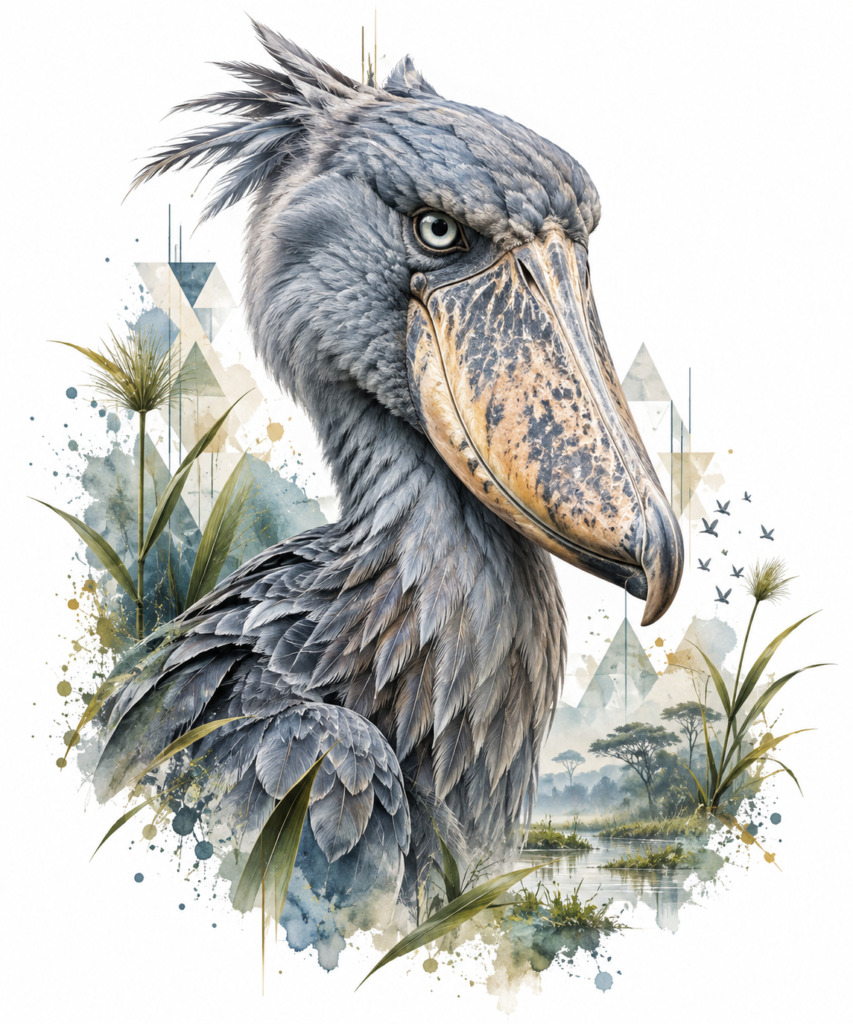
The Shoebill Stork: Everything You Need to Know About This Prehistoric-Looking Bird
Few birds look quite as extraordinary as the shoebill.
Standing motionless in an African wetland, with enormous feet, grey feathers, piercing eyes and a bill that seems almost too large for its head, the shoebill can look like something that has wandered straight out of prehistoric times.
Its appearance has made it increasingly famous online. Photographs and videos often show shoebills staring directly at people, standing completely still or making an astonishing machine-gun-like noise with their bills.
But what exactly is a shoebill? Is it really a stork? Can it fly? Is it dangerous? What does it eat? And are shoebills really related to dinosaurs?
Here is everything you need to know about one of the world’s most remarkable birds.
What Is a Shoebill?
The shoebill’s scientific name is Balaeniceps rex.
It is a very large wetland bird found in tropical areas of eastern and central Africa.
There is only one living species of shoebill, and it belongs to its own family, Balaenicipitidae.
Perhaps its most distinctive feature is the enormous bill from which it gets its name.
Seen from the side, the bill resembles an oversized shoe or traditional Dutch clog. It can measure around 30 cm (one foot) long and ends in a sharp hook.
It’s an extraordinary piece of natural engineering — and an extremely effective hunting tool.
Is a Shoebill Really a Stork?
Despite frequently being called the shoebill stork, the answer is no.
For many years its unusual mixture of features made the shoebill difficult to classify. Its long legs and wetland lifestyle certainly make it look rather like a stork or heron.
Modern genetic evidence, however, shows that shoebills are much more closely related to pelicans.
So although you’ll often hear the name “shoebill stork”, simply shoebill is more scientifically accurate.
Why Is It Called a Shoebill?
This one is fairly straightforward.
Look at the bird’s enormous bill from the side and you’ll see where the name came from.
Its huge, broad bill resembles a shoe — particularly an old-fashioned wooden clog.
But this strange bill isn’t just for appearance.
The edges are sharp and the end has a powerful hook, helping the bird grip and kill slippery prey.
Where Do Shoebills Live?
Shoebills are found in Africa, particularly in extensive freshwater wetlands.
Their range extends from South Sudan southwards towards Zambia, with populations occurring in countries including Uganda, Ethiopia, Rwanda, the Democratic Republic of the Congo, Tanzania and Zambia.
They favour large freshwater swamps containing vegetation such as:
- papyrus
- reeds
- grasses
- floating vegetation
- shallow open water.
These wetlands provide both cover and suitable hunting grounds.
Shoebills are particularly associated with habitats containing lungfish, one of their favourite foods.
How Tall Is a Shoebill?
This is one of those animals whose size can be difficult to appreciate until a person is standing somewhere nearby.
Shoebills can reach approximately 1.5 metres (five feet) in height. BirdLife reports a maximum size of around 152 cm.
That means a particularly tall shoebill could stand roughly chest-high against many adults.
Females weigh around 4.9 kg, while males can reach approximately 5.6 kg.
Their height, enormous bill and upright posture make them appear even more imposing.
Why Do Shoebills Look Prehistoric?
There’s something unmistakably prehistoric about a shoebill.
Part of the effect comes from the combination of its:
huge bill, intense eyes, grey plumage, enormous body, long legs and habit of standing completely motionless.
The shoebill’s appearance has therefore inspired plenty of comparisons with prehistoric animals.
That doesn’t mean modern shoebills themselves have been wandering around unchanged since dinosaur times.
But, like all living birds, shoebills ultimately belong to the evolutionary lineage that descended from theropod dinosaurs.
So calling one a “living dinosaur” makes a great description of its appearance — but shouldn’t be taken literally.
What Do Shoebills Eat?
Shoebills are carnivores.
Fish make up an important part of their diet, particularly lungfish.
They can also eat:
catfish, bichirs, tilapia, frogs, water snakes, turtles, monitor lizards and other aquatic animals.
And this leads us to one of the more surprising questions people ask about them.
Do Shoebills Really Eat Crocodiles?
There is some truth behind this extraordinary claim.
Shoebills have been recorded taking young crocodiles as prey.
That doesn’t mean shoebills are wandering around attacking fully grown Nile crocodiles.
They aren’t.
But a sufficiently small young crocodile can potentially become prey for a shoebill.
The fact that this enormous bird is capable of catching even a baby crocodile tells you something about just how formidable that bill is.
How Does a Shoebill Hunt?
Shoebills are masters of patience.
Rather than constantly chasing prey, they often use a stand-and-wait strategy.
A bird may remain remarkably still while watching the water.
When suitable prey comes within striking distance, the shoebill suddenly launches its head and neck forwards and downwards.
The transformation from motionless statue to attacking predator can happen extremely quickly.
Their habitat helps them too. Fish living in poorly oxygenated swamp water may have to come towards the surface to breathe, giving the waiting shoebill an opportunity to strike.
BirdLife reports that shoebills can remain still for hours and that around 60% of their hunting strikes may result in a kill.
Why Do Shoebills Stand So Still?
It isn’t because they’re lazy.
Remaining motionless is part of their hunting strategy.
Movement could alert fish or other animals beneath the water. By standing almost perfectly still, the shoebill can wait until its prey moves into striking range.
This behaviour also contributes enormously to their slightly eerie reputation.
A five-foot-tall bird silently staring across a swamp without moving can be quite an intimidating sight.
Why Do Shoebills Stare at People?
Those famous shoebill eyes have helped turn the species into an internet favourite.
Their forward-looking stare can appear extraordinarily intense to us.
But it is easy to interpret an animal’s facial features as if they represented human emotions.
A shoebill looking towards somebody isn’t necessarily angry, threatening them or plotting its next move.
Its facial structure, pale eyes and large bill simply create an unusually stern expression.
In other words, the shoebill looks intimidating even when it isn’t doing anything intimidating at all.
Are Shoebills Dangerous to Humans?
Their appearance certainly suggests they could be.
A shoebill possesses a huge bill designed for catching and killing sizeable prey, so it deserves the same respect as any large wild animal.
However, humans are not normal shoebill prey.
There is no reason to regard wild shoebills as animals that hunt people, and zoological accounts describe them as relatively docile towards humans.
That doesn’t mean anyone should approach or interfere with a wild shoebill.
Wildlife should always be given space, particularly around nests and young.
Why Do Shoebills Make a Machine-Gun Sound?
This is perhaps one of the strangest things about an already strange bird.
Shoebills perform a behaviour known as bill clattering.
They rapidly strike the two halves of their enormous bill together.
The resulting sound is surprisingly loud and has frequently been compared with the noise of a machine gun.
BirdLife describes this startling bill-clattering behaviour as part of the shoebill’s communication.
Hearing one before seeing the bird would certainly be an unforgettable wildlife experience.
Can Shoebills Fly?
They absolutely can.
Looking at their enormous bodies and long legs, you might reasonably wonder how.
But shoebills are capable flyers and can soar using rising air currents. When flying, they pull their neck backwards towards the body rather than stretching it straight out.
So despite their somewhat cumbersome appearance on the ground, shoebills are perfectly capable of taking to the air.
Do Shoebills Migrate?
Shoebills are generally considered non-migratory or largely sedentary when food and habitat conditions remain suitable.
They may, however, make local or seasonal movements between nesting and feeding areas as conditions change.
They therefore aren’t long-distance migrants in the way many familiar European birds are.
Are Shoebills Solitary?
Very much so.
Shoebills tend to be solitary birds.
Even breeding pairs apparently value their personal space. BirdLife reports that individuals may forage at least 20 metres apart and that members of a breeding pair can feed at opposite ends of their territory.
It’s rather appropriate for an animal whose entire appearance seems to say:
“Please leave me alone.”
Do Shoebills Mate for Life?
Shoebills form pairs during breeding, and both parents take part in nesting and caring for their young.
They build a large nest, often on floating vegetation within the wetland.
The female may lay up to three eggs, and both adults help guard, feed and protect the chicks.
However, describing shoebills simply as animals that “mate for life” goes further than the available evidence comfortably supports.
It is safer to say they form breeding pairs and cooperate extensively in raising young.
How Many Babies Do Shoebills Have?
This is one of the harsher aspects of shoebill life.
A female may lay more than one egg, but typically only one chick ultimately survives to be raised.
When several chicks hatch, the strongest usually receives the greatest parental investment. Younger chicks may not survive unless something happens to the older chick.
For a species with such a small population, this naturally slow reproductive rate makes successful breeding particularly important.
How Long Do Shoebills Live?
Shoebills are relatively long-lived birds.
BirdLife gives their lifespan as up to around 35 years, while other zoological records also report individuals reaching roughly 36 years.
That means a shoebill successfully reaching adulthood could potentially spend decades patrolling the African wetlands.
Are Shoebills Endangered?
The shoebill is currently classified as Vulnerable, rather than Endangered.
But that certainly doesn’t mean the species is safe.
BirdLife estimates that only around 3,300–5,300 mature individuals remain, with the population declining.
That’s an extraordinarily small number for such an iconic bird.
Why Are Shoebills Threatened?
Unfortunately, several pressures are working against them.
Important threats include loss and degradation of wetland habitat, disturbance around nesting areas, hunting, fires, agricultural development, drought and illegal capture for the live-bird trade.
The shoebill’s dependence on extensive freshwater wetlands makes habitat conservation particularly important.
Protecting a shoebill doesn’t simply mean protecting one bird.
It means protecting the entire wetland ecosystem on which that bird depends.
How Many Shoebills Are Left in the Wild?
Population estimates are difficult because shoebills live in enormous wetlands that can be extremely difficult for people to survey.
Current BirdLife figures estimate approximately 3,300–5,300 mature shoebills remain in the wild.
Numbers are believed to be declining.
This is another reason responsible ecotourism, wetland protection and action against illegal wildlife trade are so important.
Can You Keep a Shoebill as a Pet?
No — a shoebill is not a pet bird.
Quite apart from wildlife protection and trade restrictions, think about what the animal actually requires: extensive wetland habitat, appropriate live prey, enormous amounts of space and highly specialised care.
Illegal capture for the live-bird trade is actually recognised as one of the threats facing wild shoebills, and mortality during capture, transport and captivity can be high.
The place for a wild shoebill is an African wetland, not somebody’s home.
Can You See Shoebills in the UK?
You won’t find wild shoebills wandering around British wetlands.
They are African birds.
Shoebills are kept by a relatively small number of zoological collections internationally, but anyone specifically hoping to see one should check the current collection of the zoo concerned before travelling, as animals can move between collections.
For most people, seeing a shoebill in its natural African wetland habitat would be the ultimate encounter.
Why Are Shoebills So Popular?
It isn’t difficult to understand.
There really isn’t another bird quite like them.
A shoebill manages to look simultaneously:
prehistoric, intimidating, beautiful, strange and slightly ridiculous.
Its huge bill makes it instantly recognisable. Its stare gives it almost cartoon-like personality. Its motionless hunting behaviour makes videos fascinating, while its bill-clattering provides the perfect surprise when somebody first hears it.
Yet behind all of that internet fame is a genuinely remarkable wild animal with a vulnerable future.
10 Quick Shoebill Facts
- The shoebill’s scientific name is Balaeniceps rex.
- Despite the nickname “shoebill stork”, it isn’t actually a stork.
- Its closest living relatives include pelicans.
- Large individuals can reach around 1.5 metres tall.
- Its enormous bill can be roughly 30 cm long.
- Shoebills particularly like eating lungfish.
- They can also prey upon young crocodiles.
- They communicate partly by loudly clattering their bills.
- Shoebills can live for approximately 35 years.
- The species is classified as Vulnerable, with its population declining.
A Bird Unlike Any Other
The shoebill may initially attract attention because it looks extraordinary, but the more you learn about it, the more remarkable it becomes.
This is a bird capable of standing almost motionless for hours before exploding into action. It can catch lungfish and snakes, take young crocodiles, soar through the air despite its enormous size and produce a bill-clattering sound that resembles gunfire.
And despite being regularly called a shoebill stork, it turns out to be more closely related to pelicans.
Perhaps most importantly, the shoebill is also a reminder of how vulnerable specialised wildlife can become when its habitat disappears.
Protecting Africa’s great freshwater wetlands doesn’t just protect this extraordinary bird. It protects countless other species sharing the same ecosystem.
And without those wetlands, one of the strangest — and most unforgettable — birds on Earth could eventually disappear.
Fascinated by the shoebill’s prehistoric appearance and unmistakable character? I’ve created a GeoWild Designs Shoebill wildlife artwork inspired by this extraordinary African bird, capturing its powerful stare, enormous bill and distinctive wetland presence. If the shoebill has become one of your favourite unusual birds, explore the Shoebill design here and bring a little of its wild, prehistoric character into your home.