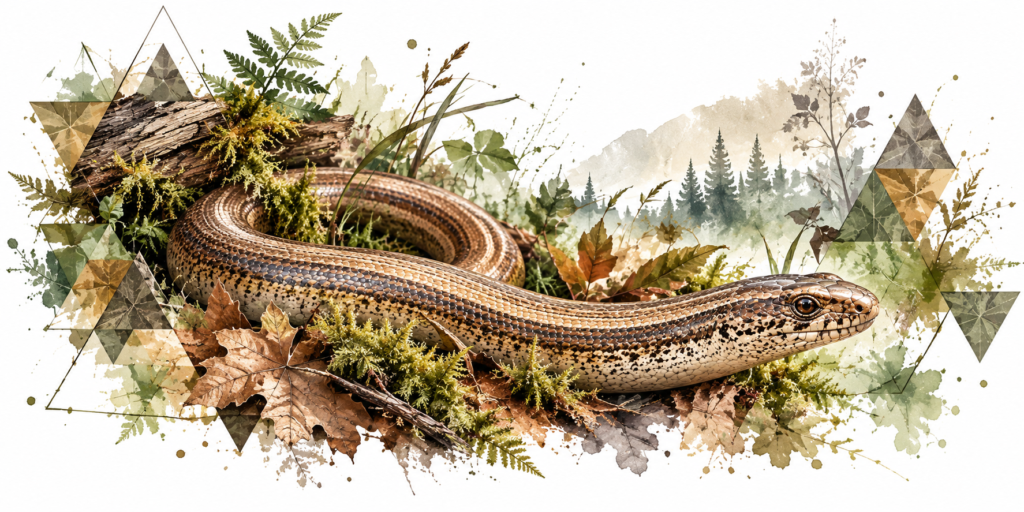
Meet One of Britain’s Most Misunderstood Reptiles
At first glance, a slow worm can easily be mistaken for a small snake. Its long, smooth body has no visible legs, it moves close to the ground, and it can suddenly appear beneath a log, paving slab or piece of garden debris.
But the slow worm is not a snake – and despite its name, it isn’t a worm either.
The slow worm (Anguis fragilis) is actually a legless lizard and one of Britain’s native reptiles.
Quiet, harmless and surprisingly long-lived, slow worms spend much of their lives hidden from view. Yet gardens can provide important habitat for them, particularly where there are plenty of insects, slugs and other small creatures to eat.
So how can you tell a slow worm from a snake? Do slow worms bite? Where do they go in winter? And what should you do if you discover one in your garden?
Let’s take a closer look at one of Britain’s most easily overlooked reptiles.
What Is a Slow Worm?
A slow worm is a species of legless lizard found across much of Europe.
Its scientific name is Anguis fragilis, and adults commonly have smooth, shiny bodies coloured in shades of brown, bronze, grey or copper.
Although their lack of legs makes them look remarkably snake-like, slow worms belong to the lizard group of reptiles.
Their ancestors had legs, but over millions of years of evolution these became greatly reduced and eventually disappeared externally.
This body shape is particularly useful for an animal that spends much of its time moving through dense vegetation, loose soil, leaf litter and other confined spaces.
Is a Slow Worm a Snake?
No. A slow worm is a lizard, not a snake.
There are several clues that reveal its true identity.
Slow worms can blink
Slow worms have movable eyelids and can close their eyes.
Snakes do not blink in the same way because their eyes are covered by a transparent protective scale.
If you’re close enough to see a slow worm blink, you’re looking at one of the clearest signs that it is a lizard.
They can shed their tails
Like many other lizards, slow worms can deliberately detach part of their tail when threatened.
The detached tail may continue moving, potentially distracting a predator while the slow worm escapes.
A replacement can grow, although it is generally shorter and does not look exactly like the original.
This ability is known as autotomy.
It is also one reason slow worms should never be picked up by the tail.
Their bodies move differently
Slow worms tend to have a somewhat stiffer style of movement than snakes because of differences in their skeletal structure.
Once you become familiar with them, their movement can be surprisingly distinctive.
Are Slow Worms Dangerous?
Slow worms are not dangerous to people.
They are not venomous and are generally shy animals whose first response to disturbance is to escape or remain still.
A slow worm has no reason to attack a person.
If you find one in your garden, there is normally no need to remove it.
In fact, its presence can be a very good sign that your garden is providing suitable wildlife habitat.
Do Slow Worms Bite?
Slow worms are capable of biting, but bites to people are unusual and generally occur only when an animal is being handled or feels threatened.
They would much rather escape than confront something as large as a human.
The simplest approach is therefore to observe them without handling them.
If a slow worm is somewhere safe, leave it where it is.
Are Slow Worms Poisonous or Venomous?
No.
Slow worms are neither poisonous nor venomous.
Their snake-like appearance sometimes leads people to worry that they may be dangerous, but they pose essentially no threat to humans or pets under normal circumstances.
Britain has several native reptile species, but the slow worm is one of the most harmless animals you are likely to encounter.
How Big Do Slow Worms Grow?
Adult slow worms can reach approximately 40–50 centimetres in length, although individuals vary.
Females are often larger than males.
Their smooth scales give them an almost polished or metallic appearance, particularly when sunlight catches their bronze or copper colouring.
Juveniles can look quite different from adults.
Young slow worms are often pale gold, silver or cream with a dark stripe running along the back and darker colouring on their sides and underside.
How Can You Tell a Male Slow Worm From a Female?
Colour and markings can sometimes provide clues.
Adult females commonly have darker sides and may retain a dark line along the centre of the back.
Males are often more uniformly coloured, usually greyish or brown, and some mature males develop distinctive blue spots.
However, appearance varies between individuals, so identifying sex purely from colour is not always straightforward.
What Do Slow Worms Eat?
Slow worms are predators, but their prey is considerably smaller than they are.
Their diet includes creatures such as:
- slugs
- snails
- earthworms
- spiders
- insects and insect larvae
- other small invertebrates
This makes them particularly useful visitors to gardens.
Gardeners sometimes spend considerable time trying to control slugs and snails, while a slow worm will happily eat them naturally.
Creating a wildlife-friendly garden can therefore encourage predators that help keep populations of some garden pests under control.
Where Do Slow Worms Live?
Slow worms favour places that provide warmth, shelter and plentiful food.
They can be found in habitats including grassland, heathland, woodland edges, allotments, railway embankments and gardens.
Gardens can be especially valuable where there are areas that aren’t kept excessively tidy.
Slow worms may shelter beneath:
- logs
- stones
- compost heaps
- sheets of metal
- paving slabs
- garden debris
- dense vegetation
They often remain completely hidden even when living surprisingly close to people.
You could potentially have slow worms in your garden for years without ever seeing one.
Why Do Slow Worms Hide Under Things?
Like all reptiles, slow worms rely heavily on external sources of heat to regulate their body temperature.
However, lying openly in bright sunshine would make them vulnerable to predators.
Instead, slow worms often warm themselves beneath objects that absorb heat from the sun.
A piece of stone, roofing material or other flat object can become warm while allowing the animal underneath to remain concealed.
This behaviour is sometimes called indirect basking.
When Are Slow Worms Most Active?
Slow worms generally become active during the warmer months of the year.
Spring is an important period as animals emerge following winter dormancy and begin preparing for the breeding season.
They may be particularly noticeable during warm but not excessively hot conditions.
Because they spend so much time hidden, however, spotting one often comes down to chance.
Moving a log or lifting something in the garden can suddenly reveal a slow worm that had been there unnoticed.
Where Do Slow Worms Go in Winter?
As temperatures fall, slow worms enter a period of winter dormancy.
They seek sheltered places where temperatures remain relatively stable, such as underground burrows, deep vegetation, tree roots or other protected cavities.
Several slow worms may sometimes use the same overwintering site.
They generally emerge again as temperatures increase in spring.
This is another reason why undisturbed areas of gardens can be so valuable to wildlife.
Do Slow Worms Lay Eggs?
Slow worm reproduction is particularly interesting.
Unlike many reptiles that lay eggs in a nest, slow worms are ovoviviparous.
The eggs develop and hatch inside, or immediately as they leave, the female’s body, meaning she effectively gives birth to live young.
The young are tiny replicas of adults in overall body shape, although their colouring is often strikingly different.
Females do not necessarily reproduce every year, particularly in cooler climates where producing young requires considerable energy.
How Long Do Slow Worms Live?
For such an inconspicuous little reptile, slow worms can be remarkably long-lived.
They are thought to be capable of living for several decades, and exceptionally old individuals have been recorded in captivity.
This means a slow worm visiting a garden may potentially have been living in the surrounding area for many years.
Their secretive lifestyle simply means we rarely get the opportunity to follow individual animals throughout their lives.
What Eats Slow Worms?
Although slow worms are predators themselves, they also form part of the diet of larger animals.
Potential predators include birds of prey, corvids, pheasants, hedgehogs, foxes and domestic cats.
Their ability to shed their tail can sometimes save their lives.
When threatened, the tail can detach and continue wriggling while the slow worm escapes into vegetation.
Unfortunately, this defence does not always protect them from domestic pets.
If you know slow worms live in your garden, keeping an eye on cats and dogs around known hiding places can help reduce disturbance.
Are Slow Worms Protected in the UK?
Yes. Slow worms have legal protection in Great Britain.
They are protected against intentional killing and injury under wildlife legislation.
That means they should be treated as wildlife rather than something to remove or destroy simply because they resemble snakes.
If you discover slow worms on your property, the best approach in most circumstances is to allow them to remain undisturbed.
What Should You Do If You Find a Slow Worm in Your Garden?
Finding a slow worm is usually something to be pleased about.
If the animal isn’t in immediate danger, leave it alone.
Avoid repeatedly lifting its shelter to check whether it is still there, as this can disturb the animal and make the location less suitable.
If you accidentally uncover one while gardening, carefully replace the object if it is safe to do so and allow the slow worm to move away in its own time.
Never pick a slow worm up by its tail.
How Can You Make Your Garden Better for Slow Worms?
A perfectly manicured garden isn’t necessarily the best garden for reptiles.
Slow worms benefit from a mixture of warm areas, dense vegetation and safe places to hide.
Allowing a small section of grass to grow longer can provide cover and encourage the invertebrates slow worms feed upon.
Compost heaps can also provide warmth, food and shelter.
Log piles, rocks and areas of dense vegetation create additional hiding places.
Avoiding unnecessary pesticide and slug-pellet use can help too, because healthy populations of invertebrates provide food for slow worms and many other garden animals.
Most importantly, don’t assume every corner of a garden needs to be tidy.
What looks slightly untidy to us can be excellent wildlife habitat.
Can Slow Worms Swim?
Slow worms are capable of swimming if necessary, but water is not their normal habitat.
They are primarily terrestrial animals and are much more at home among vegetation, soil and ground-level cover.
If you have a wildlife pond, providing an easy escape route is sensible for any terrestrial animal that accidentally falls in.
A shallow edge, stones or a wildlife ramp can help animals climb back out.
Can Slow Worms Hear?
Slow worms do not have obvious external ear openings like many lizards.
Nevertheless, they can detect vibrations and some sounds.
Their reliance on ground-level movement means vibrations can provide useful information about what is happening nearby, including the possible approach of danger.
Why Is It Called a Slow Worm?
The name is misleading in two different ways.
It isn’t a worm, and slow worms aren’t necessarily particularly slow when they need to escape.
The word “worm” was historically used more broadly for crawling or snake-like creatures, which helps explain how the name developed.
Today we know that the slow worm is firmly part of the reptile family tree.
Slow Worm or Grass Snake – How Can You Tell the Difference?
Both animals may appear in British gardens, but there are several differences.
A slow worm generally has a much smaller, smoother-looking head that blends into the body, whereas a grass snake has a more obviously snake-like head and neck.
Adult grass snakes also grow considerably larger.
Grass snakes frequently have distinctive pale markings behind the head, although colouration varies.
The most definitive difference is the eyes: slow worms have movable eyelids and can blink; snakes cannot.
Why Slow Worms Matter
Slow worms might not receive the attention given to some of Britain’s larger wildlife, but they are an important part of the ecosystem.
They are both predator and prey.
They consume numerous invertebrates while providing food for larger animals, forming another link in the complicated network of relationships that keeps an ecosystem functioning.
Their presence can also tell us something about the environment around them.
A place capable of supporting slow worms needs suitable shelter, food and relatively undisturbed habitat.
Protecting those conditions often benefits many other species too.
A Reptile Hiding in Plain Sight
Perhaps the most fascinating thing about slow worms is just how successfully they live alongside us without being noticed.
One could be sheltering beneath a log at the bottom of a garden, moving through long grass or hiding beside a compost heap while the people living only metres away have no idea it is there.
And when one finally appears, its snake-like body can make it seem like an unusual visitor.
In reality, you’re looking at one of Britain’s native lizards – an animal whose ancestors took an extraordinary evolutionary route and lost their legs altogether.
The slow worm may be quiet, secretive and easy to overlook, but it is another reminder that some of Britain’s most fascinating wildlife can be found surprisingly close to home.
Inspired by the Slow Worm?
If you’ve enjoyed discovering more about Britain’s secretive slow worm, you can also explore our Slow Worm wildlife design, inspired by this fascinating and often overlooked reptile. Created in the distinctive GeoWild Designs style, it celebrates the beauty of a creature that can be quietly living in our gardens without us even knowing it’s there.