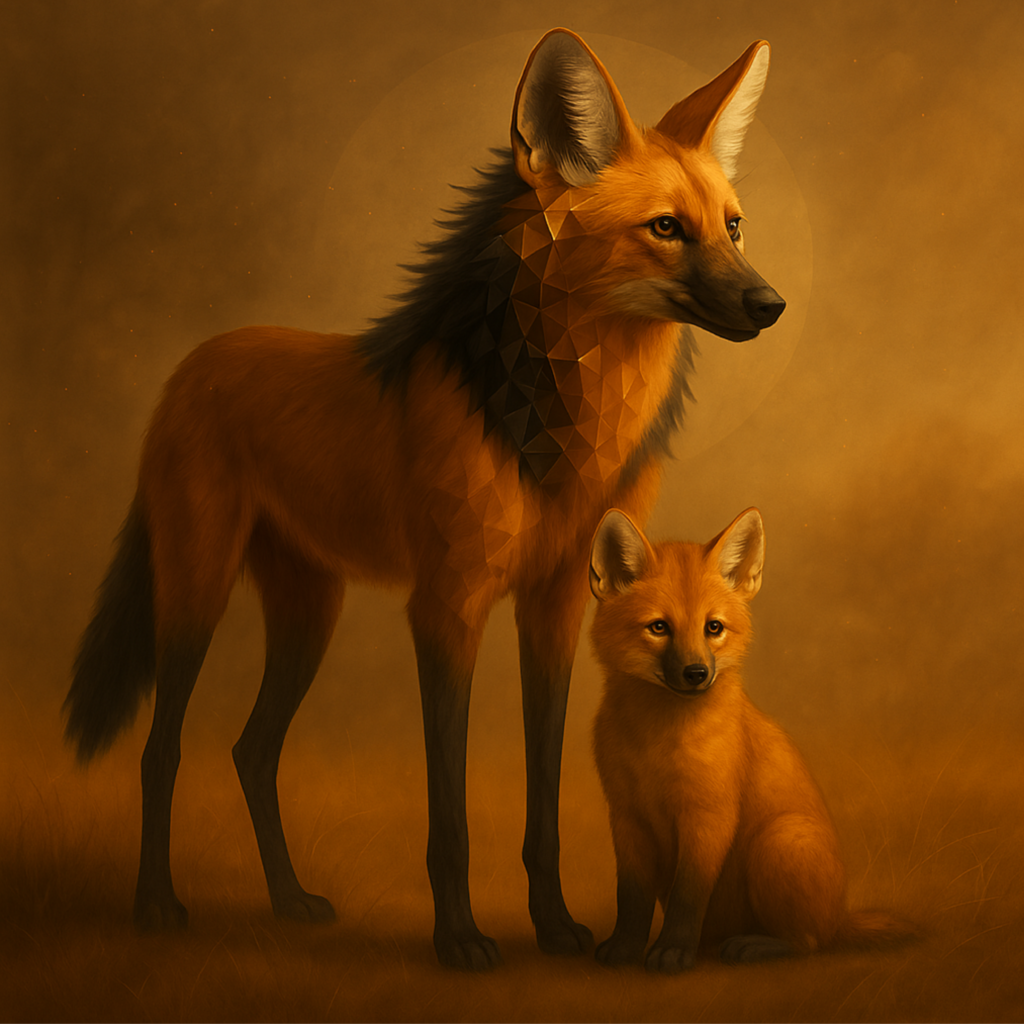
When most people think of wolves, they picture the powerful grey wolf roaming forests, mountains, or snowy landscapes. But one of the world’s most unusual canids looks nothing like its northern cousins. Meet the Maned Wolf – a fascinating animal that, despite its name, is not actually a true wolf at all.
What Is a Maned Wolf?
The Maned Wolf (Chrysocyon brachyurus) is the largest wild canid in South America. Found mainly in Brazil, Paraguay, Bolivia, Peru, and Argentina, it inhabits grasslands, scrublands, and open woodland habitats.
At first glance, the Maned Wolf looks like a fox standing on stilts. Its long black legs, reddish-orange coat, large ears, and distinctive black mane make it one of the most unique members of the dog family.
Not Really a Wolf
Despite its common name, the Maned Wolf is not closely related to true wolves such as the Grey Wolf.
In fact, the Maned Wolf belongs to its own genus and is the only surviving member of that lineage. Scientists believe it evolved separately from other canids millions of years ago.
Because many people search for wolf-related artwork and gifts, you’ll find Maned Wolf designs within the Wolf category here at GeoWild Designs. However, biologically speaking, the Maned Wolf is a very different animal from the wolves most people are familiar with.
Why Does It Have Such Long Legs?
One of the Maned Wolf’s most striking features is its incredibly long legs. These legs are an adaptation to life in the tall grasslands of South America.
The extra height helps the animal see over vegetation while hunting and allows it to move efficiently through its environment. Standing nearly one metre tall at the shoulder, the Maned Wolf is one of the tallest wild canids in the world.
What Does a Maned Wolf Eat?
Unlike many wolves that rely heavily on hunting large prey, the Maned Wolf has a surprisingly varied diet.
It feeds on:
- Small mammals
- Birds
- Reptiles
- Insects
- Fruits and berries
One of its favourite foods is the “wolf apple” (Solanum lycocarpum), a fruit native to South America. In some areas, fruit can make up a large portion of its diet.
This makes the Maned Wolf an important seed disperser, helping maintain healthy ecosystems.
A Solitary Lifestyle
True wolves are famous for living and hunting in packs, but the Maned Wolf prefers a much more independent lifestyle.
Most adults live alone and only come together during the breeding season. They communicate through scent marking and distinctive vocalisations rather than the coordinated pack behaviour seen in Grey Wolves.
Their deep, booming call, known as a “roar-bark,” can carry over long distances across open grasslands.
Conservation Challenges
Although the Maned Wolf is not currently considered endangered, it faces several threats:
- Habitat loss from agriculture
- Road collisions
- Disease from domestic dogs
- Human-wildlife conflict
Conservation efforts across South America aim to protect the grasslands and habitats that these remarkable animals depend on.
Fascinating Maned Wolf Facts
- The Maned Wolf is the largest wild canid in South America.
- It can stand nearly one metre tall at the shoulder.
- It is neither a true wolf nor a fox.
- It is the only living species in its genus.
- Fruit can make up a significant part of its diet.
- Its famous “roar-bark” can be heard from miles away.
A Truly Unique Member of the Canid Family
The Maned Wolf reminds us that nature doesn’t always fit neatly into the categories we create. While it may carry the name “wolf,” this extraordinary animal is a unique species with its own evolutionary story.
Its striking appearance, unusual behaviour, and important ecological role make it one of the most fascinating animals in the world and a worthy addition to any wildlife enthusiast’s collection.
If you’re fascinated by wolves and their relatives, be sure to explore the Wolf collection at GeoWild Designs, where you’ll find artwork inspired by some of nature’s most remarkable canids.