
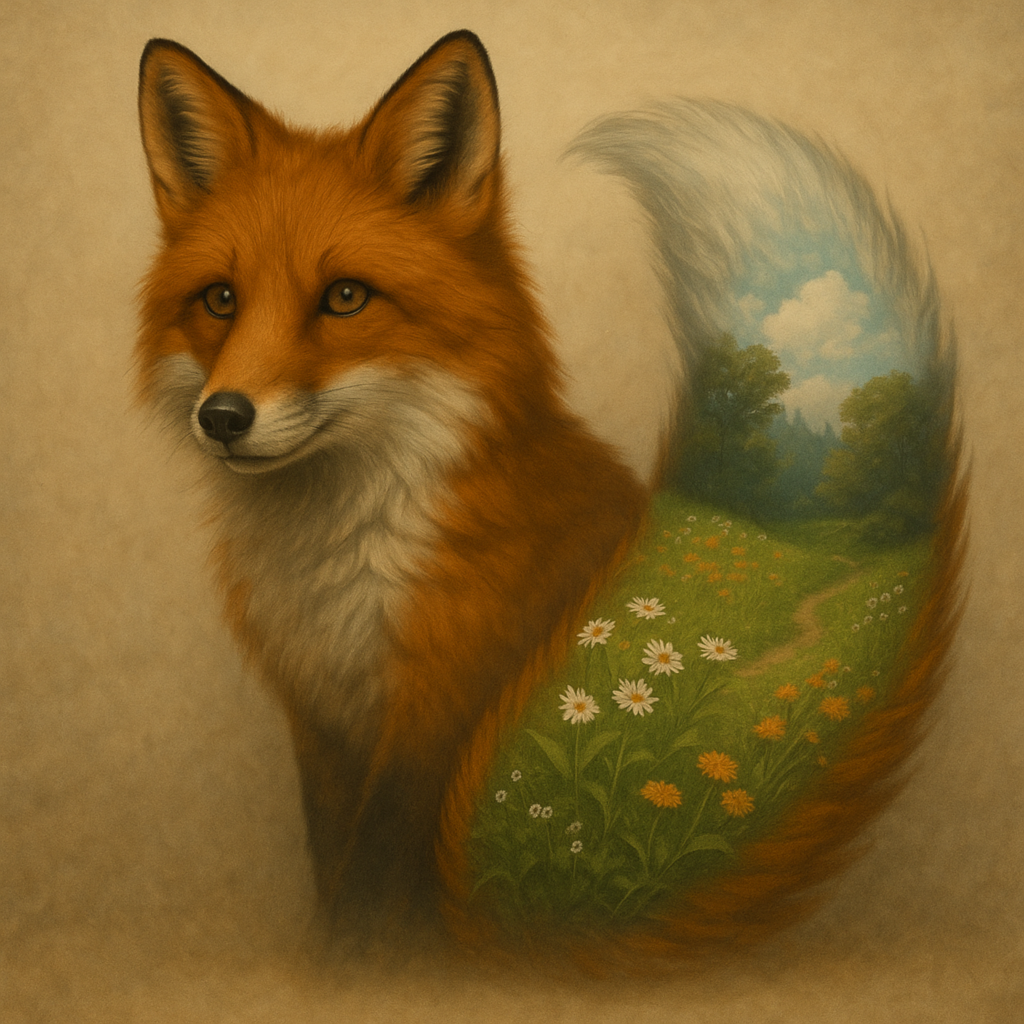
If foxes often form long-term pair bonds, an obvious question follows:
What Happens When a Fox Loses Its Mate?
Do foxes grieve in the way humans understand grief, or do they simply carry on as though nothing has happened?
The honest scientific answer is that we still have much to learn.
Unlike humans, we cannot ask wild animals how they feel. Scientists therefore rely on careful observations of behaviour rather than assuming emotions based on appearances.
What researchers have discovered is both fascinating and surprisingly practical.
When one member of a breeding pair disappears, the surviving fox usually continues to defend the territory for a period of time. It may continue following familiar routes, visiting well-known resting places and scent-marking boundaries just as before.
However, life in the wild is rarely forgiving.
Every day spent without a partner increases the challenge of finding food, defending territory and, during the breeding season, raising young successfully.
For that reason, foxes often seek another mate rather than remaining alone permanently.
This isn’t evidence that the previous bond meant nothing.
Instead, it reflects one of nature’s fundamental priorities: survival.
Do Foxes Become Lonely?
It’s tempting to describe foxes as becoming lonely after losing a partner, but scientists are careful with such language.
Animals undoubtedly experience stress, attachment and behavioural changes when social relationships are disrupted.
Many mammals form strong social bonds that influence how they behave, and foxes appear to be no exception.
Researchers have observed surviving foxes increasing their movements across the territory after a partner disappears.
Some spend more time scent-marking.
Others become more active during daylight hours.
These behavioural changes probably reflect practical needs rather than emotional ones.
A lone fox suddenly has twice the work.
It must:
- Defend the territory alone.
- Hunt enough food without assistance.
- Monitor neighbouring foxes.
- Protect any dependent cubs.
Even if an emotional response exists, natural selection strongly favours individuals that adapt quickly to changing circumstances.
Can a Fox Find Another Mate?
Yes.
If a breeding partner dies or disappears, another fox frequently takes its place.
This is particularly common where suitable territories are limited.
A vacant breeding position represents a valuable opportunity.
Young adult foxes searching for their own territory often move into these vacancies remarkably quickly.
Sometimes this happens within weeks.
In other cases, the surviving fox may remain alone until the next breeding season before forming a new partnership.
The exact timing depends on several factors, including:
- Population density.
- Food availability.
- Competition from neighbouring foxes.
- The age and health of the surviving animal.
Rather than viewing this as replacing a lifelong companion, biologists see it as an adaptive strategy that allows successful territories to remain occupied.
Territories Matter Just as Much as Relationships
To understand fox behaviour, it’s important to realise that territory is often just as valuable as a mate.
A good territory provides everything a fox family needs:
- Reliable food sources.
- Safe den sites.
- Shelter from disturbance.
- Access to water.
- Suitable places for raising cubs.
Losing such a territory may reduce survival far more than losing an individual breeding partner.
For this reason, foxes invest enormous effort into defending their home range.
A new mate can often join an existing territory more easily than establishing an entirely new one elsewhere.
What If There Are Cubs?
The situation becomes far more challenging if one parent dies while cubs are still dependent.
During the first few weeks after birth, the vixen rarely leaves the earth.
If the male dies during this period, the female suddenly faces an enormous challenge.
She must eventually begin hunting while also protecting helpless cubs.
In some cases, cub survival is reduced.
However, foxes possess an impressive degree of behavioural flexibility.
Where older daughters remain as helpers, they may contribute by:
- Guarding cubs.
- Bringing food.
- Supervising young foxes outside the den.
This cooperative behaviour can partially compensate for the loss of one adult.
Conversely, if the female dies while cubs are very young, the outcome is often more serious.
Newborn cubs depend almost entirely on their mother’s milk during the earliest weeks of life.
Without her, survival becomes much less likely unless the cubs are already old enough to eat solid food.
Nature Rewards Adaptability
One reason foxes have become one of the world’s most successful wild carnivores is their ability to adapt.
Unlike highly specialised animals that depend on one food source or habitat, foxes are remarkably flexible.
That flexibility extends to family life.
Rather than following one rigid social structure, foxes adjust according to local conditions.
Some pairs remain together for several years.
Others separate after breeding.
Some territories contain only two adults.
Others include several related females helping to raise cubs.
This adaptability explains why foxes thrive everywhere from remote Scottish hillsides to the centre of major cities.
Urban Foxes May Behave Differently
City foxes often live at much higher population densities than rural foxes.
Gardens, parks and human food waste provide abundant resources throughout the year.
Because food is more predictable, urban foxes sometimes show more complex social arrangements.
Several related females may share overlapping territories.
Young foxes may delay dispersal.
Neighbouring groups may tolerate one another more than would be expected in rural landscapes.
Scientists continue to study exactly how urban living influences fox pair bonds, but one thing is clear:
Foxes remain incredibly adaptable wherever they live.
The Evolutionary Advantage of Long-Term Partnerships
From an evolutionary perspective, remaining with the same partner offers several important advantages.
Established pairs already know:
- The safest den sites.
- Reliable hunting areas.
- Territorial boundaries.
- Each other’s behaviour.
Instead of investing time in finding a new mate every year, experienced pairs can concentrate on raising offspring successfully.
This may partly explain why long-term partnerships are common whenever conditions remain stable.
However, evolution also favours flexibility.
If circumstances change, replacing a lost partner allows breeding to continue without losing an entire reproductive season.
Nature rewards whichever strategy produces the greatest long-term survival.
Myth: Foxes Stay With One Partner Forever
One of the most persistent wildlife myths is that foxes always remain together for life.
The reality is far more interesting.
Many foxes do maintain stable pair bonds for several breeding seasons.
Some probably remain together until one dies.
Others form new partnerships when circumstances change.
Rather than following fixed rules, foxes adapt to whatever gives them the best chance of surviving and raising healthy cubs.
Their behaviour reflects practical solutions shaped by evolution rather than lifelong romantic commitment.
Coming in Part 3…
The next part of this flagship article explores:
- How scientists study fox family life.
- What DNA research has revealed about fox relationships.
- Are foxes faithful?
- How fox pair bonds compare with wolves, badgers and other mammals.
- Fascinating fox behaviours that most people never notice.
- A detailed FAQ answering the most searched questions about fox relationships.