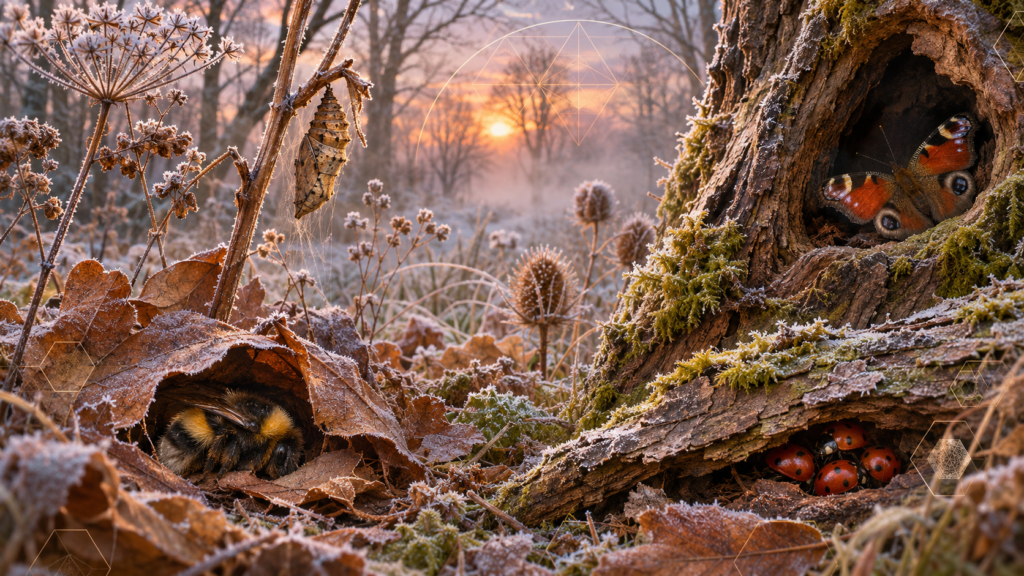
As autumn fades and the first frosts settle across Britain’s gardens, something remarkable happens. The buzzing bees, fluttering butterflies and busy insects that filled the summer air seem to disappear almost overnight.
But where do they go?
Do they die when the temperature drops? Do they hibernate like hedgehogs? Or are they simply hiding somewhere, waiting for spring?
The answer is far more fascinating than you might imagine.
While some insects do reach the end of their lives before winter arrives, countless others survive the cold in extraordinary ways. Beneath fallen leaves, inside hollow stems, under tree bark and even deep underground, an almost invisible world is waiting for warmer days.
Do Insects Hibernate in Winter?
Many insects enter a special dormant state known as diapause.
Rather than simply going to sleep, their development or activity slows dramatically, allowing them to conserve energy during periods when temperatures are low and food is scarce.
Unlike mammals, insects rely heavily on external temperatures to regulate their activity. When the weather becomes too cold, flying, feeding and searching for food can become difficult or impossible.
Diapause is one of nature’s remarkable solutions.
However, not every insect survives winter in the same form. Depending on the species, winter may be spent as an egg, larva, pupa or fully grown adult.
This means that even when a garden appears completely lifeless, countless tiny creatures may be sheltering within it.
Where Do Butterflies Go During Winter?
Butterflies have several different ways of surviving Britain’s colder months.
Some species, including the peacock, small tortoiseshell, comma and brimstone, spend winter as adults.
They seek out sheltered places such as hollow trees, dense vegetation, sheds, garages and other undisturbed spaces.
With their wings folded, they remain almost motionless, conserving precious energy until temperatures rise.
The peacock butterfly is particularly fascinating. Its spectacular red wings, decorated with striking eyespots, become almost invisible when folded. The dark undersides resemble dried leaves, providing excellent camouflage.
Other butterflies survive as eggs, caterpillars or chrysalises.
In fact, many British butterfly species spend winter as caterpillars, hidden among vegetation or leaf litter.
Did you know? A butterfly resting inside your garden shed during winter may have been there for months, quietly waiting for spring.
What Happens to Bees When It Gets Cold?
Bees have very different winter survival strategies depending on their species.
Bumblebees
In many British bumblebee species, the colony dies away towards the end of the year, but newly mated queens survive.
These queens find sheltered places, often underground, where they remain dormant through the coldest months.
When spring arrives, they emerge and begin searching for suitable nesting sites, eventually establishing new colonies.
Honeybees
Honeybees take a different approach.
Instead of becoming completely dormant, a honeybee colony survives together inside its hive.
During cold weather, the bees gather in a tight cluster around their queen, generating warmth through muscular activity and relying on stored honey for energy.
Solitary Bees
Many solitary bees spend winter inside nests hidden in soil, hollow stems or small cavities.
Depending on their species, they may overwinter as larvae or fully developed adults waiting to emerge.
This is one reason old plant stems and undisturbed patches of soil can be so valuable to garden wildlife.
Where Do Ladybirds Hide in Winter?
Ladybirds are among Britain’s most familiar garden insects, but their winter behaviour is surprisingly easy to overlook.
As temperatures fall, many ladybirds seek sheltered places where they can remain dormant.
They may hide beneath loose tree bark, among fallen leaves, in thick vegetation or around buildings.
Some species gather in groups, sometimes in remarkably large numbers.
If you’ve ever discovered several ladybirds clustered around a window frame or tucked into a sheltered corner, you may have stumbled upon their winter refuge.
Their presence is a reminder that even the smallest corners of our homes and gardens can become important shelters.
What Happens to Moths and Caterpillars?
Moths are extraordinarily varied, and so are their winter survival techniques.
Some spend winter as eggs waiting to hatch when their food plants return. Others remain as caterpillars or pupae, protected beneath soil or vegetation.
The elephant hawk-moth, for example, typically spends winter as a pupa in a sheltered location near the ground.
The fox moth can overwinter as a fully grown caterpillar, hidden in loose soil or leaf litter.
But perhaps most surprisingly, some moths remain active during winter.
The appropriately named December moth and winter moth can be seen during the colder months, sometimes flying on winter evenings.
So although we associate moths with warm summer nights, a few are perfectly adapted to life when much of the countryside is cold and quiet.
How Do Insects Survive Freezing Temperatures?
One of the most remarkable things about insects is their ability to survive conditions that would be dangerous for many other animals.
Some insects produce substances such as glycerol and other compounds that help protect their tissues against freezing damage.
Others avoid freezing by finding insulated hiding places where temperatures are less extreme.
Snow, fallen leaves, soil and decaying vegetation can all help create more stable conditions than exposed surfaces.
For some species, surviving winter is not simply a matter of enduring the cold. It is about avoiding sudden temperature changes, conserving energy and remaining protected from predators.
Not every individual survives, but these adaptations allow many insect populations to return year after year.
Do All Insects Die in Winter?
No. Although some adult insects die at the end of their breeding season, this doesn’t mean their species disappears.
In many cases, the next generation is already present as eggs, larvae or pupae.
A butterfly may die in autumn while its offspring survive hidden among plants.
A solitary bee may never see the following spring, but its developing young remain safely inside their nesting chambers.
Winter is therefore not simply an ending.
For much of Britain’s insect life, it is an essential stage in a continuing cycle.
How Can You Help Insects Survive Winter?
The wonderful thing is that you don’t need a large garden or expensive equipment to make a difference.
Even a small outdoor space can provide valuable shelter.
Here are a few simple ways to help:
- Leave some fallen leaves: Leaf litter provides shelter and insulation for many insects and their developing young.
- Keep hollow plant stems standing: Some solitary bees and other insects use stems as nesting or overwintering sites.
- Create a small log pile: Decaying wood, bark and sheltered gaps can support a wide variety of invertebrates.
- Avoid excessive autumn tidying: Cutting everything back can accidentally destroy winter shelters.
- Reduce pesticide use: Protecting overwintering insects helps maintain the balance of garden wildlife.
- Allow a quiet corner to remain undisturbed: A patch of long grass, fallen leaves or natural vegetation can become a valuable refuge.
If you find a dormant butterfly in an unsuitable heated room, avoid repeatedly disturbing it. A cool, sheltered location with an escape route for spring may be more appropriate.
Sometimes the most wildlife-friendly thing we can do is simply leave a little of nature alone.
Why Winter Insects Matter More Than We Realise
It is easy to forget about insects when they are no longer buzzing around our flowers or appearing in our gardens.
But their survival is essential to the natural world.
Insects pollinate plants, help break down organic material and provide food for birds, mammals, amphibians and countless other creatures.
Many of the birds we enjoy watching in spring depend on the abundance of caterpillars and other insects to feed their young.
The tiny creatures sheltering beneath autumn leaves today may help support an entire ecosystem when warmer weather returns.
A Hidden World Waiting for Spring
The next time you walk through a frosty garden or woodland, imagine what lies beneath the seemingly lifeless landscape.
A queen bumblebee may be resting underground.
A peacock butterfly could be tucked inside a hollow tree.
Ladybirds may be gathered beneath loose bark, while moth pupae wait patiently among fallen leaves.
Winter may appear quiet, but beneath the surface, nature is very much alive.
And when the first warm days of spring arrive, the insects we thought had vanished will begin to reappear, continuing one of the natural world’s most extraordinary cycles.
Explore More British Wildlife
Winter brings remarkable changes to the natural world. Discover more about British wildlife and the challenges facing our native species, or explore what happens to wildlife when the nights get longer and how different animals prepare for the colder months.
At GeoWild Designs, we celebrate the beauty, character and wonder of wildlife — from the smallest garden insects to the magnificent animals that share our planet.