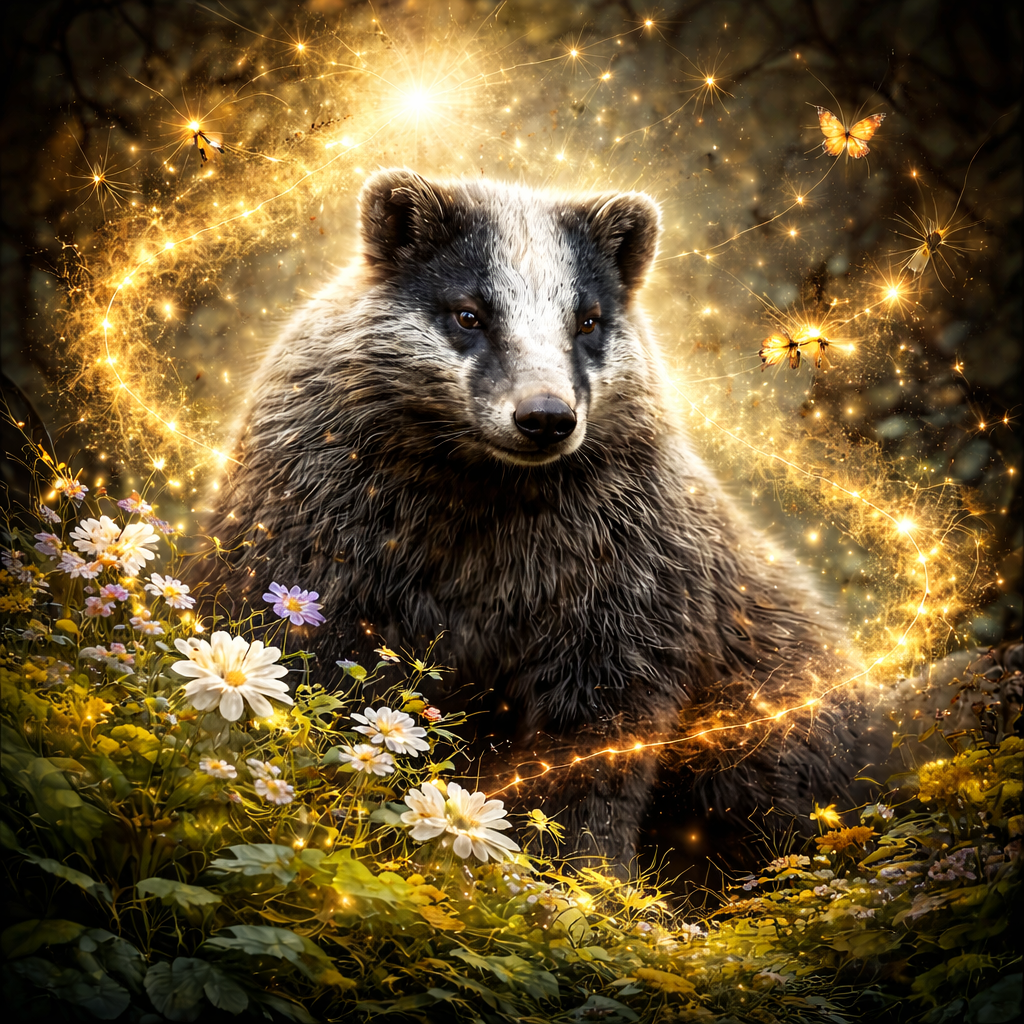
If you’ve ever caught sight of a badger at dusk, one thing is almost impossible to miss: its striking black-and-white face.
Those bold stripes make the European badger instantly recognisable. But have you ever wondered: why do badgers have stripes in the first place?
They aren’t simply there to make badgers look distinctive. Scientists have proposed several possible explanations for the unusual facial pattern, and one of the most fascinating is that the stripes could actually be a warning to other animals: this is a creature that can fight back.
Let’s take a closer look at the science behind one of Britain’s most recognisable wild animals.
What does a badger’s face actually look like?
The badger found throughout Britain is the European badger (Meles meles).
It has a distinctive greyish body, short dark legs, black ears with pale tips and, most famously, a white face marked by two broad black stripes running from around the eyes towards the back of the head.
The contrast is particularly noticeable because the rest of the badger’s body is relatively muted in colour.
That makes the face stand out dramatically, especially in the low-light conditions when badgers are most active.
And that may be important.
So, why are badgers black and white?
The honest answer is: we don’t know with absolute certainty.
Scientists have considered several possible explanations for conspicuous facial markings in badgers and other medium-sized carnivores.
One possibility is that the markings help individuals recognise one another. Another suggestion is that they could have a social function.
However, one of the strongest explanations is that the stripes act as warning coloration, a phenomenon known as aposematism.
In simple terms, the message could be something like:
“Don’t mess with me.”
Could those stripes be a warning?
This is where badgers become particularly interesting.
Aposematism is the use of conspicuous colouring or patterns to warn potential predators that an animal is dangerous, unpleasant or otherwise not worth attacking.
The classic example is a brightly coloured poisonous animal.
Badgers aren’t poisonous, of course. But they have another form of defence: they can put up a formidable fight.
Research into facial masks in medium-sized carnivores found that the warning-colouration explanation was the one most compatible with the evidence examined by the researchers. The idea is that a highly contrasting face could advertise the potential danger of attacking the animal.
For a predator looking for an easy meal, a conspicuous black-and-white face may therefore carry a very different message from camouflage.
It could effectively say:
“You may want to choose something easier.”
Why would a badger need a warning?
Badgers are not particularly large animals, but they are remarkably robust.
They have powerful jaws, strong claws and a reputation for being extremely determined when threatened.
That combination is important when considering warning coloration.
If a predator repeatedly learns that a particular striking pattern belongs to an animal that is difficult or dangerous to attack, there could be an evolutionary advantage to keeping that pattern.
Instead of having to fight every potential predator, a badger’s appearance might sometimes discourage an attack before it begins.
Researchers studying facial masks in medium-sized carnivores have proposed precisely this kind of explanation.
But aren’t stripes usually camouflage?
This is where badgers are rather unusual.
Camouflage works by making an animal harder to see or helping it blend into its surroundings.
A badger’s face does almost the opposite.
Those strong black-and-white markings are highly conspicuous, particularly at close range and in low light. Research into contrasting coloration in mammals has suggested that conspicuous head markings in some carnivores may function as warning signals rather than camouflage.
However, colouration can have more than one possible function, and scientists are cautious about claiming that the stripes have been definitively explained.
Nature rarely follows a single simple rule.
Could the stripes help badgers recognise each other?
Possibly.
Badgers live in social groups, often sharing a sett and communicating with one another using sounds, behaviour and scent.
Research has shown that scent plays an important role in badger social communication. Badgers can distinguish between the scent secretions of different individuals, and scent-marking can provide information about territory and group membership.
That doesn’t prove the facial markings are used for individual recognition, but it does show that badgers have sophisticated ways of identifying and communicating with members of their social group.
Some researchers have therefore suggested that facial markings could have a social or recognition function as well.
Do all badgers have exactly the same stripes?
No.
Although the overall black-and-white pattern is characteristic of the European badger, individual markings can vary.
This is one reason researchers have considered whether facial markings could potentially help with recognition.
The European badger’s pattern is also different from that of other badger species around the world. Some related species have much less contrasting facial markings, while others may lack the familiar European-style stripes altogether.
So the famous striped face isn’t simply a universal “badger design”.
It is a particular feature of the European badger that has evolved over time.
What about badger cubs?
Baby badgers, known as cubs, don’t arrive looking exactly like miniature adults.
Their appearance changes as they develop, with the characteristic facial markings becoming more obvious as they grow.
The familiar stripes eventually become one of the easiest ways to identify them as European badgers.
And once you know what to look for, that distinctive face is surprisingly easy to recognise.
Why are the stripes on the face rather than the whole body?
This is one of the most interesting questions.
If the purpose were simply camouflage, you might expect the pattern to cover much more of the animal.
Instead, the strongest contrast is concentrated around the head.
One hypothesis is that this makes the face particularly conspicuous to potential predators while leaving more of the body relatively subdued. Research into mammal colour patterns has found associations between conspicuous head markings and defensive signalling in several carnivores.
It is another reason why the warning-colouration theory is so intriguing.
So, are badger stripes really saying “stay away”?
Possibly — and this is currently one of the most compelling explanations.
Scientists have proposed that the dramatic facial markings of badgers could act as a visual warning, advertising the fact that attacking one may not be worth the trouble.
But we shouldn’t say that scientists have definitively proved this.
The markings could have several functions, potentially including communication between badgers, and further research is still needed to understand exactly why the European badger evolved such a distinctive face.
What we do know is that those stripes are much more than a pretty pattern.
They may be part of the badger’s evolutionary toolkit — helping communicate something about the animal before it ever has to defend itself.
The next time you see a badger…
If you’re lucky enough to see a badger crossing a road or appearing briefly in your garden at dusk, take a moment to look at its face.
Those black-and-white stripes might not simply be decoration.
They could be nature’s way of putting up a warning sign:
This little animal may be tougher than it looks.
And perhaps that’s one of the reasons the European badger has such an unmistakable face.
🦡 Did you know?
Badgers don’t rely only on their appearance to communicate. They also use scent extensively. Research has shown that their scent markings can carry information about territory and social group membership.