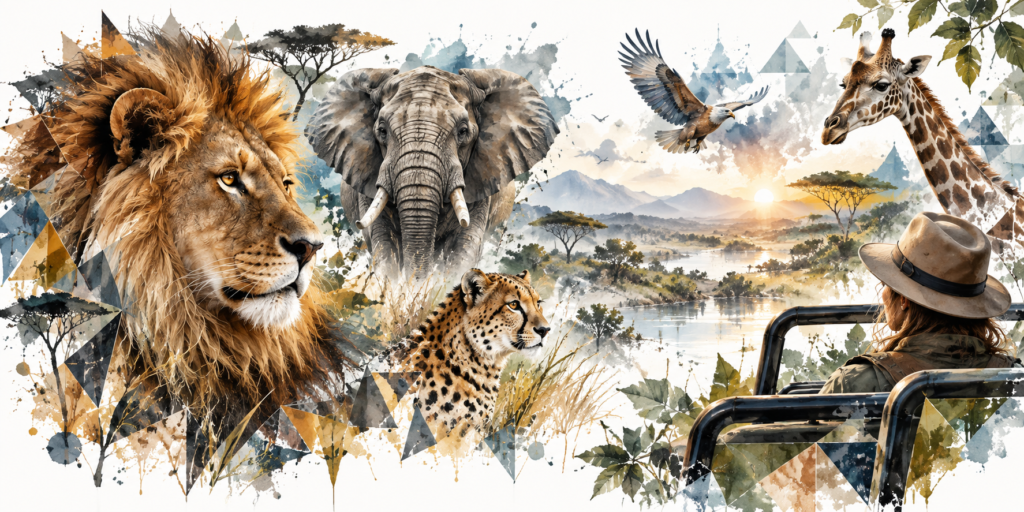
When we think about wild animals, it is easy to focus on the danger. Lions have powerful jaws, bears have enormous strength, wolves hunt in packs, and even animals that do not eat meat can be capable of seriously injuring a human.
Yet considering how many people live, work and travel in places shared with wildlife, attacks on humans are surprisingly uncommon.
So why don’t wild animals attack humans more often?
The answer is more complicated than simply saying that animals are frightened of us. For many wild species, attacking a human offers little benefit and potentially enormous risk. Evolution, experience, instinct and the way animals perceive us all play a part.
And perhaps most surprisingly, many predators simply don’t regard humans as normal prey.
Are Wild Animals Naturally Afraid of Humans?
Many wild animals are wary of humans, although the strength of that reaction varies enormously between species, individuals and circumstances.
For an animal in the wild, avoiding unnecessary danger is important for survival. An injury that would be treatable for a human can be disastrous for a wild animal. A damaged leg, injured eye or broken tooth could make it difficult to hunt, escape predators or compete for food.
This means that confrontation can be extremely costly.
If an animal encounters something large, unfamiliar and unpredictable, avoiding it may be a much safer strategy than investigating or attacking it.
Humans certainly fit that description.
We stand upright, move in unusual ways, make noise, travel in groups and carry unfamiliar objects. We also dramatically alter landscapes.
For many animals, keeping their distance makes good sense.
Why Don’t Predators See Humans as Food?
One of the biggest misconceptions about predators is that they automatically view every other animal as potential food.
They don’t.
Predators usually specialise in particular types of prey and hunting strategies. Lions commonly hunt animals such as zebra, wildebeest and antelope. Wolves often hunt hoofed mammals. Many large cats have their own preferred prey depending on where they live.
Humans do not necessarily fit the pattern.
We walk upright, have an unusual silhouette and behave differently from the prey these predators have evolved to pursue.
Hunting is also dangerous. Prey animals kick, bite, gore and fight back, so predators have to judge whether an attack is worth the energy and risk.
An unfamiliar animal may simply not be worth testing.
That doesn’t mean a hungry predator could never attack a human. It means humans are generally not the automatic first choice we might imagine.
Why Don’t Wild Animals Attack Humans More Often?
There isn’t one single reason. Instead, several factors work together.
Attacking Is Risky
Wild animals cannot afford unnecessary injuries.
Even a successful fight can leave an animal wounded, and in nature there is no veterinary treatment waiting afterwards.
Avoiding confrontation can therefore be the safest option.
Humans Are Unfamiliar Prey
Most predators evolve alongside particular prey species. Their hunting behaviour becomes adapted to finding, chasing and capturing those animals.
A human walking upright doesn’t necessarily trigger the same response.
Humans Can Be Intimidating
We may not feel particularly impressive when standing near a lion, tiger or bear, but from an animal’s perspective humans are unusual.
Our upright posture makes us appear relatively tall, while our movements, voices and behaviour can be difficult for animals to predict.
Animals Learn From Experience
Wild animals can learn that humans represent danger.
This doesn’t require an animal to understand weapons, vehicles or wildlife management. If approaching humans repeatedly produces frightening or unpleasant experiences, avoiding people can become the safer behaviour.
Young animals can also learn behaviours by observing adults.
Do Wild Animals Know Humans Are Dangerous?
Not in the same way that humans consciously understand danger, but animals are extremely good at recognising threats.
Many species use sight, smell and sound to assess what is happening around them.
They can also learn from previous encounters.
An animal doesn’t need to understand why humans might be dangerous. It only needs to learn that being close to humans increases risk.
This distinction is important.
A deer fleeing from a walker isn’t necessarily thinking, “Humans are dangerous.” Its nervous system is responding to a potential threat and telling it that increasing the distance is the safest option.
Why Don’t Wild Animals Attack Sleeping Humans?
This is an especially interesting question because a sleeping person appears far less threatening than someone who is awake, standing and moving around.
Yet going to sleep doesn’t suddenly turn a human into normal prey.
Our scent remains the same, and predators that don’t normally regard humans as food don’t automatically change their behaviour simply because a person is lying still.
For many wild animals, approaching an unfamiliar large creature is still an unnecessary risk. If there is no reason to investigate, keeping away may remain the safest choice.
However, this certainly doesn’t mean sleeping outdoors around potentially dangerous wildlife is risk-free.
Food can be particularly important. Animals that have learned to associate campsites with meals may investigate tents, rubbish, cooking areas or stored food. A wild animal that has become accustomed to people can also behave very differently from one that naturally keeps its distance.
The species and location matter too. Sleeping outdoors in an area inhabited by large predators requires appropriate precautions, and local wildlife guidance should always be followed.
So the reason sleeping humans aren’t routinely attacked is much the same as the reason awake humans aren’t: most wild animals simply have no reason to attack us in the first place.
Why Don’t Lions Attack Safari Vehicles?
This is one of the most fascinating examples of how animals perceive humans.
Videos from African safaris sometimes show lions, cheetahs and other predators resting just metres from tourists sitting inside open vehicles.
To us, this can seem extraordinary.
Surely the lion can see the people?
It can.
But what matters is how the animal interprets what it sees.
A safari vehicle containing several passengers may be perceived as one large, unfamiliar object rather than a collection of individual humans that could potentially be approached as prey.
Animals in frequently visited safari areas can also become accustomed to vehicles that behave predictably and don’t threaten them.
The vehicle arrives, people remain inside, and eventually it leaves.
Over time, animals can become habituated to this pattern.
This does not mean the animals are tame.
They remain completely wild.
It is also one reason visitors are normally instructed to remain inside the vehicle and follow their guide’s directions. A person suddenly standing up, climbing out or moving away from the vehicle changes the familiar shape and situation the animal has become accustomed to.
Why Can Getting Out of a Safari Vehicle Be Dangerous?
From inside a vehicle, a person is visually connected to a much larger object.
Step outside and that changes immediately.
The animal can now see a separate human figure moving independently.
Movement can also attract attention, particularly from predators whose hunting instincts are sensitive to fleeing animals.
This doesn’t mean that a lion will automatically attack someone who leaves a vehicle. It means that the predictable situation has changed and the risk becomes far less controllable.
Experienced safari guides understand the behaviour of local wildlife and the circumstances in which animals should be given additional space.
Following their instructions is therefore extremely important.
When Do Wild Animals Attack Humans?
Although most wild animals prefer to avoid us, attacks do happen.
Often, however, the motivation isn’t predation.
When an Animal Feels Cornered
An animal that would normally flee may attack if it believes there is no escape route.
This is why giving wildlife space is so important.
When Protecting Young
Parents can become much more defensive when offspring are nearby.
Even normally cautious animals may confront a perceived threat if their young are at risk.
When Defending Food
A carcass or important food source can be extremely valuable.
Some animals may defend it aggressively.
When Surprised
Suddenly encountering a large animal at close range can trigger a defensive response before either the human or animal has time to retreat.
When Injured or Sick
Pain, injury or illness can alter an animal’s behaviour and make its reactions less predictable.
When Humans Behave Like Prey
Running away can sometimes encourage pursuit in predators because rapid movement can activate chase behaviour.
This is one reason wildlife safety advice differs depending on the species encountered.
When Animals Become Habituated to Human Food
Wild animals that repeatedly receive food from people can lose some of their natural caution.
They may begin deliberately approaching humans because they associate us with an easy meal.
This can create dangerous situations for both people and animals.
Feeding wildlife may appear harmless or even kind, but it can profoundly change an animal’s behaviour.
Are Herbivores Safer Than Predators?
Not necessarily.
An animal doesn’t have to want to eat you to be dangerous.
Large herbivores can be extraordinarily powerful, and defensive aggression can cause devastating injuries.
Elephants, hippos, buffalo and other large plant-eating animals may charge when they feel threatened, surprised or protective.
Their motivation isn’t hunger.
It is usually defence.
This is an important reminder that “predator” and “dangerous” don’t mean exactly the same thing.
A carnivore may decide you aren’t worth pursuing, while a frightened herbivore may decide the safest option is to remove the threat.
Why Don’t Wolves Usually Attack Humans?
Wolves have been surrounded by frightening stories for centuries, but wild wolves generally avoid people.
Humans don’t form a normal part of their prey base, and wolves living in areas where people are present frequently learn to keep their distance.
However, circumstances matter.
Wolves that become accustomed to people or associate humans with food can behave differently, which is another reason deliberately feeding wild predators is dangerous.
The frightening wolf of folklore and the behaviour of a typical wild wolf are often very different things.
What About Bears?
Bear behaviour illustrates why there isn’t one universal rule for encounters with wildlife.
Different bear species behave differently, and even within the same species an animal’s response can depend on whether it is surprised, protecting cubs, defending food or investigating something unfamiliar.
Some encounters are defensive rather than predatory.
That distinction is extremely important because the appropriate human response can depend on the species and situation.
It is therefore always best to follow official wildlife guidance for the area you are visiting rather than relying on one piece of advice for every large animal.
Can Wild Animals Become Too Comfortable Around Humans?
Yes, and strangely enough, an animal losing its fear of humans isn’t necessarily a good thing.
Wildlife that lives around towns, campsites and tourist areas may gradually become habituated to people.
If humans don’t appear threatening, the animal may stop fleeing.
Add food into the equation and the situation can become more serious.
An animal may begin approaching people deliberately, searching campsites, entering gardens or investigating bags and vehicles.
What initially looks like confidence or friendliness can eventually lead to conflict.
Keeping wild animals wild is often one of the best ways of protecting them.
Do Wild Animals Understand That We Are Humans?
Animals certainly distinguish between different kinds of creatures, but we can’t know exactly how another species mentally categorises us.
What we do know is that animals respond to characteristics such as our shape, movement, scent, sound and behaviour.
Some species are also remarkably capable of distinguishing between different types of human activity.
An animal living near a busy walking trail, for example, may react differently to people following the familiar path than to someone approaching it directly.
From the animal’s perspective, context matters.
Why Do Some Animals Attack People While Others Run Away?
Every encounter involves a combination of species, individual temperament, previous experience and circumstances.
One animal may flee immediately.
Another may freeze and watch.
Another might display warning behaviour.
And another may defend itself aggressively.
Age, sex, health, hunger, offspring, food availability, distance and previous encounters with people can all influence the outcome.
Wild animals are individuals, not machines following a perfectly predictable set of rules.
Are Humans Predators Too?
From an ecological perspective, humans are unusual predators.
For thousands of years we have hunted animals using tools, cooperation and increasingly sophisticated technology.
Unlike most predators, humans can kill animals much larger and faster than ourselves while remaining some distance away.
This long history of hunting and persecution may have helped shape the behaviour of wildlife around us.
Research into animal behaviour has shown that human activity can influence where animals live, when they are active and how they move through landscapes.
In some places, animals even become more nocturnal when human activity increases.
Rather than confronting us, wildlife often changes its behaviour to avoid us.
Why Are Wild Animal Attacks So Memorable?
There is another reason we may overestimate how often wild animals attack humans: attacks make dramatic stories.
A lion attack, shark bite or bear encounter is frightening, unusual and memorable.
Millions of uneventful encounters aren’t.
Nobody reports that a walker passed through a forest and a deer quietly moved away.
A safari vehicle driving past a pride of lions without incident isn’t normally international news.
Our perception of risk can therefore become distorted because unusual attacks receive far more attention than the countless occasions when wild animals simply avoid people.
Does This Mean Wild Animals Aren’t Dangerous?
Absolutely not.
A wild animal doesn’t need to regard humans as prey to injure or kill someone.
Large animals possess strength, speed, teeth, claws, horns, antlers and powerful defensive behaviours that evolved for survival.
The important distinction is that being capable of attacking humans is not the same as actively wanting to attack humans.
Most wildlife encounters don’t end in attacks because animals frequently have another option: leaving.
Giving them the space to choose that option helps keep both humans and wildlife safe.
What Should You Do Around Wild Animals?
The safest approach is to respect wildlife rather than fear it or attempt to interact with it.
Keep an appropriate distance, don’t feed wild animals, don’t approach young animals and never assume that an animal which appears calm is tame.
If visiting somewhere with potentially dangerous wildlife, follow local guidance because safe behaviour varies between species.
Most importantly, allow the animal an escape route whenever possible.
Wild animals generally don’t need us to approach them to appreciate them.
Sometimes the most respectful wildlife encounter is simply watching from a distance.
So, Why Don’t Wild Animals Attack Humans More Often?
Perhaps the most surprising answer is that, most of the time, there is simply no good reason for them to.
Attacking another large animal costs energy and carries the risk of injury. Humans aren’t normal prey for many predators, and countless wild animals have learned that keeping their distance from us is the safer option.
When attacks do happen, they are often connected to fear, defence, surprise, protection of young or food, habituation, or unusual circumstances rather than an animal deliberately hunting a person.
The natural world isn’t divided neatly into harmless animals and animals waiting for an opportunity to attack us.
Wild animals are constantly making decisions about risk.
And much of the time, when faced with a human, the safest decision is the same one we might make when confronted by something strange, unpredictable and potentially dangerous:
keep your distance.
A Different Way to Look at Wild Animals
Stories about wildlife often concentrate on the animals we should fear. But understanding why wild animals usually don’t attack us reveals something much more interesting about the natural world.
Survival isn’t just about being the strongest or most aggressive animal.
It is also about knowing when not to fight.
From wolves disappearing quietly into forests to lions resting beside safari vehicles, wild animals are constantly assessing the world around them and deciding what deserves their attention and what is better avoided.
At GeoWild Designs, that fascinating relationship between animals, behaviour and the natural world is what inspires us. If you’ve enjoyed discovering why wild animals usually avoid humans, explore more of our free wildlife and nature articles, or discover our wildlife-inspired wall art and clothing celebrating some of the extraordinary animals that share our planet.