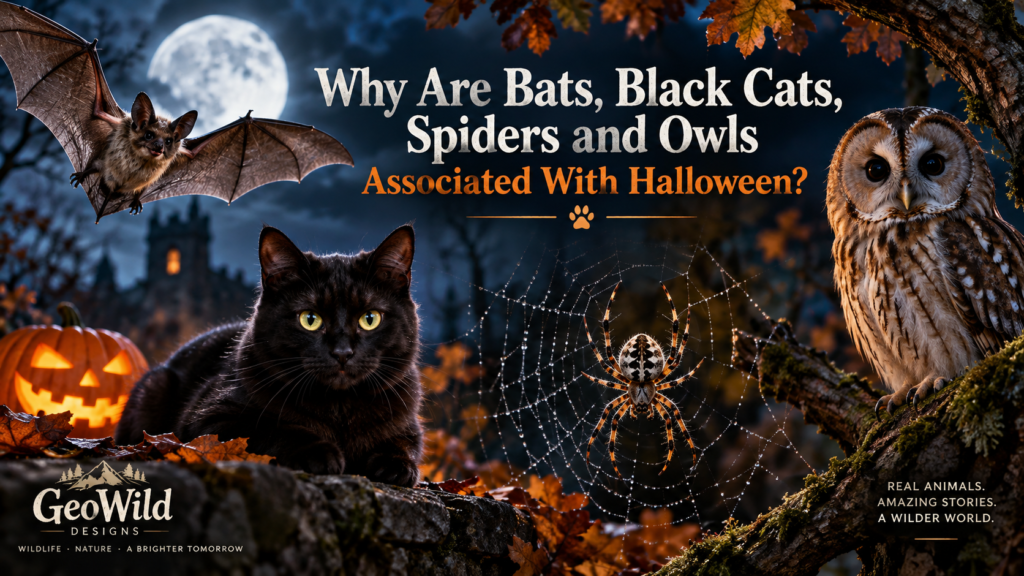
As October nights grow darker, a familiar collection of animals begins appearing everywhere. Bats spread their wings across Halloween decorations. Black cats sit beside pumpkins. Spiders crawl across artificial webs, while wide-eyed owls watch from moonlit branches.
These Halloween animals have become so familiar that we rarely stop to wonder why these particular creatures were chosen.
After all, bats aren’t supernatural creatures. Black cats aren’t unlucky. Most spiders would much rather avoid us, and owls aren’t mysterious messengers from another world.
So how did perfectly ordinary animals become associated with ghosts, witches, magic and Halloween?
The answer is a fascinating mixture of ancient beliefs, folklore, fear of the night and the behaviour of the animals themselves.
Why Are Animals So Important to Halloween?
Halloween has roots in traditions surrounding the changing seasons, darkness, death and the supernatural.
Long before electric lighting transformed our nights, darkness was genuinely mysterious. Once the sun disappeared, humans couldn’t easily see what was moving around them.
But many animals could.
Creatures that emerged at dusk or remained active throughout the night naturally became associated with a world humans couldn’t fully understand.
A flutter of wings overhead, glowing eyes in the darkness or an unexplained call from the trees could seem very different hundreds of years ago than it does today.
Over generations, stories grew around these encounters.
And some animals acquired reputations they are still carrying today.
Why Are Bats Associated With Halloween?
Perhaps no animal represents Halloween quite as strongly as the bat.
Their connection with the spooky season isn’t difficult to understand.
Bats emerge as daylight disappears. They fly almost silently through the darkness, often around old buildings, caves and church towers. Many species spend daylight hours hidden in dark crevices before suddenly appearing at dusk.
To people who didn’t understand echolocation or bat behaviour, their ability to navigate almost complete darkness must have seemed extraordinary.
Their appearance probably helped too.
Bats are the only mammals capable of true sustained flight, giving them a combination that seems unusual even today: the furry body of a mammal and the wings of a flying animal.
But another influence eventually made bats even more frightening.
Did Vampires Make Bats Spooky?
Vampire folklore existed long before vampire bats became widely known in Europe, but over time the two became firmly connected in popular culture.
Real vampire bats live in Central and South America, and they do feed on blood. However, they aren’t the enormous human-hunting monsters portrayed in horror stories.
Literature and later films strengthened the relationship between bats and vampires enormously.
Bram Stoker’s Dracula, published in 1897, helped cement vampire imagery within popular culture, while twentieth-century films repeatedly portrayed vampires transforming into bats.
Eventually the silhouette of a bat against a full moon became visual shorthand for something supernatural.
The real animals, meanwhile, were simply out hunting insects.
Are Bats Actually Frightening?
Not when you understand them.
Most bats eat insects, fruit, nectar or other natural foods depending on the species.
In the UK, bats are insect eaters and can consume large numbers of flying insects.
Far from being sinister creatures of darkness, they perform important ecological roles around the world, including controlling insect populations, pollinating plants and dispersing seeds.
Their Halloween reputation tells us much more about human imagination than it does about bats.
Why Are Black Cats Associated With Halloween?
A black cat sitting beside a witch may be one of Halloween’s most recognisable images.
But cats haven’t always been viewed negatively.
Throughout history, different cultures have regarded cats in dramatically different ways. They have been admired, valued, feared and surrounded by superstition.
During parts of European history, cats — particularly black ones — became increasingly connected with witchcraft.
One widespread belief was that witches possessed supernatural animal companions known as familiars.
Cats were among the animals believed to serve this role.
As stories of witches developed, the image of a black cat accompanying a witch became firmly established.
Why Black Cats Rather Than Other Cats?
Their colour probably played an important part.
Black has long been associated in many Western traditions with darkness, mourning, death and the unknown.
A black cat moving silently through a poorly lit street could effectively disappear into the night, leaving only its reflective eyes visible.
That was perfect material for superstition.
But beliefs about black cats have never been universal.
In some cultures and traditions, black cats have actually been regarded as symbols of good fortune and prosperity.
So whether a black cat represents good luck or bad luck depends largely on which piece of folklore you happen to believe.
The cat itself remains blissfully unaware of either.
Are Black Cats Really Unlucky?
No.
Coat colour has no supernatural ability to influence someone’s luck.
A black cat is simply a cat whose genetics have produced dark pigmentation in its fur.
Unfortunately, centuries of storytelling have been remarkably difficult to erase, which is why black cats remain such powerful Halloween symbols today.
Perhaps Halloween offers us an opportunity to appreciate them rather than fear them.
Why Are Spiders Associated With Halloween?
Walk into almost any Halloween display and you’re likely to encounter spider webs.
Sometimes enormous ones.
Our association between spiders and frightening places probably comes partly from where we tend to notice their webs.
Abandoned buildings, sheds, attics, cellars and dark corners can accumulate webs when they aren’t regularly disturbed.
Those same locations feature heavily in ghost stories and horror films.
Want to make a room look as though nobody has entered it for decades?
Add cobwebs.
Once haunted houses became a Halloween staple, spiders came with them.
Why Are Humans So Frightened of Spiders?
Spiders move in a way very different from us.
Eight legs allow them to accelerate suddenly, change direction rapidly and sometimes appear where we weren’t expecting them.
Some species are venomous, which may also have contributed to humans developing caution around spiders.
But the overwhelming majority of spiders aren’t hunting people.
They are hunting much smaller prey.
Many spiders living around our homes actually help control populations of flies, mosquitoes and other insects.
The tiny creature sitting quietly in the corner is much more interested in the fly buzzing around your lamp than it is in you.
What About Spider Webs?
Webs themselves have become powerful Halloween imagery.
Their intricate patterns look beautiful when covered in morning dew, yet place exactly the same web across a dark doorway and suddenly it looks eerie.
Webs also symbolise something old and undisturbed.
That’s why horror films use them so effectively.
A web stretched across a doorway silently tells us:
Nobody has walked through here for a very long time.
And immediately we wonder why.
Why Are Owls Associated With Halloween?
Owls have almost everything required to become creatures of folklore.
They are largely associated with nighttime.
They have enormous forward-facing eyes.
They can turn their heads remarkably far.
They fly with extraordinary quietness.
And some produce calls that can sound haunting when heard unexpectedly in darkness.
Imagine living centuries ago without streetlights and hearing the cry of an owl somewhere beyond the firelight.
You couldn’t see the animal.
You might not know precisely where the sound was coming from.
It’s easy to understand how stories could begin.
Were Owls Considered Bad Omens?
That depends entirely on the culture.
Owls have accumulated an extraordinary range of meanings throughout human history.
They have been associated with wisdom, knowledge and protection, but elsewhere they have been connected with death, omens and the supernatural.
Ancient Greek tradition famously associated the owl with Athena, goddess of wisdom.
Other traditions interpreted nocturnal calls very differently.
This is a recurring pattern with supposedly “spooky” animals.
The animal doesn’t change.
Our interpretation of it does.
Why Does an Owl Fly So Quietly?
This particular ability probably added enormously to their mysterious reputation.
Owls possess specialised feather adaptations that help reduce the noise generated during flight.
For an owl hunting at night, silence is extremely useful.
Its prey may have little warning that the owl is approaching.
For humans, however, seeing a relatively large bird suddenly glide through darkness without the obvious sound of flapping wings can seem almost ghostlike.
There is nothing supernatural happening.
It’s simply an extraordinary hunting adaptation.
What Do Bats, Black Cats, Spiders and Owls Have in Common?
At first they seem like completely different animals.
One is a mammal capable of flight.
One is a domesticated feline.
One is an arachnid.
And one is a bird.
Yet they share several characteristics that help explain their Halloween reputations.
Many are active or particularly noticeable around darkness.
They can move quietly or unexpectedly.
They sometimes live in places humans consider mysterious.
And historically, people didn’t understand their behaviour as well as we do today.
Humans are exceptionally good at creating stories to explain things we don’t understand.
Sometimes those stories survive long after science provides the real explanation.
And What About Ravens, Crows, Wolves and Toads?
The Halloween animal collection doesn’t end with our four main characters.
Ravens and crows have long appeared in folklore and stories surrounding death, battlefields and the supernatural.
Wolves became connected with fear, darkness and eventually werewolf legends.
Toads appeared alongside witches in European folklore.
Snakes, rats and moths have also found their way into darker stories and Halloween imagery.
Again, these reputations usually tell us more about human fears and cultural storytelling than the animals themselves.
A crow isn’t predicting your death.
A wolf isn’t waiting for the full moon to transform.
And the toad sitting underneath a garden plant hasn’t been employed by a witch.
Why Do These Old Beliefs Survive?
Because they’re wonderful stories.
Humans have always used animals as symbols.
The lion represents courage. The dove represents peace. The fox represents cunning.
And Halloween has its own collection.
The difference today is that we can enjoy the folklore while also understanding the real animals behind it.
A bat silhouetted against the moon still looks wonderfully spooky.
An owl calling from a dark woodland still creates atmosphere.
A black cat beside a pumpkin still looks unmistakably Halloween.
And a spider web stretched across an old doorway can still make us hesitate before walking through it.
Knowing the science doesn’t necessarily destroy the magic.
Sometimes it makes the animals even more interesting.
The Real Wildlife Behind Halloween
Perhaps the most fascinating thing about Halloween’s animals is how different reality is from their reputations.
Bats aren’t supernatural creatures of darkness. They are remarkable flying mammals equipped with extraordinary adaptations for navigating and hunting.
Black cats aren’t unlucky. They’re domestic cats carrying genes that produce beautiful dark coats.
Spiders aren’t decorating haunted houses for us. They’re sophisticated predators building some of the most extraordinary structures created by any animal.
And owls aren’t ghostly messengers. They’re highly specialised birds whose remarkable eyes, hearing and feathers help them hunt in low light.
For hundreds — and sometimes thousands — of years, humans have looked into the darkness and created stories about the animals we found there.
Some became lucky.
Some became wise.
And some became frightening.
This Halloween, when you see the familiar silhouettes of bats, black cats, spiders and owls decorating windows and pumpkins, perhaps look at them slightly differently.
Behind every spooky legend is a real animal.
And very often, the truth is even more fascinating than the myth.